PIC Based Picture Frame

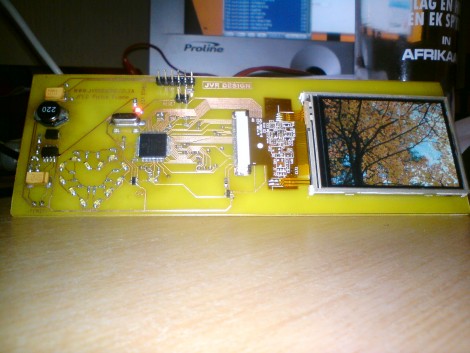
Take a PIC 24HJ256GP206 processor and add a dash of knock-off touchscreen and a pinch of SD card compatibility for a DIY digital picture frame. [Daniel] wrote his own driver for the HX8347 controlled LCD that can achieve 15 FPS at 320×240 resolution with 16-bit color. As this was a gift for his wife, [Daniel] included a heart-shaped ring of LEDs that fade in and out like an electronic pulse. He notes that the JPEG decoder runs rather slow but that’s mostly because of the bottleneck caused when accessing data from the SD card. We’ve got more pictures and a link to the source code after the break.
Continue reading “PIC Based Picture Frame”

Servo Controller Board

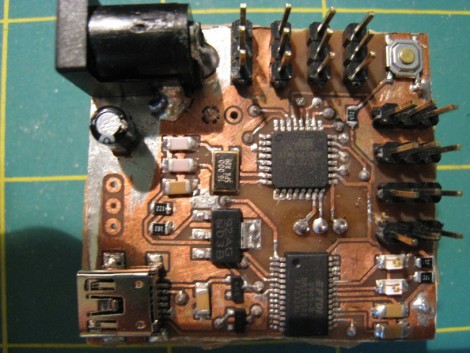
This board is [Eric Seifert’s] venture into working with AVR microcontrollers. He has worked with PIC microcontrollers in the past and used the goal of developing a servo controller board as his motivation to try the grass on the other side of the fence. He found he likes the AVR line for its ease of development under Linux, a feature we also appreciate. What he ended up with is a tiny board that controls up to eight servo motors. If you’ve got a project that is spilling over with servo-controlled limbs, maybe this will save you some development time.

Control A TV With GLCD Commands

[youtube=http://www.youtube.com/watch?v=t3gMjuVdQnA]

This hack lets you use a TV in place of a graphic LCD screen. But we like to think of this less as a replacement for a GLCD and more of a simple way to get your information onto a television. A PIC 18F452 acts as a translator between the GLCD parallel inputs and a composite video output. There are some malformed image links on the page which we’ve fixed and linked to after to the break so that you can take a look at the schematic, component layout, and PCB artwork. The assembler code and hex file are available for download but you’ll need to register to get access to them.

Working image links:

[Thanks Flacoclau]

Coded Safety For Diy Laser

[youtube=http://www.youtube.com/watch?v=2yVtJia5UWY]

Finally we see a hack that is focuses on safety when it comes to high-power laser hacks. A safety switch has been added to the butt of the flashlight body which houses the laser diode. When the safety is flipped on an LED blinks to prompt the user for a security code. If you enter the correct code on a momentary push switch, electrical access to the laser is enabled. There are also a couple of nice features such as continuous on and auto shutoff.

This would be hard to implement if you’re working on a watertight package but we like the fact that an unsuspecting house guest won’t go blind if searching for a flashlight during a storm. One last thing, the code entry system is PIC based which reminds us of [Alan Parekh’s] one-button system.

Links Expanded: Snake On LED Matrix

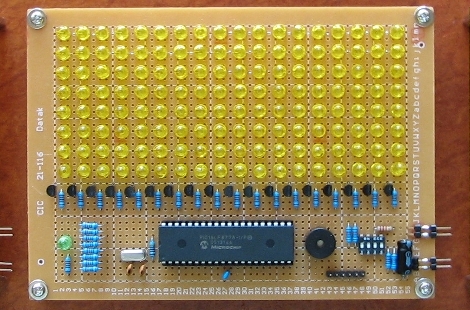
[Yosh] came through with a link to the Snake playing LED matrix that he read about in our links post from yesterday. It seems that [Arty Fart] actually built three of these in green, yellow, and red. You can see him throw one together (an 8-10 hour job) in the video after the break. In addition to playing Snake the PIC 16F877A can also scroll messages, play a mean game of Tetris, and show a Pong screen saver on the 144 LED display. We love the clean build and the urge to make another LED matrix is becoming irresistible.

Now off to eBay for a good deal on a bulk LED order. Continue reading “Links Expanded: Snake On LED Matrix”

Multi Multimeter Clock

[Alan Parekh] built this clock to look like a Multimeter using analog multimeters for the three displays. A PIC does the timekeeping and feeds a specific amperage to the three displays which show hours, minutes, and seconds.

We’ve seen clocks that use analog meters before. [Alan] took the concept to the next level, replacing the graduated markings behind each needle to correspond to the correct display. He’s also included precise calibration so that each meter is as accurate as possible. After watching his video we’re convinced this is a refined product ready for a wide market, at least for those who appreciate the geek factor of the display.

Giant LED Matrix

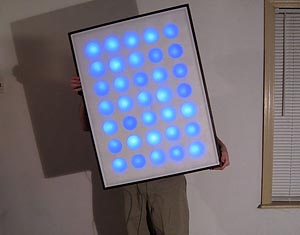
We all love blinky lights. What we love even more than blinky lights is a very detailed tutorial with great photos. [Richard Kline] has written this fantastic tutorial on how to build a large 5×7 LED matrix and control it with a PIC processor.  The bulk of the body is a foam insulation board, covered with a diffuser. Source code and schematics are available for download from the site. If you’ve ever thought about getting into PIC processors, this would be a great beginner project.

[via MakeZine]