Direct To PCB Etch Resist Printing

Here’s a step-by-step guide for printing etch resist directly to copper clad boards. Two methods of making printed circuit boards at home have long dominated as the favorites; using photo-resist, and the toner-transfer method. The latter involves printing board artwork on a laser printer and then ironing it onto the copper clad. We’ve seen some efforts to print toner directly to the copper, or to use ink to adhere toner and then heat fuse it, but this hack is the first one we remember seeing that uses an inkjet printer directly.

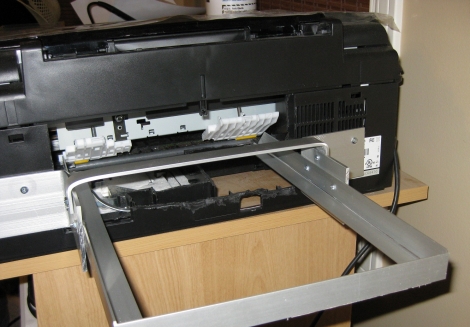
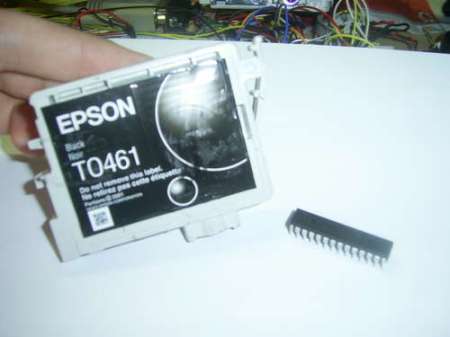
The best reason inkjet printing isn’t often used is do to the ink’s iability to protect copper from the etchant. This method uses MISPRO ink that is pigment based and will resist the acid. An Epson Stylus Photo R260 printer was chosen because you can get refillable printer cartridges which work with the ink, and they’re fairly easy to modify. In order to feed substrate through the device it needs some physical alteration to make room for the thickness of the material, and an ATtiny13 has been added to trick one of the sensors.

Unfortunately we didn’t find photos of the printed resist. But there is source code available for the tiny13 if you do give this a try.

[Thanks Pavlejo]

Emulating Ink Cartridges

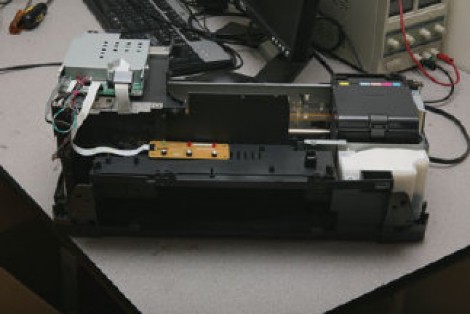
[Smartie_on_computer] wanted to do some experimenting with an epson printer.  After getting a somewhat disassembled one, the first step was to simply get it running. Unfortunately, one of the ink cartridges was missing and these printers refuse to do pretty much anything without all the cartridges installed.  Rather than go purchase a costly cartridge that they didn’t intend to actually use, [Smartie_on_computer], chose to emulate the cartridge using a microcontroller. After some searching for the protocol used on the cartridge, the info ended up being in the patent. [Smartie_on_computer] now has a functional printer that is destined to be a 3d printer in the near future. You can see a video breakdown after the break.

Continue reading “Emulating Ink Cartridges”

DTG: Improved Printing On T-shirts

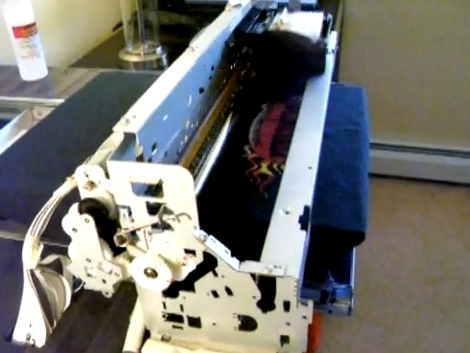
[Jeff German] improved upon his DIY direct to garment printer an ended up with a machine he thinks is equivalent to anything you can buy commercially. We last looked in on this project in June but much has been done since then. Most notably, there are build instructions available (requires login). [Jeff’s] printer is based around an Epson R1900 plus the base that holds and feed a garment. Take a look after the break to see it printing full color designs in high resolution. From the YouTube description it sounds like he wants to go into production with this. Kudos to him for also sharing the build techniques.

Continue reading “DTG: Improved Printing On T-shirts”

Futuristic 3D Mouse Originally Arduino Powered And 3D Printed

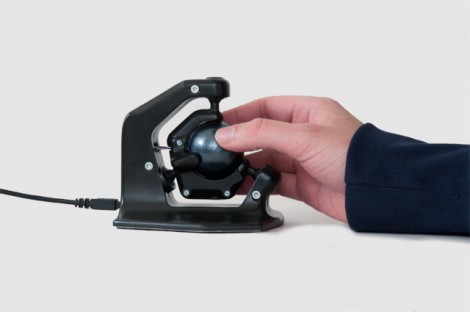
We usually shy away from posting about commercial products. Strap on a bib to protect your shirt from the drool, watching the video after the break will show you why we had to post about this. [Valentin Heun] and his cohorts developed this three-dimensional controller using tools common to the hacker community. The patent-pending device uses a sphere for rotational input but can also be nudged for movement on 3 axes.

You may remember that [Valentin] as involved with that 10,000 watt flourescent lamp display. His Arduino skills were honed with that installation and used during the development of this mouse. Also joining in the prototyping fun was a 3D printer used to make the parts. From project to production, we figure the skills you use when hacking are breaking down the barriers that inventors have traditionally faced when looking to marked useful products.

This would be fantastic for 3D cad, modelling, etc. But we think it would also go well with Eagle, like the other 3D mouse hack did.

Continue reading “Futuristic 3D Mouse Originally Arduino Powered And 3D Printed”

3D Printing With Visible Light

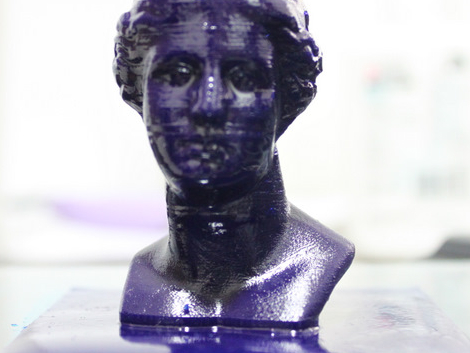
This 3D printer manages some pretty fantastic resolution, and these are just the early results of [Junior Veloso’s] build. He put together a machine that prints objects in resin that cures in visible light. To print, a thin layer of raw liquid resin self-levels across a printing surface and a DLP-based projector shines light from below, onto the portion to be hardened. The z-axis then pulls that layer up and the next to be printed will become the newest bottom layer. Horizontally the printer yields 1024×768 resolution with a layer thickness as small as 0.01 mm. No wonder he’s turning out this kind of quality.

The model above took 5 hours to print, with eight-second exposure for each layer, and 0.1mm layer thickness. There is lots of good information on his blog, from the early planning, to the finished hardware so take some time to learn about this fascinating project.

Update: Thanks to reader [Nave.notnilc] for pointing out that we’ve seen a chemical 3D printing technique before.

Game Boy Printer USB Cable And Software

[Furrtek] hooked up his Game Boy printer for use with a PC (translated). The two-part hack started with a cable to attach the device via USB. A Nokia interface cable was used as a base to translate the USB signals into serial, and an ATtiny45 microcontroller added to talk to the printer. He did a great job of free-forming the circuit alterations and fitting it back into the plastic USB plug housing.The next step was to write some software. Using VB6 he coded an application that loads in an image, scales it to fit, and allows you to adjust the contrast that the thermal printer produces. For testing purposes he’s reusing old receipts. See it in action after the break.

Continue reading “Game Boy Printer USB Cable And Software”

Printing From A Famicom Clone Computer

This is an 8-bit computer and Famicom clone that [133MHz] bought for $2. It plays Nintendo games and using an 80-in-1 cartridge it has a rudimentary operating system and set of applications. Seeing a standard DB25 port on the back [133MHz] wondered if he could make the system talk to a printer. His first step was to investigate the electronics inside to find that the connector has a couple of chips that map to the data bus of the CPU and use the same control lines as the cartridge. That means it can be setup to do just about anything in software. After a bit of coding he’s got it printing to a dot-matrix. See for yourself after the break.

Continue reading “Printing From A Famicom Clone Computer”