PWM-controlled LED Display Is Truly A Gift From The Heart

led_heart_panel

Instructables user [Simon] admits he addicted to electronics. Lucky for him, his wife of 15 years is pretty cool with, or at least tolerant of his need to fiddle with anything that plugs in. As a gift for their wedding anniversary, he decided it would be neat to combine his love for his wife with his love for electronics. The result is the the RGB LED “Love Heart” you see above. He built an RGB LED circuit controlled by a PIC12F683 microcontroller, which shines into a hand-etched plexi-glass panel.

The LED color is controlled using PWM, as you would expect. What you might not expect however, is the lengths [Simon] would travel to ensure nearly perfect color and brightness matching across the 5 LEDs he used in his project. Since RGB LEDs do not have a uniform output brightness, he used a Lux meter to precisely measure the white balance of each LED. He then plotted the results in Excel before coding the PWM driver. Now that’s devotion! Once the LEDs were settled, he went about constructing the rest of the LED panel.

If you are interested in building one for your sweetheart, [Simon] has you covered – he provides all of the schematics, templates, and source code required to get the job done.

Continue reading to see a video of his heart panel in action.

Continue reading “PWM-controlled LED Display Is Truly A Gift From The Heart”

Intro To Circuit Bending

Electronic musical instruments are a lot of fun for a hacker because, with a small palette of tools, know-how and curiosity, they are easily modified. As with any hack, there is always the chance that the subject will be ruined, so it’s not necessarily worth the risk to muck about inside your thousand-dollar pro synthesizer. Luckily for all of us, there are shovel-fulls of old electronic musical toys littering the curbs and second-hand shops of the world. These fun little devices provide ample opportunity to get familiar with audio electronics and circuit bending techniques.

A note on definitions: the term “circuit bending” can be synonymous with “hardware hacking” in the world of audio electronics, and we have seen some debate as to which term is better suited to a given project. We welcome you to share your viewpoints in the comments.

Keep reading to get started.
Continue reading “Intro To Circuit Bending”

LED Lighthouse Simulator

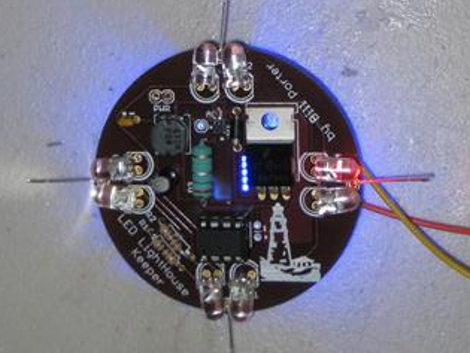
This Christmas [Bill Porter] decided to show his parents that those college dollars were well spent. He upgraded the custom lighthouse light which he originally designed in high school for their garden fountain. He even went so far as to craft some retail-worthy packaging for the gift.

We think it’s a wonderful design, on a custom PCB and based around an ATtiny85. A real lighthouse has a spinning lens to aim the beam of light. When the lens sweeps across your viewpoint there is a sudden flash and he’s recreated that effect using PWM. Take a look at the video after the break and you’ll see what we mean.

Also, during development he was plagued by a startup glitch which we got majorly sidetracked reading aboutContinue reading “LED Lighthouse Simulator”

Large Magnets Spark On Halloween, Who Knew?

This overly large magnet certainly completes the mad scientist look (for an even crazier look, take a jar of water with red food coloring and place in one large cauliflower, instant brain in a jar).

The base of the magnet is painted foam cut with a makeshift hot-knife; to get the magnet sparking [Macegr] laser etched acrylic with a fractal pattern and embedded LEDs in the ends of the acrylic. An Arduino handles the flashing LEDs and also produces a 60Hz PWM pulse for the spark’s hum. The end result is satisfyingly mad, and while practicing your evil ominous laugh catch a video of the magnet after the jump.

Continue reading “Large Magnets Spark On Halloween, Who Knew?”

Plantenna: The Plant Antenna

The back story behind [Mike] experimenting with plants as AM radio transmission antennas antennae is rather interesting and worth the short read. But for those who just want the facts, [Mike] took an ATMega324, modified the PWM output into a sinusoidal AM signal (using a simple form of RLC circuitry), and connected the circuit to a plant no plants were harmed in the making of this project. The results? Well we’re not ones who would spoil the surprise, you’ll have to see for yourself in the video after the jump.

Continue reading “Plantenna: The Plant Antenna”

Discussing Pulse-Width Modulation

[Michael Kleinigger] posted a lengthy discussion on Pulse-Width Modulation that goes beyond the traditional beginner tutorial. He starts a bit of background info on PWM and a tip about using a camera to judge frequency and duty cycle of LEDs. From there it’s down the rabbit hole with some testing of power-loss versus frequency.

When you change from frequencies of 50 Hz to 1 MHz how does the parasitic power loss from switching affect the overall efficiency of the circuit? It turns out there’s a rather large amount of loss at the highest level, around 1.5 mW. The greatest balance of low power loss and elimination of flicker seems to be right in the 300-500 Hz range.

5 Tones, 1 Arduino

Because the Arduino is in such high demand for producing multiple musical tones at the same time; [Jeremy Blum] has successfully figured out the math and other necessaries that will take your once previously single tone producing MCU and turn it into a 5 tone producing machine. unsurprisingly its really just some creative use of PWM control but it all works out in the end anyway and helps prevent you from purchasing additional sound generating chips. This truly does open up some new doors, as [Jeremy] shows with his still in production thingamakit like project: ReacXion.