Frankendrones: Toy Quads With A Hobby Grade Boost

If you’re not involved in the world of remote controlled vehicles, you may not know there’s a difference between “toy” and “hobby” grade hardware. For those in the RC community, a toy is the kind of thing you’ll find at a big box store: cheap, works OK, but lacking in features and build quality. On the other hand, hobby hardware is generally considered to be of higher quality and performance, as well as being more modular. At the risk of oversimplification: if you bought it ready to go from a store it’s probably a toy, and if you built it from parts it would generally be considered hobby grade.

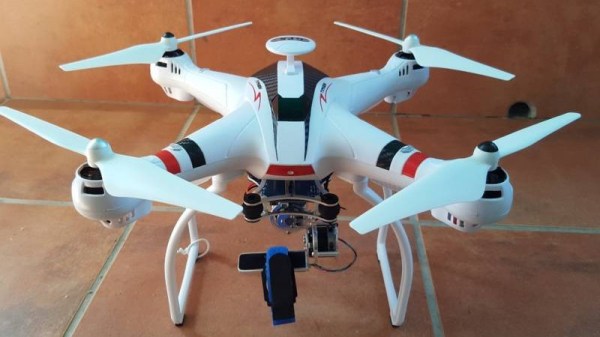
But with the rock bottom prices of toy quadcopters, that line in the sand is having a harder time than ever holding some in the community back. The mashup of toy and hobby grade components is giving rise to the concept of “frankendrones” that combine the low cost of toy hardware with key upgrades from the hobby realm. Quadcopter blogger [garagedrone] has posted a roundup of modifications made to the Bayangtoys X16, a $99 quadcopter which is becoming popular in the scene.

Some of the modifications are easy enough for anyone to do. Swapping out the original propellers for ones meant for the DJI Phantom 3 increases performance and doesn’t even require tools. If you want to go a bit further down the rabbit hole, you can cut off the X16’s battery connector and replace it with a standard XT60. That lets you use standard 3S LiPo batteries, which are cheaper and higher capacity than the proprietary ones the toy shipped with.

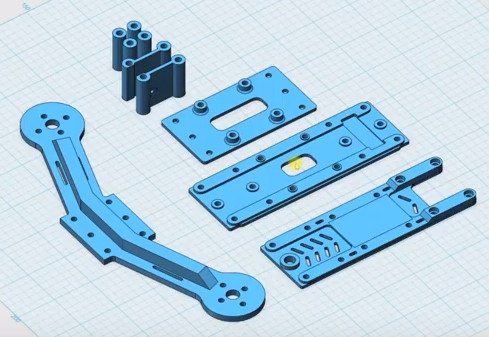
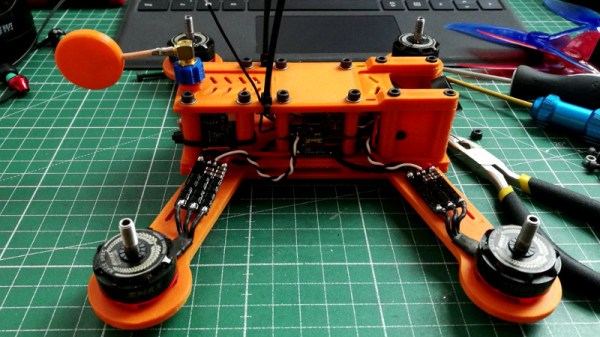
If you have a 3D printer, there are also a number of upgraded parts you can print which will bolt right onto the X16. Payload adapters, landing gear, and GoPro mounts are all just a few clicks (and some filament) away. This library of 3D printable parts is made possible in part because the X16’s frame is itself a clone of another toy quadcopter, the popular Syma X8C. So anything listed as compatible with the Syma X8C should work with the X16 (and vice versa).

Finally, if you really want to take the X16 to the next level, you can swap out the flight controller with an open source and better supported hobby grade model. Some of these flight controllers and associated new receivers can end up costing about half as much as the X16 did to begin with, but the vast improvement in performance and capability should more than make up for the cost.

We’ve covered previous efforts to increase the performance of low cost quadcopters in the past, as well as builds that put frugality front and center. It seems that no matter what your budget is a screaming angel of death is available if you want it.

Thanks to [Calvin] for the tip.

Continue reading “Frankendrones: Toy Quads With A Hobby Grade Boost”

Dubai Police Test Quadcopter Motorcycle

If you ever wish you could be on your quadcopter when you fly it, you will really want to see the video showing the Dubai police department testing the Hoverbike. The Russian company Hoversurf that markets the device doesn’t provide a lot of technical details, but it looks fairly simple. It is basically a motorcycle seat along with a big quadcopter. From the videos about the device, you can deduce that the pilot can control it or you can fly it remotely. You can see one of the videos, below.

There are a few things that worry us here. Of course, the huge spinning propellers as the pilot’s knee level should give you sweaty palms. In the demo, they even show the removal of the propeller guards before the test flight but let’s be honest, those don’t look like they would keep a falling pilot out of the rotors at all anyway. When looking beyond the hype we find it curious that the demo doesn’t show many (if any) shots of the pilot making a turn. The benefit of a vehicle like this to police should be maneuverability and from what we saw the Hoversurf is still limited.

So is it real? Hard to say. The short videos mostly show vertical or horizontal flight with no maneuvering. Is it hard to turn? Is the battery life really short? One other oddity: When we first saw a letter from the US Patent Office on their site, we thought they might have some new technology. However, that letter is simply showing they registered a trademark and doesn’t reference a patent. If there is a patent we want to know what is new and novel here.

Of course, we know it’s possible to build such a machine since we saw [Colin Furze] do it with two rotors instead of four. The US Department of Defense is working on something with a company called Malloy and there are other practical examples. There are also some less practical examples. What we’re really on the lookout for is a product that works so well it will actually be used. You know, like those Segways that airport police use, right?

We hope Hoversurf can bring this to market because we definitely want one. There’s no reason to think they can’t, but we do wish there were more details forthcoming.

Fidget Spinner Slash Drone Is Both

So Hackaday loves fidget spinners and we don’t care who knows it. Apparently so does [Jeremy S Cook], who decided to mash up a spinner and a cheap quadcopter. To what end? Is that even a question? Spinners are the bearing-studded equivalent to the Rubik’s Cube craze of the ’80s and all we can do is embrace it.

[Jeremy] designed a quadcopter shape with a hole in the center matching a VCB 22 mm ceramic bearing he had on hand. He CNCed out the design from a sheet of Lexan resin. Then he detached the electronics amd motors from a quad.

He used a rotary tool to cut off the housing, removed the motors, then inserted them in the new frame, using hot glue to secure them. He installed the control board 90 degrees off of the frame, before realizing it would mess with the accelerometer and re-installed it flat. Meanwhile, the center of the frame sports the all-important bearing.

If you’re looking for more quad projects check out these cool projects: a Power-Glove-controlled drone, this PVC-pipe quadcopter frame, and reverse engineering quadcopter controls.

Continue reading “Fidget Spinner Slash Drone Is Both”

Duocopter Does It With Two Fewer Propellers

Quads are a great ‘copter design. The paired blades counteract each others’ torque, and varying the relative speeds of the four motors makes it easy to steer. But what if you could get by with fewer blades, substituting a significantly fancier control algorithm?

[Dirk Brunner]’s DuoCopter drone uses two propellers that counter-rotate, and it steers by increasing and decreasing the speed at which the blades rotate within a single revolution. Spinning faster on one side than the other makes it tilt. Saying this is one thing, but getting the real-time control algorithms up and running is another. From the video embedded below, it looks like [Dirk] has it working. (He also holds the world’s record for fastest quadcopter ascent, FWIW.)

Of course some of you out there won’t be satisfied until your ‘copter has only one propeller. Or maybe you’d prefer a third prop. Whatever your taste, we’re stoked to see people pushing the boundaries of copter design.

Continue reading “Duocopter Does It With Two Fewer Propellers”

DEF CON Badgelife: Someone Finally Did It

Badgelife is the celebration of electronic conference badges, a way of life that involves spending far too much time handling the logistics of electronics manufacturing, and an awesome hashtag on Twitter. Badgelife isn’t a new thing; it’s been around for a few years, but every summer we see a massive uptick in the lead up to Def Con.

For the last few years, the designers and engineers deep into Badgelife have had the same conversation dozens of times. One person says, “you know, someone should build a badge that’s a quadcopter.” Another person replies, “Can you imagine how annoying that would be? You’d be putting ten thousand people in a room during the closing ceremonies at DefCon, and a few dozen people would have quadcopters. It would be horrible” Yes, there have been plans to build a quadcopter badge for the last few years, but cooler heads prevailed.

Someone finally did it. The wearable electronic conference badge that’s also a quadcopter is finally here. It’s the work of [b1un7], and it’s going to be exactly as annoying as you would expect.

This badge is actually two PCBs, the first being the quadcopter itself, the second being the joystick/controller. The quad is shaped like the familiar jolly roger found in most Whiskey Pirate badges ([b1un7] hangs with that crew), and the controller is a pirate’s treasure map loaded up with joysticks, buttons, and radios. The motors for this quad appear to be brushed, not brushless, and it looks like the arms of the quad have some space for obnoxiously bright LEDs.

This is an awesome badge but it’s still [b1un7]’s first attempt at making a badge. Right now, there’s still a bit of work to do — there’s only one week until Defcon — but with any luck [b1un7] will have 25 of these wearable electronic conference badges buzzing around. It’s a terrible idea and we love it.

Manned Multirotor Flies Again, Electric Style

You can’t keep a good hacker down. [Amazingdiyprojects] wants to build a reliable manned multirotor, and by golly, he’s doing it.  After a crash of his petrol powered design, [Amazingdiyprojects] went back to the drawing board. The new version is called chAIR, and is electric-powered.

The flying machine is lifted by 76 Multistar Elite quadcopter motors. Control is passed through 5 KK 2.1 quadcopter controllers. The KK board is a very simple controller, and we’re a bit surprised [Amazingdiyprojects] didn’t go with a newer setup. Batteries are 80x Multistar 4S 5.2Ah packs, stored below the seat. If these names sound familiar, it’s because just about every electrical part was purchased from Hobby King – an online hobby retailer.

The machine has an all up weight of 162 kg. A bit more than a single person can carry, but chAIR breaks down for easy transport.

We’re blown away by all the little details on chAIR – including the new control system. The left stick controls throttle, while right appears to control aileron/elevator and twist for the rudder control. Somewhat different from the collective/cycle controls found on conventional helicopters!

Even the battery connectors needed custom work. How do you connect 20 batteries at once? [AmazingDiyProjects] mounted XT60 connectors in a metal ring. The ring is compressed with a central screw. A quick spin with a battery-powered drill allows this new aviator to connect all his batteries at once. Is this the future of aviation, or is this guy just a bit crazy? Tell us in the comments!

Continue reading “Manned Multirotor Flies Again, Electric Style”

Harrier-like Tilt Thrust In Multirotor Aircraft

A traditional quadcopter is designed to achieve 6 degrees of freedom — three translational and three rotational — and piloting these manually can prove to be a challenge for beginners. Hexacopters offer better stability and flight speed at a higher price but the flight controller gets a bit more complex.

Taking this to a whole new level, the teams at the Swiss Federal Institute of Technology (ETH Zürich) and Zurich University of the Arts (ZHDK) have come together to present a hexacopter with 6 individually tiltable axes. The 360-degree tilt in rotors allows for a whopping 12-degrees of freedom in flight and allows the UAV to fly in essentially any direction including parallel to walls.

In addition to the acrobatic capabilities of the design, the team has done some testing with autonomous control using external cameras. Their blog contains videos of their testing at various stages and it interesting to see the project evolve over a short span of nine months. Check out the video below of the prototype in action.

With Amazon delivering packages via drone and getting patents for parachute labels, UAV design is evolving faster now than ever. We can’t wait to see where this 12 DOF takes the state of the art. Continue reading “Harrier-like Tilt Thrust In Multirotor Aircraft”