Retrofitted Retro Radio

In a world full of products that are only used for a brief time and then discarded, it gives a lot of us solace to know that there was a time when furniture was made out of solid wood and not particle board, or when coffee makers were made out of metal and not plastic. It’s hard to say exactly what precipitated the change to our one-time-use culture, but in the meantime there are projects that serve to re-purpose those old, durable products from another time so that they can stay relevant in today’s ever-changing world. [Jose]’s new old radio is a great example of this style of hack.

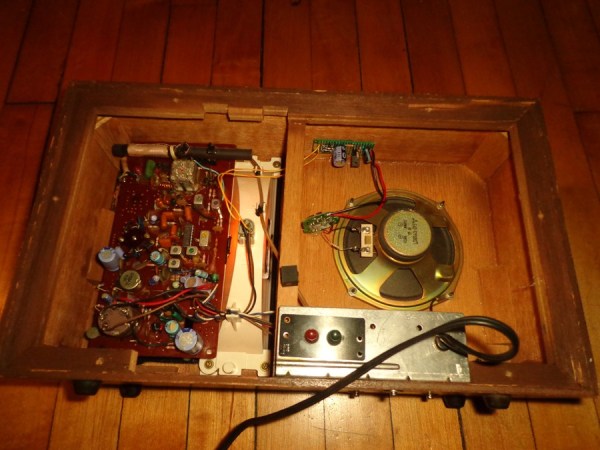
[Jose] had a 1970s-era single-speaker radio that he found in a thrift store. The first thought that he had to get the aesthetically pleasing radio working again was to install a Bluetooth receiver into the radio’s amplifier. This proved to be too time-consuming of a task, and [Jose] decided to drive the Bluetooth module off of the power circuit for the light bulb. He built a 6V AC to 4.2V DC circuit, swapped over the speaker cable, and started listening to his tunes. The modifications he made aren’t destructive, either. If he wants, he will be able to reconnect the original (and still functional) circuitry back to the speaker and pretend he’s back in 1970.

While this isn’t the most intricate hack we’ve ever featured, it’s always refreshing to see someone get use out of an old piece of technology rather than send it off to the landfill with all of our Pentium IIs or last year’s IKEA shelves that have already fallen apart. And even if the 70s aren’t your era of choice, perhaps something newer will inspire you to bust a move.
A VNA On A 200 Euro Budget

If you were to ask someone who works with RF a lot and isn’t lucky enough to do it for a commercial entity with deep pockets what their test instrument of desire would be, the chances are their response would mention a vector network analyser. A VNA is an instrument that measures the S-parameters of an RF circuit, that rather useful set of things to know whose maths in those lectures as an electronic engineering student are something of a painful memory for some of us.

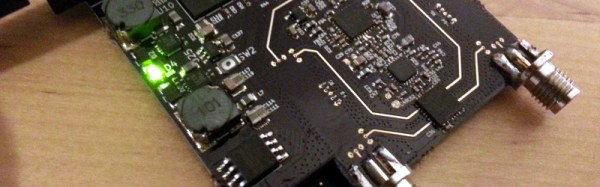
The reason your RF engineer respondent won’t have a VNA on their bench already will be fairly straightforward. VNAs are eye-wateringly expensive. Second-hand ones are in the multi-thousands, new ones can require the keys to Fort Knox. All this is no obstacle to [Henrik Forstén] though, he’s built himself a 30MHz to 6 GHz VNA on the cheap, with the astoundingly low budget of 200 Euros.

The operation of a VNA

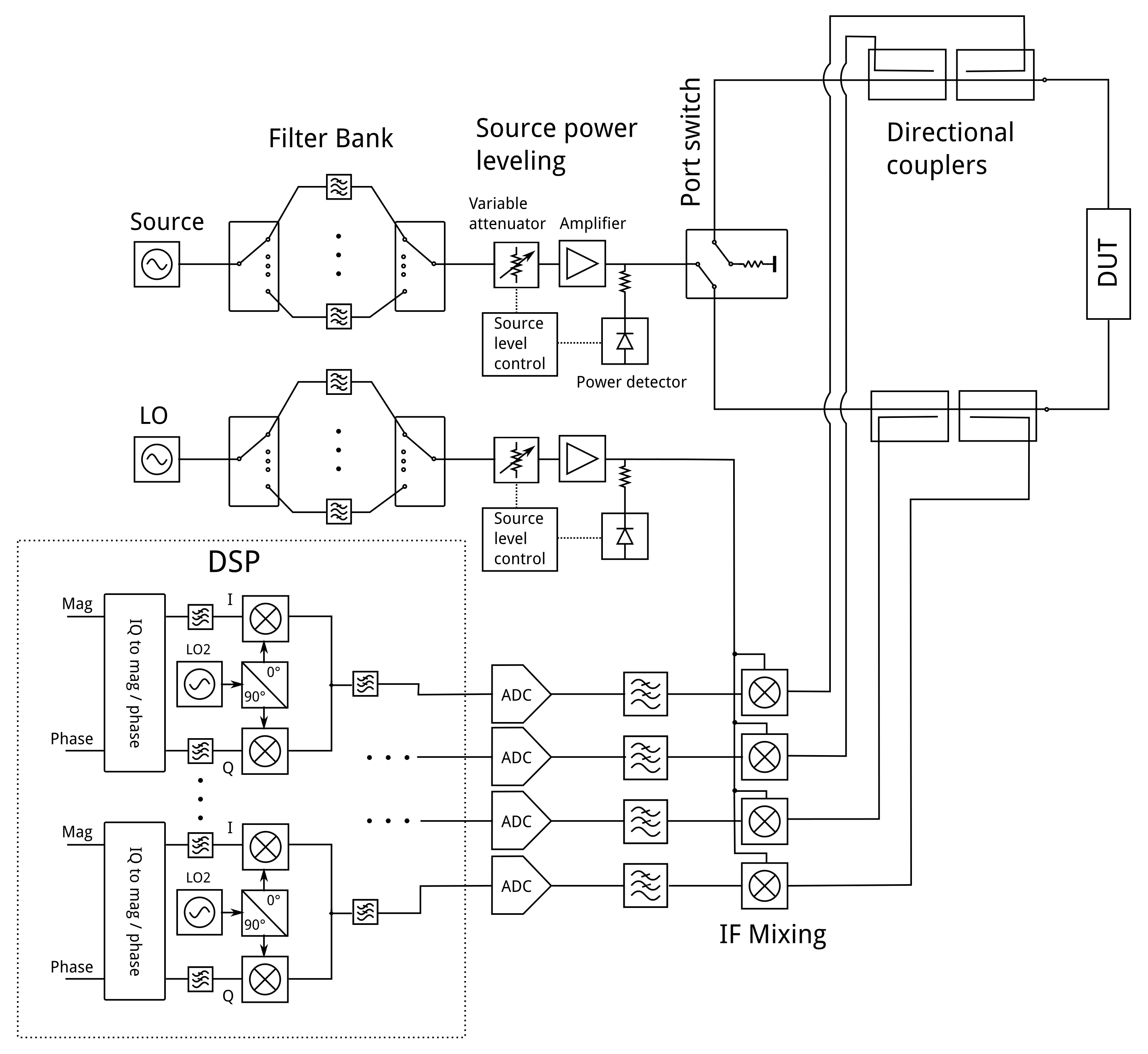
On paper, the operation of a VNA is surprisingly simple. RF at a known power level is passed through the device under test into a load, and the forward and reverse RF is sampled on both its input and output with a set of directional couplers. Each of the four couplers feeds what amounts to an SDR, and the resulting samples are processed by a computer. His write-up contains a full run-down of each section of the circuit, and is an interesting primer on the operation of a VNA,

[Henrik] admits that his VNA isn’t as accurate an instrument as its commercial cousins, but for his tiny budget the quality of his work is evident in that it is a functional VNA. He could have a batch of these assembled and he’d find a willing queue of buyers even after taking into account the work he’s put in with his pricing.

[Henrik]’s work has appeared on these pages several times before, and every time he has delivered something special. We’ve seen his radar systems, home-made horn antennas, and a very well-executed ARM single board computer. This guy is one to watch.

Thanks [theEngineer] for the tip.

Russian Decapping Madness

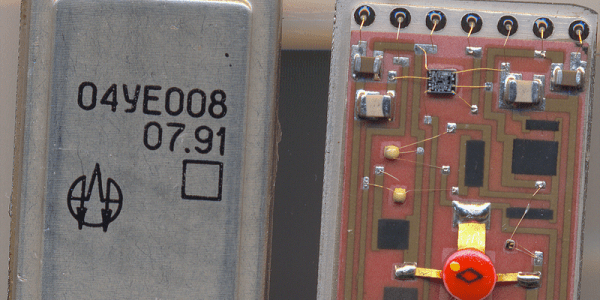
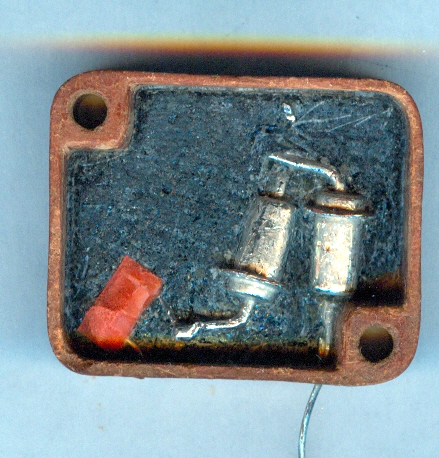
It all started off innocently enough. [mretro] was curious about what was inside a sealed metal box, took a hacksaw to it and posted photographs up on the Interwebs. Over one hundred forum pages and several years later, the thread called (at least in Google Translate) “dissecting room” continues to amaze.

h_1466184174_4168461_2f4afb42b7If you like die shots, decaps, or teardowns of oddball Russian parts, this is like drinking from a firehose. You can of course translate the website, but it’s more fun to open it up in Russian and have a guess at what everything is before peeking. (Hint: don’t look at the part numbers. NE555 is apparently “NE555” in Russian.)

From a brief survey, a lot of these seem to be radio parts, and a lot of it is retro or obsolete. Forum user [lalka] seems to have opened up one of every possible Russian oscillator circuit. The website loads unfortunately slowly, at least where we are, but bear in mind that it’s got a lot of images. And if your fingers tire of clicking, note that the URL ends with the forum page number. It’d be a snap to web-scrape the whole darn thing overnight.

We love teardowns and chip shots, of old gear and of new. So when you think you’ve got a fake part, or if you need to gain access to stuff under that epoxy blob for whatever reason, no matter how embarrassing, bring along a camera and let us know!

Thanks [cfavreau] for the great tip!

Not Quite 101 Uses For An Analog UHF TV Tuner

Young electronics hackers today are very fortunate to grow up in an era with both a plethora of capable devices to stimulate their imagination, and cheap and ready access to them. Less than the price of a hamburger meal can secure you a Linux computing platform such as the Raspberry Pi Zero, and a huge choice of sensors and peripherals are only an overnight postage envelope away.

Casing back a few decades to the 1980s, things were a little different for electronically inclined youth. We had the first generation of 8-bit microcomputers but they were expensive, and unless you had well-heeled parents prepared to buy you a top-end model they could be challenging to interface to. Other electronic parts were far more expensive, and mail order could take weeks to deliver the goods.

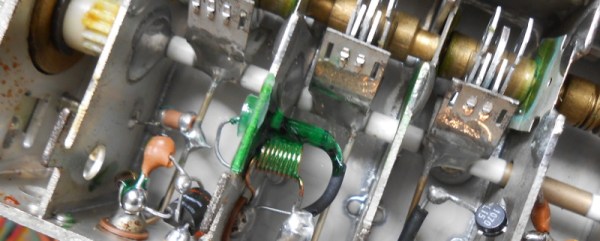
For some of us, this was not a problem. We simply cast around for other sources of parts, and one of the most convenient was the scrap CRT TV you’d find in nearly every dumpster in those days before electronic recycling. If you could make it from 1970s-era consumer-grade discrete components, we probably did so having carefully pored over a heap of large PCBs to seek out the right component values. Good training, you certainly end up knowing resistor colour codes by sight that way.

Continue reading “Not Quite 101 Uses For An Analog UHF TV Tuner”

GPS And SDR Combine Forces

Software-defined radio (or SDR) is a relatively new (to average tinkerers, at least) way of sending and receiving radio signals. The interest in SDR exploded recently with the realization that cheap USB TV tuner cards could be used to start exploring the frequency spectrum at an extremely reduced cost. One of the reasons that this is so advantageous is because of all of the options that a general-purpose computer opens up that go beyond transmitting and receiving, as [Chris] shows with his project that ties SDR together with GPS.

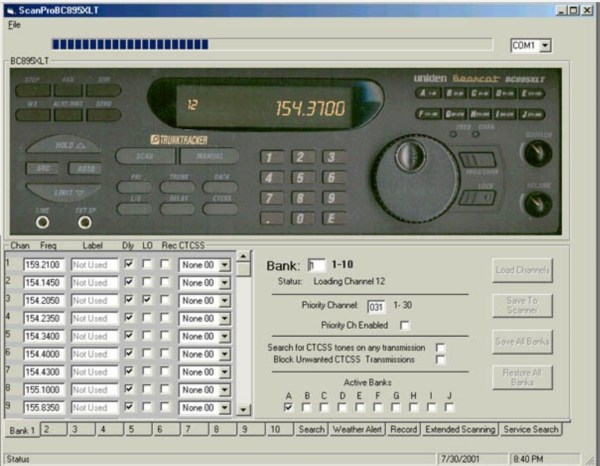
The goal of the project was to automatically tune a radio to the local police department’s frequency, regardless of location. To do this, a GPS receiver on a computer reports information about the current location. A JavaScript program feeds the location data to the SDR, which automatically tunes to the local emergency services frequencies. Of course, this relies on good data for what those frequencies are, but this is public information in most cases (at least in the US).

There are a lot of opportunities here for anyone with SDR. Maybe an emergency alert system that can tune to weather broadcasts if there’s a weather alert, or any of a number of other captivating projects. As for this project, [Chris] plans to use Google’s voice recognition software to transcribe the broadcasts as well. The world of SDR is at your fingertips to do anything you can imagine! And, if you’re looking to get started in it, be sure to check out the original post covering those USB TV tuner dongles.

FCC To Investigate Raised RF Noise Floor

If you stand outside on a clear night, can you see the Milky Way? If you live too close to a conurbation the chances are all you’ll see are a few of the brighter stars, the full picture is only seen by those who live in isolated places. The problem is light pollution, scattered light from street lighting and other sources hiding the stars.

The view of the Milky Way is a good analogy for the state of the radio spectrum. If you turn on a radio receiver and tune to a spot between stations, you’ll find a huge amount more noise in areas of human habitation than you will if you do the same thing in the middle of the countryside. The RF noise emitted by a significant amount of cheaper modern electronics is blanketing the airwaves and is in danger of rendering some frequencies unusable.

Can these logos really be trusted? By Moppet65535 (Own work) [CC BY-SA 3.0], via Wikimedia Commons
If you have ever designed a piece of electronics to comply with regulations for sale you might now point out that the requirements for RF interference imposed by codes from the FCC, CE mark etc. are very stringent, and therefore this should not be a significant problem. The unfortunate truth is though that a huge amount of equipment is finding its way into the hands of consumers which may bear an FCC logo or a CE mark but which has plainly had its bill-of-materials cost cut to the point at which its compliance with those rules is only notional. Next to the computer on which this is being written for example is a digital TV box from a well-known online retailer which has all the appropriate marks, but blankets tens of megahertz of spectrum with RF when it is in operation. It’s not faulty but badly designed, and if you pause to imagine hundreds or thousands of such devices across your city you may begin to see the scale of the problem.

This situation has prompted the FCC Technological Advisory Council to investigate any changes to the radio noise floor to determine the scale of the problem. To this end they have posted a public notice (PDF) in which they have invited interested parties to respond with any evidence they may have.

We hope that quantifying the scale of the RF noise problem will result in some action to reduce its ill-effects. It is also to be hoped though that the response will not be an ever-tighter set of regulations but greater enforcement of those that already exist. It has become too easy to make, import, or sell equipment made with scant regard to RF emissions, and simply making the requirements tougher for those designers who make the effort to comply will not change anything.

This is the first time we’ve raised the problem of the ever-rising radio noise floor here at Hackaday. We have covered a possible solution though, if stray RF is really getting to you perhaps you’d like to move to the National Radio Quiet Zone.

[via Southgate amateur radio news]

Easy DIY Telemetry Goes The Distance

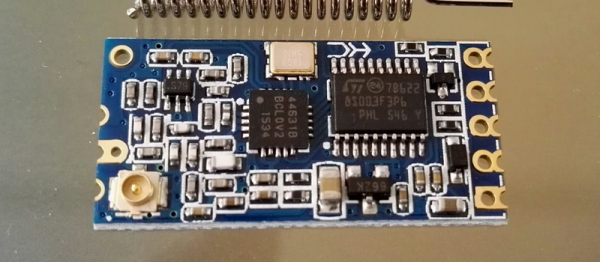
[Paweł Spychalski] wrote in to tell us about some experiments he’s been doing, using cheap 433 MHz HC-12 radio units as a telemetry radio for his quadcopter.

In this blog post, he goes over the simple AT command set, and some of the limitations of the HC-12 part. Then he takes it out for a spin on his quadcopter, and finds out that his setup is good for 450 meters in an open field. Finally, he ties the radio into his quad’s telemetry system and tethers the other end to his cellphone through a Bluetooth unit for a sweet end-to-end system that only set him back around $20 and works as far out as 700 meters.

The secrets to [Paweł]’s success seem to be some hand-made antennas and keeping the baud rate down to a reasonable 9600 baud. We wonder if there’s room (or reason?) for improvement using a directional antenna on the ground. What say you, Hackaday Antenna Jockeys?

Also check out this very similar build where an ESP8266 replaces the Bluetooth module. And stashes it all inside a nice wooden box! Nice work all around.