Battery Capacity Tester

battery-capacity-tester

[Moris_zen] built a device to accurately measure the capacity of batteries. He needed to have an accurate measurement for the batteries he uses in a RC airplane. Knowing the discharge time allows him to fly the friendly skies while avoiding crashes from lost communications.

He based the tester around the Arduino platform. Instead of using a pre-built Arduino board he referenced the open source schematics and built the device from components to fit his needs. His solution automatically detects the battery type (Lithium-Ion, Nickel Metal Hydride, etc) based on voltage when the battery is added to the circuit. It then uses a 2.2 Ohm resistor and ADC measurements to take the battery through a discharge cycle. A character display shows status information with the ability to track discharge information using a computer to graph the data.

Apart from flashing an LED this was his first Arduino project. It’s a great use of the platform and much more automatic than other solutions we’ve covered.

Radio Controlled Beetle Flight Footage

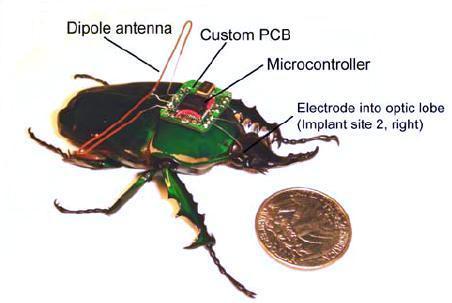
Earlier this year we were amazed when University of California researchers controlled a beetle via electrical implants. The video available at the time of the original report showed beetles tethered in place while electrical stimuli was applied via the chip. New video of free flight is has now been posted. Although the motion is rather sporadic, it is obvious that simple commands to start flight, stop flight, and turn left or right are having their intended effect. Check out this cyborg action after the break. Is DARPA one step closer to unleashing legions of insect warriors on unsuspecting masses? Continue reading “Radio Controlled Beetle Flight Footage”

RCDC: DC Motor Control Via Servo Signals

[youtube=http://www.youtube.com/watch?v=x2Hn8No5oFQ]

[Spikenzie]  has put together this nice kit for controlling a DC motor with RC servo signals. He’s using a PIC12F629 to convert the signal to PWM. As you can see in the video above, it seems to work quite well. It is in a neat and tidy package and available as a kit. We have to admit though, what caught our eye was the prototype. Even though it is a kit for sale, it looks as though they plan on releasing the PCB files and code.

The HeliControl Project

helicontrol_offen (Custom)

We’ve all seen those little toy helicopters appearing everywhere. They’re getting cheaper and cheaper with some models getting down to roughly $30. The JRL team wanted to be able to control them with a PC, and figured the best way to do it was to build somewhat of a universal remote for them. The HeliControl module currently has several different types of copters programmed in, and they plan on adding more. Its not surprising to see the rise in popularity of these mini choppers, we’ve even seen some pretty extensive mods to the bodies and even mechanicals. Click around this forum to see what some people are doing to them.

Autonomous ATV

[youtube=http://www.youtube.com/watch?v=Ja3ND8Pk_0M&hl=en&fs=1]

A team at UNC Charlotte has been working on an autonomous vehicle to drag a cart that has sensing equipment. Starting with a stock Honda ATV, different systems were added to give a Renesas processor control of the ATV.  A model airplane receiver was attached to the Renesas to give remote control for Phase 1 of the project. Basically they’ve turned the ATV into a giant remote controlled car.

Later revisions will incorporate LIDAR, cameras, and multiple GPS units so the ATV can autonomously traverse most terrain with a high level of accuracy. Path planning will become a large part of the project at that point.

Continue reading “Autonomous ATV”

Paintball Gun Turret

paintball_sentry

[Jared Bouck] has been sending in his projects for a couple years now. We’ve enjoyed his heavy-duty DDR pads, LCD backlight repair, and ion cooling projects. His latest, an RC paintball gun turret, is our favorite though. He actually rates this as one of the easier projects he’s published; it just took a while to assemble. Several design decisions were made to keep the project simple. Two 32 Degrees Icon-E paintball guns were used. The guns already have electric solenoids for firing, so a special trigger mechanism didn’t have to be fashioned. Q-loaders were used to prevent any ball feed problems. The motors, driver boards, and RC components are all borrowed from combat robots for reliability. He’s hoping to produce a small number of kits based on this design.

Related: We’ve got quite a few sentry gun projects in the archive.