RC Car And Beagle Board Mate For A Versatile Robot Build

Here’s a rover project that has plenty of power (translated) to go places. This is true not only of its locomotive capability, but processing power as well.

The RC car used here (translated) is not overly expensive, but offers a lot of versatility. It’s got front and rear steering via two servo motors, as well as independent drive motors for each end. The frame also offers an advanced suspension system that lets the vehicle flex to keep as many wheels on the ground as possible. It’s a great find if you don’t want to start off your project bogged down in the hardware design.

On the control side of things a Beagle Board has been choosen. The demo after the break shows it controlling an added turret servo, as well as the drive mechanism controlled via a keyboard. These are driven through the embedded Ubuntu image running on the board. This should provide plenty of processing power to add obstacle avoidance and autonomy routines in future versions.

Continue reading “RC Car And Beagle Board Mate For A Versatile Robot Build”

Cypherbot Uses Older UC And Retro-controller

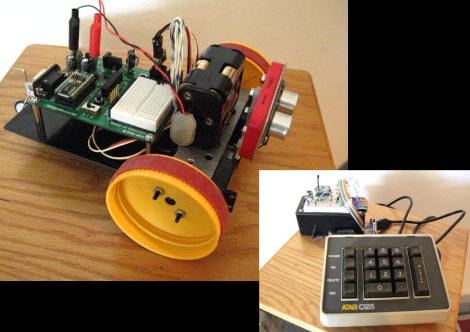
[PJ Allen] has been working on a little robot which he calls Cypherbot. The control circuitry is quite familiar; a Board of Education which features the Basic Stamp 2 microcontroller. This is an older and slower microprocessor, but it works quite well for this application since there’s no need for speed or heavy number crunching. The wheels of the bot are made out of plastic lids (we’re thinking peanut butter jars) with rubber bands for traction that are each driven by a servo motor. The third wheel is tiny and swivels as needed.

The front of the bot has a PING ultrasonic sensor mounted on a servo motor which lets the bot scan back and forth for a wider obstacle avoidance angle. In addition to the autonomous mode there’s an Xbee remote control. [PJ] picked up an Atari keyboard and is using that as the user input. Check out the little guy driving around the house in the video after the break.

Continue reading “Cypherbot Uses Older UC And Retro-controller”

Obstacle Avoiding Hexapod From Reused Parts


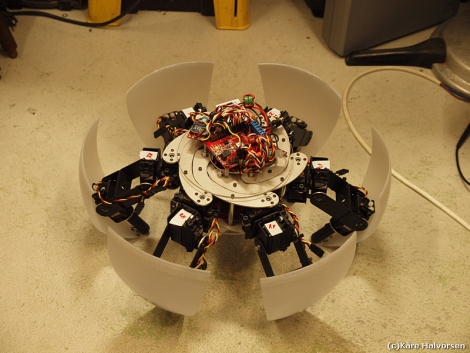
[Rob] built this hexapod one day when he had some free time after work. Just like the last hexapod we saw, he based the build on the Pololu design which uses three servo motors for surprisingly reliable movement.

The hardware is very straight forward. A Dorkboard serves as the brain. It’s a PCB that is wider on each side by the width of one female pin-header than a standard AVR 28-pin microcontroller. This gives easy access to all of the pins on the Arduino chip while making it small and light. You can see that a four-pack of batteries hangs below the servo motors to provide power.

Protruding above the 6-legger is a PING ultrasonic rangefinder. This adds autonomy to the little robot, which you can see running some obstacle avoidance routines in the video after the break. We’ve asked [Rob] if is able to share his code and will update this post if we hear back from him.

Update: Here’s a link to the sketch, and we’ve updated the picture with one that [Rob] sent to us.

Continue reading “Obstacle Avoiding Hexapod From Reused Parts”

DIY Servo Activated Door Lock With Capacitive Touch Keypad

diy_servo_activated_door_lock_capacitive_touch

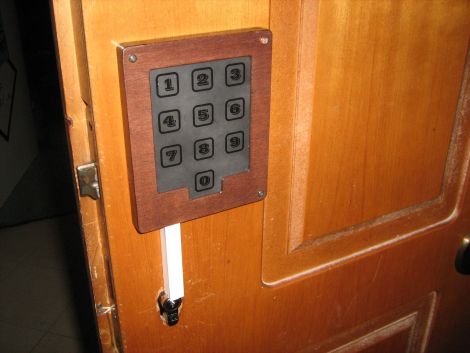
Since he was a kid [Giorgos Lazaridis] has always loved the idea of having an electronic door locking mechanism, and now that he has the means, he’s decided to construct one for securing the door to his apartment. He calls the project “simple and cheap”, though we’re not sure about the first part. Taking a look at his very detailed build log, you can see that he has invested quite a bit of time and effort into this impressive project.

Buying an off the shelf product was expensive and not a whole lot of fun, so [Giorgos] disassembled his door’s locking mechanism to see how he might be able to actuate the lock electronically himself. With minimal modifications to the lock, he was able to add a servo which reliably opens the it when triggered.

With the mechanical portion of the project out of the way, he spent a great deal of time working on the door’s electronic components, including the PIC-based controller and capacitive keypad. The keypad proved to be a bit of a problem, but after a few revisions he found a design that was both reliable and pleasing to the eye.

The locking mechanism works pretty well, as you can see in the video below, and [Giorgos] is quite pleased with the results.

Continue reading “DIY Servo Activated Door Lock With Capacitive Touch Keypad”

Tiny Transforming Beer Can Robot

beer_can_robot

The next time you reach for a cold one, you might want to take a look at the can to ensure that your beer won’t suddenly sprout legs and start skittering across the table.

You might remember [Ron Tajima] from some of his previous creations, including this Roomba-based baby cradle and the PacMan Roomba mod. This time around, he has created a cool little transforming robot that fits inside a beer can.

The robot’s brains are stored just underneath the top of the beer can on a custom-built board. On one side of this board, you will find an mbed controller which is used to manage all of the robot’s functions, and on the other side, four batteries provide all of the device’s power. The robot’s three legs are controlled by six servos, allowing for movement in several different planes. The beer-bot’s movements are controlled with a Wiimote, so we’re assuming he has crammed a Bluetooth module somewhere in there as well.

[Ron] mentions that it moves a bit slowly when standing on end, but we think the robot is pretty awesome as is, and we can’t wait to see what improvements the next version might bring.

Stick around to see a video demonstration of the robot in action.

[Thanks Sascha]

Continue reading “Tiny Transforming Beer Can Robot”

Android Controlled Labyrinth

[Pcdevltd] pulled an all-nighter to get his first Android Developer Kit project up and running. Basing the project off of the example that Google used when unveiling the new accessory development hardware, he set to work controlling a marble labyrinth game using his smart phone. What began at 7pm was wrapped up by 5am to produce the results seen in the video after the break.

These ball mazes use two knobs to pivot the playing surface, changing gravity’s pull on the ball to get it to go where you want. [Pcdevltd] pulled off the bottom on his labyrinth and installed two small servo motors. These connect to the Android Open Accessory Development Kit via a small cable. Connect that to the phone and you can then use the internal accelerometer to play the game. If you have an Android phone and an Arduino this should be pretty easy to replicate since we know you can already use the ADK with Arduino. Get to work on your own projects and don’t forget to send us a link to your project log.

Continue reading “Android Controlled Labyrinth”

Automatic Espresso Loader For Those Late Night Hack Sessions

For [Roy’s] graduate electronics class, he decided to make something that many in and out of the hacking world would certainly love, an automatic espresso loader.  One can choose from three flavors available. In order to accomplish this, a Parralax Propeller board is used to control three servos that regulate the amount of coffee dispensed, chosen by a handy LCD HMI (human machine interface).

After the coffee is dispensed, the chute swings out of the way. A modified inkjet cartridge carrier (from a dead printer) is then used to compact the beans. Check out the video of this machine in action after the break. Continue reading “Automatic Espresso Loader For Those Late Night Hack Sessions”