MindWave Is Developer (read: Hacker) Friendly Mind Control

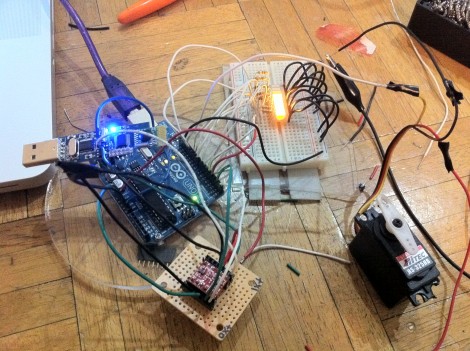
Here’s a setup to control a servo motor with your mind. [Danny Bertner] made this project happen by interfacing a MindWave headset with an Arduino. You might wonder what’s the big deal about that since we’ve covered quite a few mind control hacks that work this way? So far, the majority of those hacks used the Mindflex toy (to be fair there were several using the Force Trainer as well), which depends on a chip made by the company that is responsible for the MindWave. Both the Mindflex and the Force Trainer were reverse engineered to access the stream of data coming in from the EEG sensors. But NeuroSky is embracing the urge to mess with their products by offering developer tools.

[Danny] took advantage of these resources, using the comany’s own guide to interfacing with an Arduino (PDF). The quick clip after the break shows his finished project, grabbing data from the USB dongle that comes with the headset, converting it to the necessary levels for the Arduino, then processing the signals for display on and LED bar graph.

We can’t help but chuckle about the warranty-voiding disclaimer at the top of the PDF guide.

Continue reading “MindWave Is Developer (read: Hacker) Friendly Mind Control”

One-eyed, One-armed Metal Rolling Roomba Robot

roomba_robot

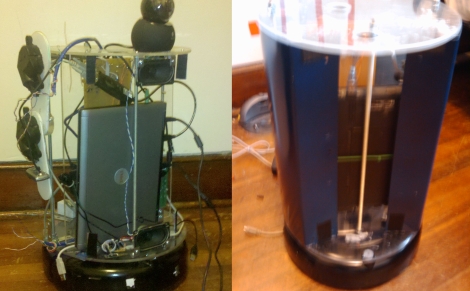
[Erik] was looking for a sturdy robotics platform and was initially considering the iRobot Create, until he found that he could score a Roomba Discovery series for a fraction of the price. The Discovery includes a battery, which is missing from the iCreate, though it also has all of the standard vacuum bits included as well.

He immediately removed all of the vacuum parts once he got his hands on the Roomba, and began adding the support structure to house the rest of his robot’s components. The robot is controlled via a small laptop which sits on top of the Roomba’s base, and features a panning and telescoping webcam to provide feedback to the operator.

The robot has been under construction for a little over a year now, and has had a few upgrades over that time. The original laptop was swapped out for a newer dual-core model, and the webcam was upgraded to a model featuring motion tracking. The whole thing has been skinned in thin sheet metal for a sleek look, and he has added a servo-driven arm as well.

The project is not quite complete, and he hasn’t really stated what he plans on using the robot for, but it looks good so far – we can’t wait to see it when it’s finished.

Blu-ray Laser Plotter Writes On Glow-in-the-dark Screen

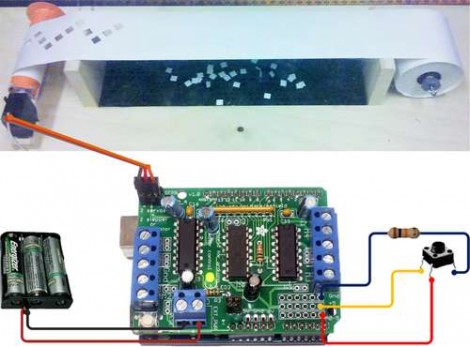
This laser display is persistent thanks to a glow-in-the-dark screen. [Daniel] built it using a Blu-ray laser diode. As the laser dot traverses the screen, it charges the phosphors in the glow material, which stay charged long enough to show a full image.

The laser head is simple enough, two servo motors allow for X and Y axis control. A Micro Maestro 6-channel USB servo controller from Pololu drives the motors, and switches the diode on and off. This board offers .NET control, which [Daniel] uses to feed the graphics data to the unit. Check out the video demonstration below the fold to see a few different images being plotted. It’s shot using a night-vision camera so that you can really see where the laser dot is on the display. It takes time to charge the glow material so speeding up the plotting process could actually reduce the persistent image quality.

This is yet another project that makes you use those geometry and trigonometry skills.

Continue reading “Blu-ray Laser Plotter Writes On Glow-in-the-dark Screen”

Real Life Super Mario Coin Block

mario_coin_block

Instructables user [Bruno] recently constructed a fun little toy that brings a bit of the Mario nostalgia out of the video game universe and into ours. His Super Mario coin block is instantly recognizable from the first Mario game and performs just as you would expect it to. Punching or tapping the bottom of the block releases coins one at a time, complete with sounds straight from the game.

The coin block is constructed from thick cardboard and wrapped in color mock ups of the in-game block. Inside, a spring-loaded tube of coins is placed above a launch arm which is also connected to a spring. A servo actuated arm pulls the launch arm down, dropping a coin from its tube on to the launch arm which is then flung from the top of the box once the servo arm rotates far enough. When this occurs, the built-in MP3 player is triggered to play the “coin sound” from the game. A 555 timer is used to ensure the servo actuated arm rotates once per activation, and a LM386-based amplifier is used to increase the output volume of the MP3 player, both of which operate using rechargeable batteries.

Be sure to check out some of the inner workings as well as the final product in the videos embedded below.

[Thanks, Samjc3]

Continue reading “Real Life Super Mario Coin Block”

RC Override For Autonomous Hardware

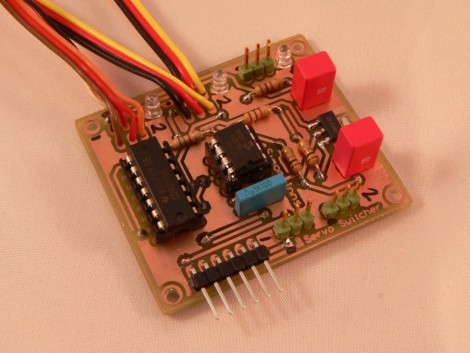
[Simon Inns] developed this board to act as a radio controlled override for autonomous hardware. It sits between some servo motors and two different sets of controllers for those motors. One set of hardware that can control the motors is a microcontroller programmed for autonomous tasks. In [Simon’s] case this enables a sailboat to navigate open water with out human intervention. But if that board fails, or if you just need to call the boat back to port, this module allows for a traditional RF vehicle controller to take command.

The board seen above, dubbed the Servo Switcher, uses a PIC 12F683 to monitor the incoming signal from the RF receiver. If that signal is not present it switches control of the motors over to a separate microcontroller board. This means that the override control is established simply by turning the handheld controller on. This will save you a swim to retrieve your boat, which is a nice convenience. But if you modify this for a plane or helicopter, it can save your aircraft from certain destruction. Check out the video walk through after the break.

Continue reading “RC Override For Autonomous Hardware”

Hackaday Links: March 22, 2011

3D holographic fog display

3d_fog_display

Some researchers in Japan are hard at work building a 3D volumetric fog display that would allow you to live out some of your Leia-related Star Wars fantasies. Using a column of fog and three projectors, they were able to create a display that looks three-dimensional from any angle. It might be a while before the technology hits your living room, so don’t clear your calendar just yet, Obi Wan. [via Neatorama]

The Claw – a three-fingered robotic gripper

the_claw

Instructables user [AntMan] has been hard at work revising his robotic claw gripping mechanism. Laser cut from wood, this servo-driven claw can easily grasp small objects with little effort. We can’t wait to see someone build a version from milled aluminum!

Ben Heck’s retro Xbox 360

ben_heck

[Ben Heck] is at it again, and has recently given the Xbox 360 a sweet retro makeover. Taking inspiration from gaming consoles of the 70’s, he converted an Xbox 360 into a laptop-style portable (again), but this time with the look and feel of an old Atari 2600. Retro gamers rejoice, you can now get your Xbox on while enjoying the sweet simulated wood-grain you grew up with.

Rocket-based ice fishing notification system

ice_rocket

What fun is ice fishing if you have to sit outside freezing your butt off? We’re assuming that was the driving thought behind [Mike’s] rocket-based ice fishing rig. A model rocket is attached to his fishing sledge, which is triggered when a fish is detected on the line. Using a low-tech detonator, the rocket lets him know it’s time to check the lines. Now only if we could get the fish to fillet themselves…

Case modding video series hits the web

modmen_logo

The “Mod Men” is a fairly new web series that takes you out of the basement and into the garage for some professionally constructed case mods. Described as “American Chopper for geeks with a dash of This Old House”, the creators aim to showcase over-the-top case mods with a professional flair. They already have three episodes under their belt, all of which are available on their site.

Freedombot Explores Your Fridge

Freedombot is a neat little robot designed for exploring magnetic surfaces. It has two whiskers for detecting objects in its path and two rare earth magnets which allow it to stick to your fridge.

Overall Freedombot may not be anything revolutionary but its builder [skater_j10] does a good job of covering topics which my be interesting to robotics beginners. For example he goes through the process of modifying some HiTec HS- 55 Micro Servos for continuous rotation which allows them to act as the wheels. To control the bot he uses two 555 timers wired up in astable mode to generate the needed PWM for the servos. The proximity sensors are simple limit switches with some wire soldered on to the end.  The end result is a neat little robot for roaming the front of your fridge. See a video of it in action after the break.

This happens to be [skater_j10]’s entry into the 555 timer contest. Unfortunately the deadline has passed for new entries but be sure to swing by and check out some more awesome 555 hacking.

Continue reading “Freedombot Explores Your Fridge”