12 Foot LED Display Keeps Your Office Informed

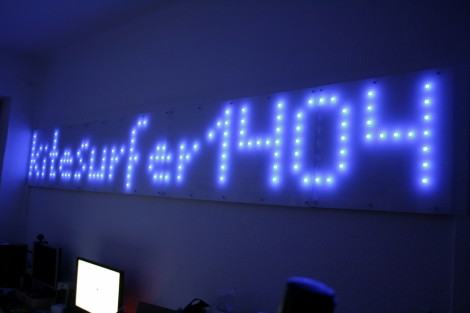
Don’t reach for a sticky note when you need to leave a message for your office mates, write it down on a 12 foot LED marquee. [Kitesurfer1404] built this for his home office, but we’re sure he’ll find fun stuff to use it for. The display has 512 LEDs driven by plain old 595 shift registers for the high-side columns, with an ULN2803A Darlington Array to pull the eight rows to ground. The whole thing is controlled by an ATmega8 via a serial connection. Our compliments to the builder for accurately drilling a grid of 64×8 holes in each hardboard panel of the display. The buses for each row and column also look nice and clean. For the final look a 79% light transmittance frosted acrylic panel was added to diffuse the light.

We used the same method to build our LED pumpkin. Transistors ran the low side, and if we had needed more columns, shift registers are a popular go-to for I/O expansion. Check out that project to learn more about display multiplexing.

Helicopter POV Display Is A Masterwork

helicopter hack LED mod

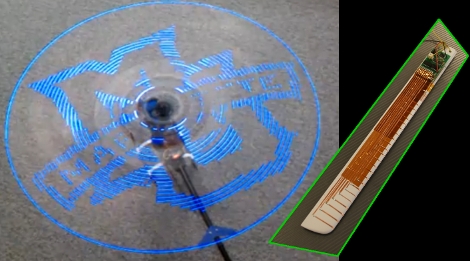
Yes! A radio control helicopter with a fairly high-resolution persistence-of-vision display is a beautiful thing. [Mziwisky’s] handiwork is the result of several steps along the prototyping path. He built up a POV test rig on a breadboard, designed his first PCB for the project, and then went to work building it. After initially being inspired by a POV ceiling fan [Mziwisky] looked around to see if anyone else had already added a display to a helicopter. Indeed, this has been done before but there were very few details on the build.

The helicopter has two blades and each have the same hardware on them and gobbled up about ten hours of assembly time each. He basically built a printed circuit board using the blades as a substrate by attaching adhesive copper foil. This makes up the matrix for the LEDs and connects to a small circuit board with an ATmega8 and some shift registers mounted on the inside end of the blade. There’s also a 180 mAh LiPo battery pack, and a hall effect sensor to synchronize the display on each. The results are spectacular, as you can see in the video after the break, but there’s a few bugs left to work out in order to fully tame the 32 LEDs on each rotor.

Kind of looks like the future is happening right now.

Continue reading “Helicopter POV Display Is A Masterwork”

Spy Video TRAKR: Software And First Hack

Our initial view of the Spy Video TRAKR “App BUILDR” site had us believing this would be an internet-based code editor and compiler, similar to the mbed microcontroller development tools. Delving deeper into the available resources, we’re not entirely sure that’s an accurate assessment — TRAKR may well permit or even require offline development after all. Regardless of the final plan, in the interim we have sniffed out the early documentation, libraries and standalone C compiler and have beaten it into submission for your entertainment, in order to produce our first TRAKR hack!

Continue reading “Spy Video TRAKR: Software And First Hack”

7-segment Sudoku

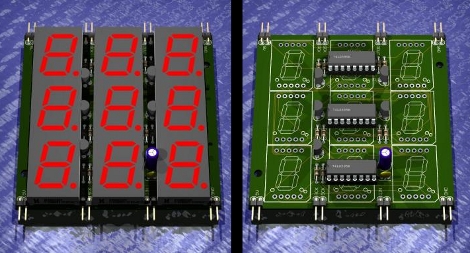
[John Sarik] keeps cranking out new ideas for his digital Sudoku project. This time he’s using 7-segment displays for each digit. The game play works the same as the Nixie Tube version, but this makes things quite a bit easier to build. The board above is one of the nine modules that make up the game. They each use three shift registers to drive the nine 7-segment displays. With the help of five resistors all of the multiplexing is addressed via the serial input on those chips.

LED Matrix With A Gross Of Pixels

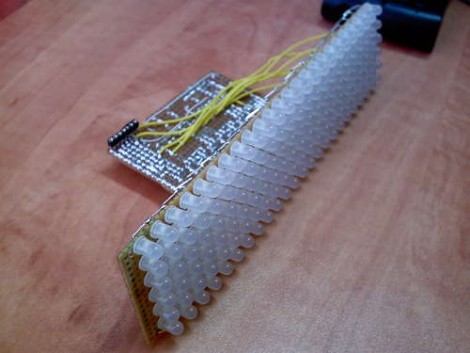
This LED matrix is arranged in a 24×6 pattern for message scrolling. There’s no etched boards here, making us wonder where [Syst3mX] found protoboard this long. He’s using an Arduino to drive the demonstration (clip after the break) but you can use any microcontroller with this setup. That’s because he’s using three shift registers for column data and a decade counter for row scanning, requiring just five control pins.

While you’re going to the trouble of ordering components, maybe you should try your hand at building a touch sensitive LED matrix too.

Continue reading “LED Matrix With A Gross Of Pixels”

Printed Circuit Board Minus The Printed Traces

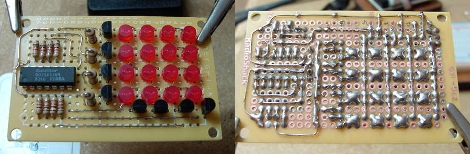
Reader [Osgeld] is a board-layout ninja. He populated this 4×4 LED matrix board without having a layout plan to start with. Watch it develop in slideshow format to see the art work he performs. The display is driven by a shift-register and he’s included all the proper parts like resistors and transistors, yet he makes everything fit. Why is this amazing? He’s using uninsulated wire and not a single one of them crosses another wire. He’s physically designing a printed circuit board, routing the traces as he solders away. He’s built this to use with an Arduino shift register tutorial and our only question is where is the header to hook this board to a microcontroller?

Wire-wrapping An LED Matrix

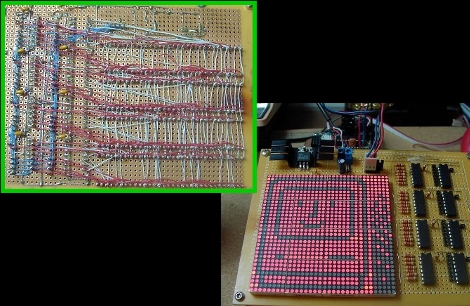
Regular reader [Osgeld] built a 1024 LED display matrix. This is a proof-of-concept design and he admittedly has overloaded the components. Most notably, the 595 shift registers (featured over the weekend) are sourcing too much current if all eight pins are active. That’s easy enough to fix in the next design by moving up to cascading LED drivers. Instead of soldering every connection in the display, [Osgeld] soldered the components in place and then used wire wrapping to make the point-to-point connections. This must have saved him a ton of time and frustration. We can’t wait to see what comes out of this first prototype.