Perovskite Solar: Coming Soon?

Making solar cells out of silicon is difficult. There’s plenty of manufacturing steps, many of them at very high temperatures, and you need a high vacuum and a clean room. However, perovskite solar cells–cells made with hybrid organic-inorganic materials in a perovskite crystal structure–are relatively easy to make using wet chemistry involving solvents or vapor deposition.

In theory, silicon solar cells could be 30% efficient, but in reality, 25% seems to be a practical limit with commercial cells typically topping out at 20%. Perovskite cells are nearly that high now, and could be higher by stacking thin layers, each sensitive to different wavelengths of light.

A recent development at the Lawrence Berkeley National Laboratory may lead to even more efficient perovskite cells. Researchers found that certain crystal structures had a much higher efficiency than other structures. The problem now is figuring out how to produce the crystals to increase the prevalence of that structure.

Continue reading “Perovskite Solar: Coming Soon?”

Solar Powered Hydroponics

[Dan Bowen] describes the construction of a backyard hydroponics set-up in an angry third person tirade. While his friends assume more nefarious, breaking, and bad purposes behind [Dan]’s interest in hydroponics; he’d just like some herbs to mix into the occasional pasta sauce.

Feel particularly inspired one day after work, he stopped by the local hardware store and hydroponics supply. He purchases some PVC piping, hoses, fittings, pumps, accessories, and most importantly, a deck box to hide all the ugly stuff from his wife.

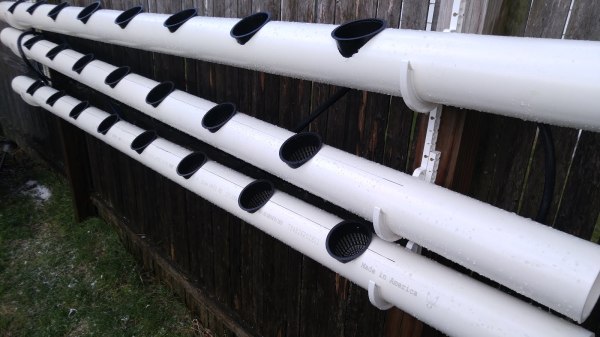
The design is pretty neat. He has an open vertical spot that gets a lot of light on his fence. So he placed three lengths of PVC on a slant. This way the water flows quickly and aerates as it goes. The top of the pipes have holes cut in them to accept net baskets.

The deck box contains a practically industrial array of sensors and equipment. The standard procedure for small-scale hydroponics is just to throw the water out on your garden and replace the nutrient solution every week or so. The hacker’s solution is to make a rubbermaid tote bristle with more sensors than the ISS.

We hope his hydroponics set-up approaches Hanging Gardens of Babylon soon.

A Toasty Warm Pool Without The Propane Bills

So, you’ve got the deck, you’ve got the pool and the lounger, you’ve got the summer, and you’ve got the piña colada. All set, you might say.

Sounds idilyic, but sadly we aren’t all lucky enough to live in a tropical climate. So while sipping the cocktail on the lounger you’d be warm enough the chances are that taking a dip would leave you feeling as though you’d just jumped into the Arctic Ocean. Not a problem, just turn on the pool heater. At this point you discover just how much it costs to heat a large body of water kept outdoors and open to the atmosphere. You become the kind of valued customer your liquid propane dealer sends a Christmas card to, you are reduced to living on a diet of budget ramen, and your children wear shoes with holes in them.

[ClanMan] had almost the problems outlined above, at least as far as the uncomfortable propane bills. His solution was a surprisingly simple one, he built himself a solar water heater from inexpensive PVC pipe.

It might not be immediately apparent to the uninitiated, but the key to making an efficient solar collector from such a basic material lies in careful selection of the bores of the various sections of pipe being used. The hot water feed from the propane heater had quite a narrow bore with a fast flow rate, but because [ClanMan] needed his water to linger in the collector and pick up as much solar heat as possible, he chose a much wider bore to feed it to ensure a much slower flow. The collector itself was made from multiple parallel lengths of much narrower pipe, to preserve the slow net flow across their combined cross-section while ensuring the maximum surface area contact between hot pipe and water.

The resulting heat helped take the temperature of his pool from 75 to 80 Farenheit. This may not sound like much, but was enough to make a noticeable difference.

We’ve featured quite a few solar heat projects before here at Hackaday. Best title has to go to the Hippie-Redneck Solar-Heated Kiddo Swimmin’ Pool And Hot Tub, but we’ve also featured a very tidy coiled solar collector. All this swimming is hungry work though, so how about a solar cooker made from a satellite dish?

Networked Solar Birdhouses Deep In The Woods

[Oitzu] in Germany wrote in to let us know about a series of short but very informative blog posts in which he describes building a series of solar-powered, networked birdhouses with the purpose of spying on the life that goes on within them. He made just one at first, then expanded to a small network of them. They work wonderfully, and [Oitzu]’s documentation will be a big help to anyone looking to implement any of the same elements – which include a Raspberry Pi in one unit as a main gateway, multiple remote units in other birdhouses taking pictures and sending those to the Pi over an nRF24L01+ based radio network, and having the Pi manage uploading those images using access to the mobile network. All with solar power.

Continue reading “Networked Solar Birdhouses Deep In The Woods”

Solar FPV Plane Flies Forever

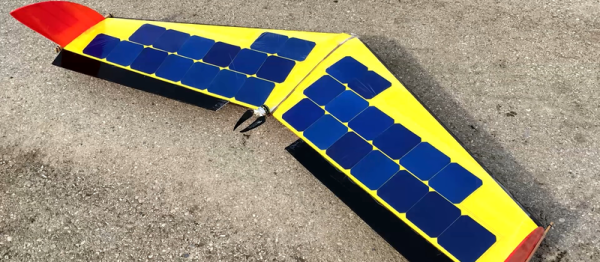
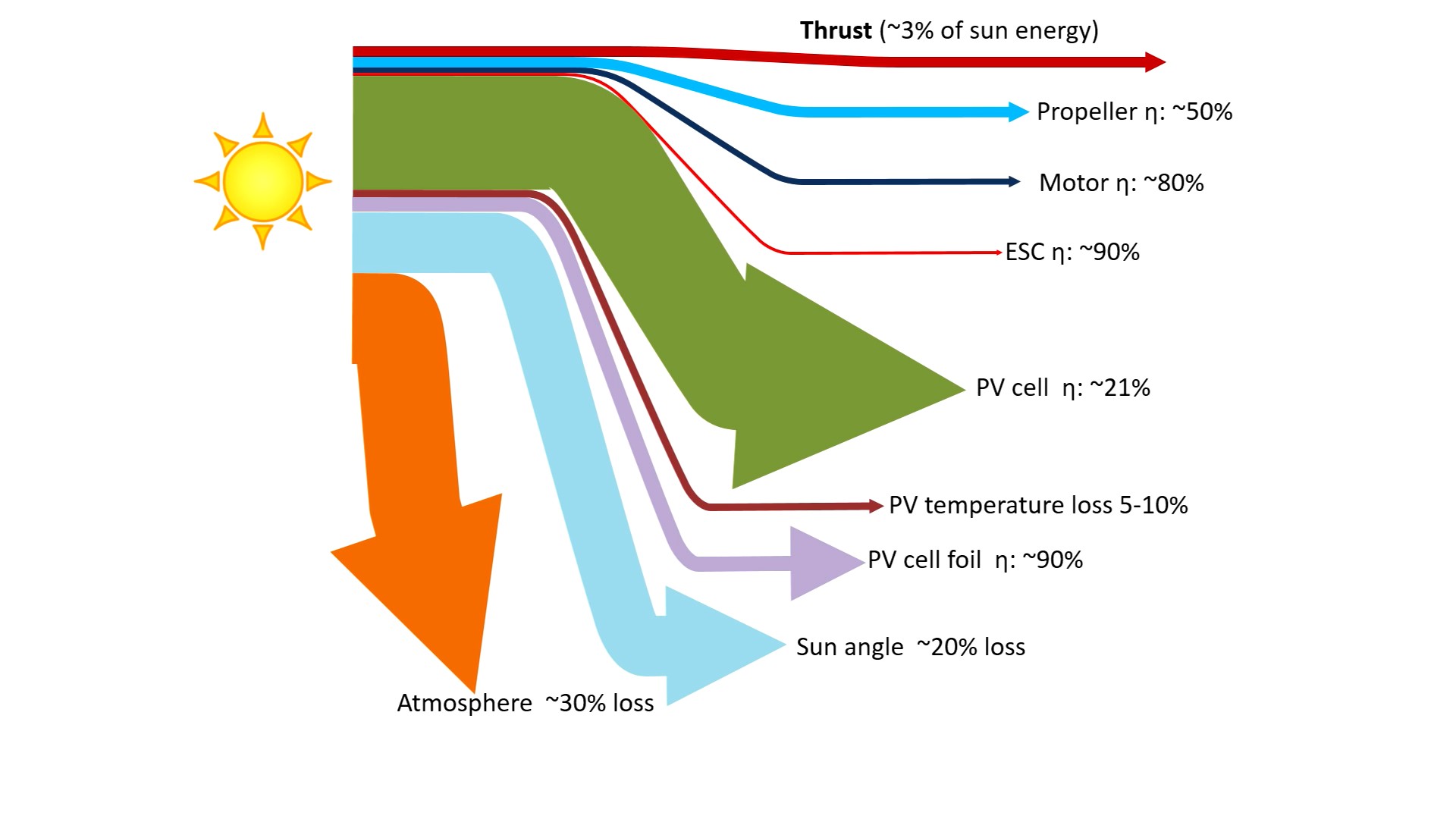
We love solar power. Not only is it environmentally friendly, but it’s relatively lightweight and involves fragile high technology. Just the sort of thing that we’d want to strap onto the wings of a large model aircraft.

Solar power on a remote-controlled plane would get you unlimited cruising range. Now, a normal land-and-swap-battery process might be good enough for some people, but judging from [Prometreus]’s YouTube channel, he’s a fan of long flights over the Alps, and of pushing long-distance FPV links to the breaking point. For him and his friends, the battery power is definitely the limiting factor in how far / long he can fly.

solar-powered-plane-_-drone-_-fpv-_-built-_-rc-aircraft-rmkpjbf6dnqmkv-shot0012

All of the information we have is in the video, but that’s plenty. [Prometreus] didn’t bother with maximum-power-point tracking, but instead wired up his solar cells to work just about right for the voltage of his batteries and the level of sun that he’s seeing. So it won’t work nearly as well on cloudy days. (Check out this MPPT build that was submitted for the Hackaday Prize.)

He could switch the solar cells in an out remotely, and it’s pretty gratifying to see the consumed current in the battery go down below zero. In the end, he lands with a full battery. How cool is that?

Continue reading “Solar FPV Plane Flies Forever”

Nixie Tubes Adorn Steampunk Solar Power Meter

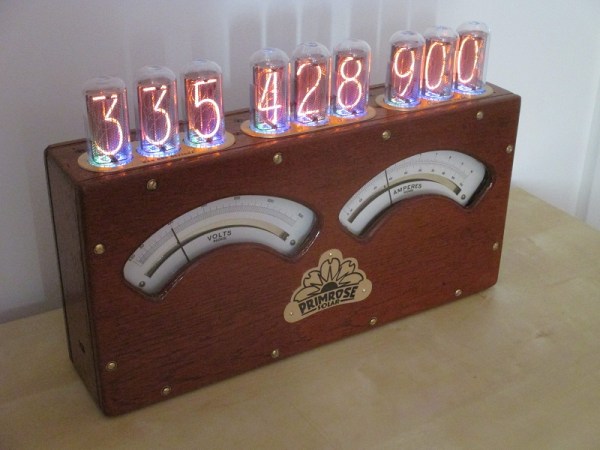
The appeal of adding Nixie tube displays to a project seems to know no end. First it was Nixie clocks, now it’s Nixie power meters, with the latest addition being this Nixie-Steampunk hybrid solar power monitor.

We’re suckers for a project with a vintage look, and this one pushes all the buttons. Built on commission for a solar power company CEO’s office, [Paul Parry]’s build is based on a Depression-era Metropolitan-Vickers combined voltmeter and ammeter. The huge meters with mirrored scales and the rich wood of the case – our guess is that it’s mahogany – made a great starting point, and after some careful hole drilling, nine IN-18 Nixies were sprouting from the case. A strip of RGB LEDs below decks added the requisite backlighting of the envelopes, and a Raspberry Pi was enlisted to interpret data from the company’s solar farm and drive the tubes and the meters. The project was capped off with a new finish on the case and a couple of fancy brass plaques.

[Paul] sent us the tip for his build after seeing the last power meter we covered, and we have to say they’re both great looking and functional projects. Keep the Nixie projects coming!

Quick Network Bridge Gets Off-grid Home Back Online

Off-grid living isn’t for everyone, but it has gotten easier in recent years. Cheap solar panels and wind turbines let you generate your own power, and there are plenty of strategies to deal with fuel, water and sanitation. But the one thing many folks find hard to do without – high-speed internet access – has few options for the really remote homestead. [tlankford01] wants to fix that and is working on an open-source mesh network to provide high-speed internet access to off-grid communities.

But first he had to deal with a major problem. With high-speed access provided by a Clearwire wireless network, streaming content to his two flat-screen TVs wasn’t a problem. At least until Sprint bought Clearwire and shut down the service in early November. Another ISP covered his area, but his house lies in a depression out of line of sight of their tower. So he rigged up a bridge between the WiMAX network and his lab. The bridge sits on a hill in sight of the ISP’s tower 3.5 miles away. Solar panels, a charge controller and deep-cycle batteries power everything, and a wireless link down the hill rounds out the build.

This is obviously a temporary solution, and probably wouldn’t last long in winter weather. But it’s working for now, and more importantly it’s acting as proof of concept for a larger mesh system [tlankford01] has in mind. There are plenty of details on what that would look like on his project page (linked above), and it’s worth a look too if you’re interested in off-grid connectivity.