Vanishing Point Robot Guidance

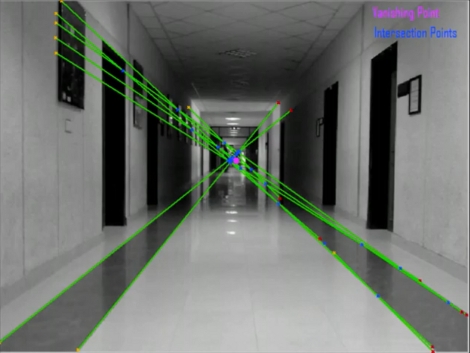
Students at the National University of Computer and Emerging Sciences in Pakistan have been working on a robot to assist the visually impaired. It looks pretty simple, just a mobile base that carries a laptop and a webcam. The bot doesn’t have a map of its environment, but instead uses vanishing point guidance. As you can see in the image above, each captured frame is analyzed for indicators of perspective, which can be extrapolated all the way to the vanishing point where the green lines above intersect. Here it’s using stripes on the floor, as well as the corners where the walls meet the ceiling to establish these lines. From the video after the break you can see that this method works, and perhaps with a little bit of averaging they could get the bot to drive straight with less zig-zagging.

Similar work on vanishing point navigation is being done at the University of Minnesota. [Pratap R. Tokekar’s] robot can also be seen after the break, zipping along the corridor and even making turns when it runs out of hallway.
Continue reading “Vanishing Point Robot Guidance”

Dance For A Dollar With The YayTM

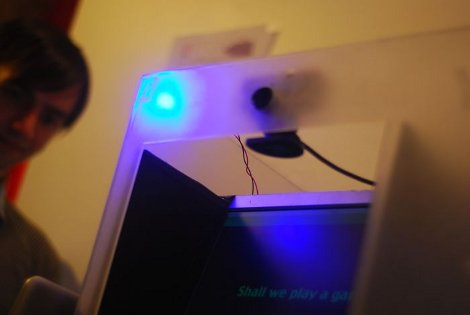
The YayTM is a device that records a person dancing and judges whether or not the dancing is “Good”. If the YayTM likes the dance, it will dispense a dollar for the dancers troubles. However, unless the dancer takes the time to read the fine print, they won’t realize that their silly dance is being uploaded to YouTube for the whole world to see. Cobbled together with not much more than a PC and a webcam,  the box uses facial recognition to track and rate the dancer.

The YayTM was made by [Zach Schwartz], a student at NYU, as a display piece for the schools Interactive Telecommunication Program. Unfortunately there aren’t any schematics or source code, but to be honest, having one of these evil embarrassing boxes around is probably enough. What song does the YayTM provide for dancing, you ask? Well, be sure to check it out here.

EDIT: [Zack] has followed up with an expanded writeup of the YayTM. Be sure to check out his new page with source code and more info. Thanks [Zack]!

Zipitbot

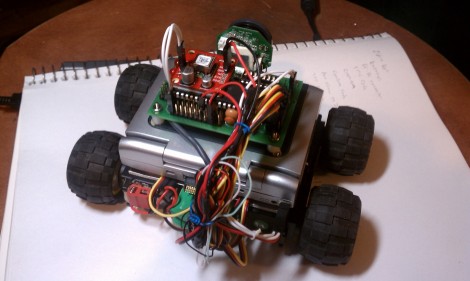
[Nulluser’s] Zipit was fine, but it couldn’t go anywhere on its own. Adding some motors and a microcontroller fixed that issue, and now he’s got a little robot called the Zipitbot. That’s a dsPIC board on top which communicates with the Zipit over an I2C bus. Four servo motors provide plenty of power to the wheels,with some extra battery packs nestled between them.

Since the Zipit is running Linux, and already has WiFi hardware, it’s not too hard to add Internet control. With this in mind there’s a webcam on the front to broadcast a video feed for use when controlling it remotely. See a couple of videos of this hack after the break.

Continue reading “Zipitbot”

Adding Pan And Tilt To A Webcam

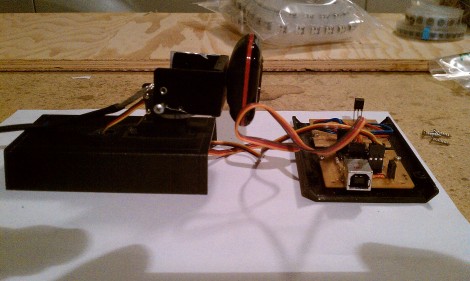
[Brent] and his wife wanted a way to provide more family time for Grandparents that lived far away. They tried a webcam, but their daughter just didn’t oblige by staying in the frame. Instead of chasing her around the room with with the camera he added pan and tilt features to the device. He settled on IR control using a common television remote, similar to our USB remote control receiver tutorial except that it drives servo motors instead of forwarding signals over the serial connection. [Brent] used a Picaxe 08M, connecting two servos together as a base on top of the project box. If you try this yourself there’s a lot of room to grow. Once you’ve assembled the hardware it wouldn’t be too hard to make this web enabled so that Grandpa can click on a web interface to look around the room.

Using Quality Optics With A Webcam

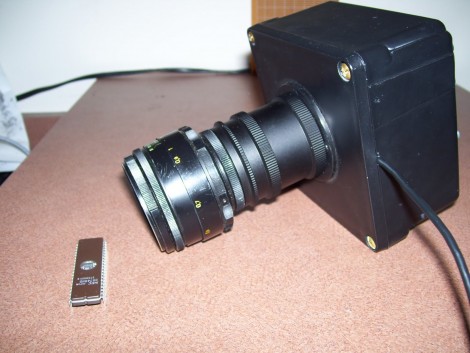
[Devon Croy] built a case to join a webcam sensor with a camera lens. The box is a PVC conduit box you’d find at a home center. He used JB Weld to attach four bolts to the back of the box. These are used to fine-tune the mounting plate for the webcam sensor to ensure it’s at the focal point of the lens. The lens connects through a couple of extension tubes to an adapter mounted in the center of the box’s cover plate. The setup above shows a macro lens that takes pretty good pictures.

If you need images of really tiny things you should look into a microscope adapter for your camera.

Nerf Sentry Turret

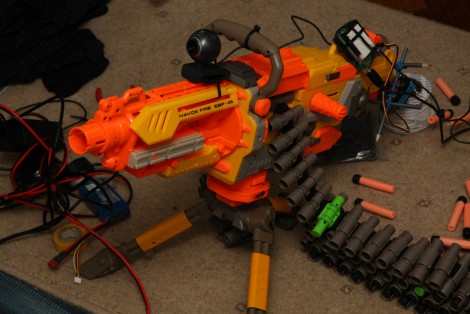
With exams behind him [Adam Greig] had time to make a Nerf sentry gun. It’s actually quite easy to pull everything together. He’s got a netbook running Motion, an open source motion sensing program for use with a webcam. When movement is detected an Arduino, connected via a USB cable, actuates a servo to pull the trigger of the gun. The turret itself has seen a battery upgrade that increases the firing speed. It’s fun to see hardware prototyping done with a few pencils and a fist full of cable ties. Check it out after the break.

This particular toy, the Nerf N-Strike Vulcan, has become quite a popular starting point for turrent projects. We’ve seen one that uses a motorized base, and another that was part of a final project at Cornell.

Continue reading “Nerf Sentry Turret”

Intelligent Ground Vehicle Competition 2010 Day One Report

The Intelligent Ground Vehicle Competition (IGVC) is the precursor to the DARPA Grand Challenge, and in many ways it is just as difficult. We have the pleasure of being at the competition this year with the Tennessee Technological University Autonomous Robotics Team. The teams at the competition pull off some amazing home-brew robotics, so we’ve decided to do a short section on some exemplary robotic hacking each day of the competition.

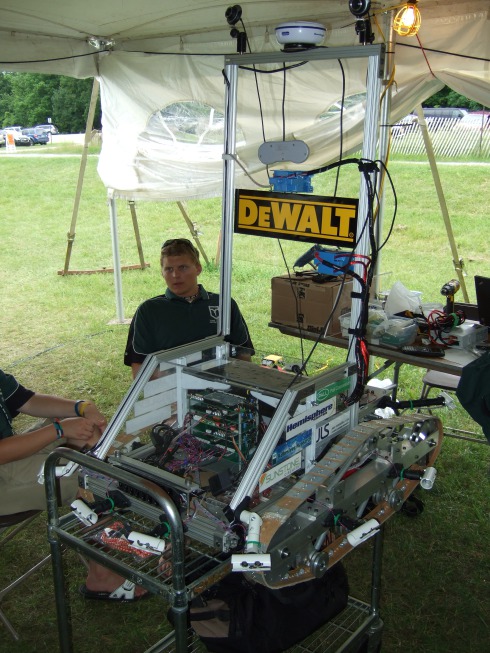
Today’s robot comes from the York College of Pennsylvania. The robot, dubbed “Green Lightning”, features an impressive set of custom made hardware.

We interviewed the team, and got a pretty thorough rundown of their robot with pictures after the jump. Continue reading “Intelligent Ground Vehicle Competition 2010 Day One Report”