Arduino RC Airplane

arduino_airplane

[Olivier] told us about this fantastic project where he built his own RC airplane. The airplane itself is nothing special, it is the controls that are worth paying attention to. He used an Arduino Diecemilla , some XBee transceivers, and a SparkFun Wee. The main site is a general overview, but there are links to more detailed breakdowns of how to build some of the parts. There are several videos of him flying it as well.

Wireless Arduino Programming With ZigBee


ZigBee is a low-power communication system using digital radios. It’s intended to be easier to work with than Bluetooth. Adafruit recently added an adapter board for Digi’s XBee product line and has put together a great how-to to show the devices potential. Using two XBee radios and adapters you can wirelessly program an Arduino board. This would be great if your Arduino was installed in an inaccessible area or maybe it’s over 100feet away from where you’re working. The radios do serial communication just fine. What the how-to covers is getting the reset line working so the Arduino can restart automatically after you program it. Once the radio pair is configured properly, it will pass the RTS line state directly from one device to the other.

Eavesdrop On Keyboards Wirelessly

[vimeo http://vimeo.com/2007855%5D

Every time you press a key on your keyboard, a small burst of electromagnetic radiation is let out. This radiation can be captured and decoded. Though it only affects some models, this is pretty serious. They tested 11 different keyboards and they were all vulnerable to at least one of the four methods of attack. Tests have shown that the data can be read through walls and up to 65 feet away. That is pretty scary stuff. Someone could be setting up in the apartment or office right next to yours to listen to every keystroke you type.  Check out the second video after the break.

Continue reading “Eavesdrop On Keyboards Wirelessly”

Wireless Accelerometer Controlled RGB LED

[Andlier] sent us this cool little project.  He has built a wireless accelerometer controlled RGB LED lighting system. Based on what a mouth full that is, it sounds complicated right? The end result looks fairly intuitive. Simply pick up the controller and tilt your hand to change the color of the light.

The controller consists of an Atmel AVR168 microcontroller. He doesn’t specify what transceiver he is using, but if you look in the comments, he notes that he added an antenna to it to extend the range. The part that controls the LED is based off of an Atmel AVR169 microcontroller hooked to some shiftbright LED modules.

Continue reading “Wireless Accelerometer Controlled RGB LED”

Xbox 360 Battery Pack Teardown

Reader, [Fox9p3400], opened up an Xbox 360 controller battery pack so we could all see what goes into one. It contains two Sanyo 2100mAh NiMH AA rechargeables (Model HR-3U 1.2V). In addition to that, there is an Atmel microcontroller (not pictured) and the copper temperature probe you can see above. He has more pictures on Photobucket.

Xbox 360 Wireless Visual Interface

[jon barber] pointed out another great project on the benheck forums that hasn’t gotten much attention. [techknott] built a wireless video interface for his Xbox 360. Think of it as a sort of video game thin client. It has the form-factor of a portable but doesn’t include the 360’s components. Instead it has a 1.2GHz A/V receiver and the guts of a wireless controller. The specific transmitter was chosen because it wouldn’t interfere with the 2.4GHz controller. The power supply is two 2600mAh batteries running at 7.5V with a built in charging circuit. The draw from the screen is ~500mA. The entire unit is 1 inch thick.

Wifi Robot : A Hacked WRT54GL Rover

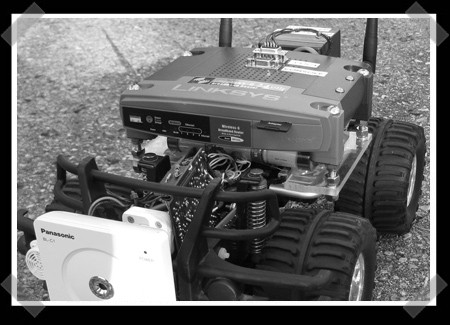
[Jon Bennett] sent us this link to his Wifi Robot. After playing with a Linksys WRT54GL router, he was inspired to build something that would utilize this embedded Linux system. Using a thrift store R/C truck, he built a wireless robot rover. This thing can be controlled over the internet, or by laptop with a range of about 500 meters.

The router has been modified to have 2 Serial ports and a 1GB SD Card. It connects to a micro controller, which could be an Arduino or AVR Butterfly. He has supplied information for both. The truck has been mostly gutted, leaving only the chassis and electronics. He had to beef up some of the truck electronics when they fried under the load. The entire unit is powered by a pair of 7.2 Volt 3800 mAh battery packs. The most important thing on the list though, is the horn. You can honk the horn while you are driving this thing around.

The site supplies tons of information including pictures of his build, videos of it in action, speed tests, schematics, software downloads, and resource links. Great job [Jon].