
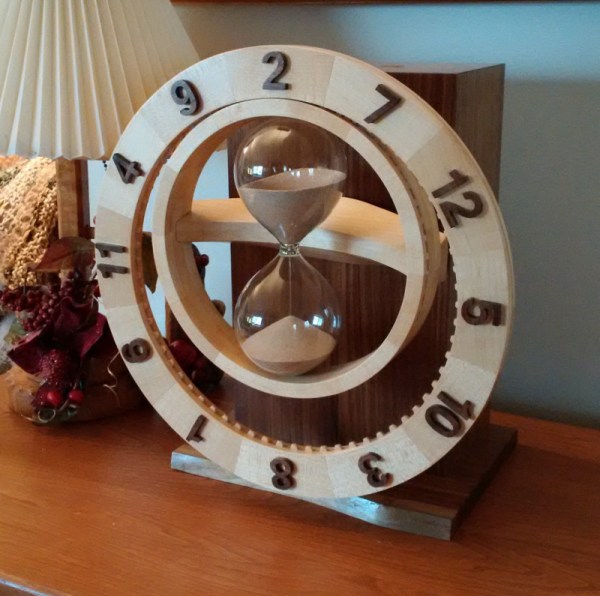
Once upon a time, [Mike] bought an hourglass for his sister. He intended to build it into a clock and give it to her as a gift, but life and other projects got in the way. Fast forward a couple of decades to the point when it all came together and [Mike] had everything he needed on hand to build a beautiful wooden clock that automatically flips the hourglass over.
Every 60 minutes, the bulb, which is situated inside a handcrafted maple ring, rotates 180 degrees to restart the flow of sand. Whatever number is at the top of the outer wheel denotes the current hour. The digit for the next hour is always at the five o’clock position relative to the current hour. This works out because the pockets on the outside of the bulb’s ring share a 5:6 ratio with the gear teeth on the outer ring. Confused? Watch the time-lapse video from [Mike]’s that shows it in action.
[Mike] was determined to build this clock using only things he already had on hand, like a cheap digital watch to keep time and a car window motor to rotate the hourglass. He hacked a USB port into the watch so he could use the hourly chime function to trigger the motor through a quad op-amp. The motor runs until it is triggered to shut off optically—a pair of slits cut into the gear that moves the hourglass pass over a sensor. [Mike] built a beautiful box to hold the guts from a nice piece of walnut and spared no detail in the design.
There are a ton of build pictures on the projects site and an in-depth video tour of the clock, which is embedded after the break. Whether they are designed to amaze or confuse, we love a good clock build around here. If you’re into hourglasses, we featured a digital version not too long ago.
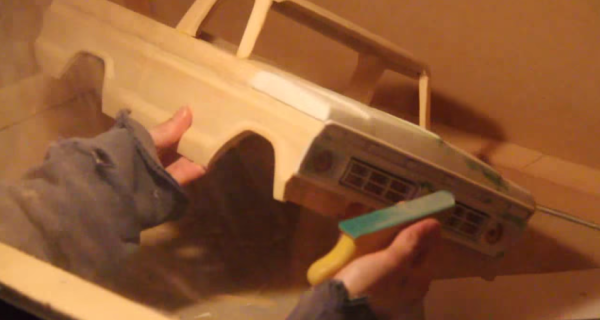
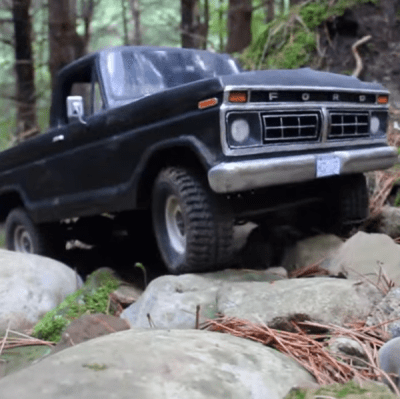 The build starts with the slab sides of the truck. The basic outline is cut into a piece of lumber which is then split with a handsaw to create a left and a right side. From there, [Headquake137’s] uses a Dremel to carve away anything that doesn’t look like a 1977 F100. He adds pieces of wood for the roof, hood, tailgate, and the rest of the major body panels. Small details like the grille and instrument panel are created with white polystyrene sheet, an easy to cut material often used by train and car modelers.








