Wireless Sniffing and Jamming of Chronos and iclicker

posted Jan 25th 2011 3:00pm by
filed under: radio hacks, security hacks, wireless hacks

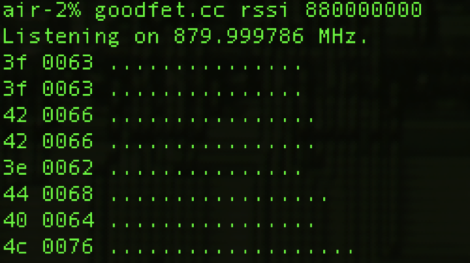
The ubiquitous presence of wireless devices combined with easy access to powerful RF development platforms makes the everyday world around us a wireless hacker’s playground. Yesterday [Travis Goodspeed] posted an article showing how goodfet.cc can be used to sniff wireless traffic and also to jam a given frequency. We’ve previously covered the work of [Travis] in pulling raw data from the IM-ME spectrum analyzer, which also uses goodfet.cc.

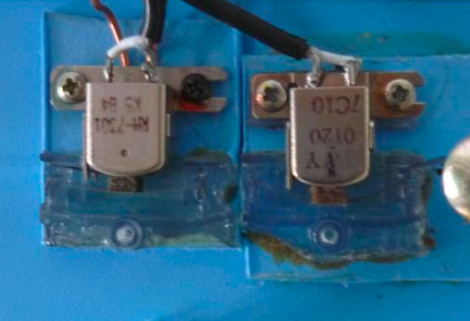
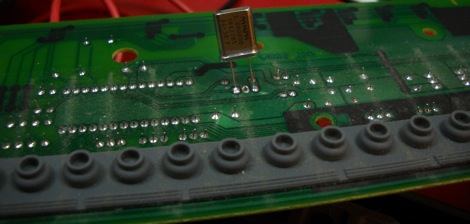
The Texas Instruments Chronos watch dev platform contains a C1110 chip, which among other things can provide accelerometer data from the watch to an interested sniffer. The i>clicker classroom response device (which houses a XE1203F chip) is also wide open to this, yielding juicy info about your classmates’ voting behaviour. There is still some work to be done to improve goodfet.cc, and [Travis] pays in beer–not in advance, mind you.

With products like the Chronos representing a move towards personal-area wireless networks, this sort of security hole might eventually have implications to individual privacy of, for example, biometric data–although how that might be exploited is another topic. Related to this idea is that of sniffable RFID card data. How does the increasing adoption of short-range wireless technologies affects us, both for good and bad? We invite you to share your ideas in the comments.

Phosphorescent Laser Painting

posted Jan 18th 2011 9:09am by
filed under: laser hacks, video hacks

Here’s a simple and interesting idea that increases the visual persistence of a laser scanner image. Using glow-in-the-dark paint, [Daito Manabe] prepares a surface so that the intense light of a laser leaves a trace that fades slowly over time. He’s using the idea to print monochromatic images onto the treated surface, starting with the darkest areas and ending with the lightest. The effect is quite interesting, as the image starts out seeming quite abstract but reveals its self with more detail over time.

As evidenced in the test videos, the bursts of laser scanning are matched to the fade rate of the paint. Therefore it would seem that the time taken to “write” an image is directly proportional to the desired visual persistence of the final image. We wonder, by combining clever timing and variable laser intensity could you write images much more quickly? How hard would it be to use this for moving pictures? With the ability to create your own tiny laser projector, and even an RGB scanner, there must be a lot of potential in this idea for mind-blowing visual effects. Add portability by using a phosphor-treated projection screen!

Share your ideas and check out the test videos after the break.

Read the rest of this entry »


Intro to Circuit Bending

posted Jan 11th 2011 3:00pm by
filed under: digital audio hacks, how-to, musical hacks, toy hacks

Electronic musical instruments are a lot of fun for a hacker because, with a small palette of tools, know-how and curiosity, they are easily modified. As with any hack, there is always the chance that the subject will be ruined, so it’s not necessarily worth the risk to muck about inside your thousand-dollar pro synthesizer. Luckily for all of us, there are shovel-fulls of old electronic musical toys littering the curbs and second-hand shops of the world. These fun little devices provide ample opportunity to get familiar with audio electronics and circuit bending techniques.

A note on definitions: the term “circuit bending” can be synonymous with “hardware hacking” in the world of audio electronics, and we have seen some debate as to which term is better suited to a given project. We welcome you to share your viewpoints in the comments.

Keep reading to get started.
Read the rest of this entry »

Quiet Dust Extractor from Scavenged Materials

posted Jan 5th 2011 3:30pm by
filed under: tool hacks

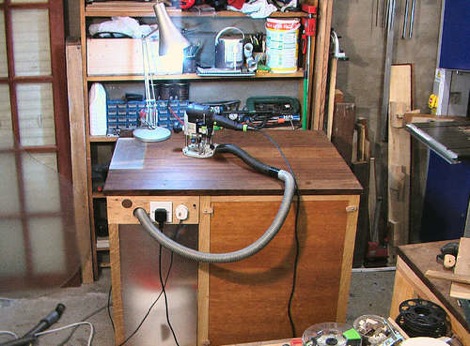
As with many of the projects covered on hackaday, [bongodrummer]‘s Dust Sniper came about because of a lack of effective commercial solutions, in this case to the problem of quiet dust extraction.

Workshops are generally full of dust and noise, both of which take their toll on the human body. This is why safety regulations exist for noisy and dusty workplaces and–as [bongodrummer] rightly points out–we have to take precautions in our own home and community workshops. Hearing protectors, dust masks and safety goggles are integral, but reducing the amount of dust and noise in the fist place is paramount.

Using mostly scavenged materials [bongodrummer] did a quality job building the Dust Sniper–and all for a bill of materials totaling £20. It has an integrated work surface, automatic switches on 2 vacuum lines to sync up with power tools, a cyclonic air filter that prevents clogging the HEPA filter and reducing suction power, inlet and outlet soundproofing, and a plain old power outlet for good measure.

Whether or not you’re interested in building an integrated workbench/extractor system like this one, we recommend you check out the details of the cyclone filter and the sound reducing components. Not only are they an interesting read, but they could be useful to apply in other projects, for example a soldering station with fume hood.

We think it would be really neat to include more cyclones in our projects. Stick around after the break to see [bongodrummer]‘s prototype cyclone filter in action.

Read the rest of this entry »

Tape delay made from recycled cassette decks

posted Dec 20th 2010 12:00pm by
filed under: classic hacks, digital audio hacks, musical hacks

Professional tape delay units are great fun, but often expensive. You’d think that with so many derelict cassette decks filling the world’s dumpsters someone must have figured out a way to make a cheap tape delay… not only in the interest of saving money (sometimes quality is worth paying for) but also in the interest of re-using otherwise wasted resources.

Forosdeelectronica forum user [Dano] has made just such a device from used cassette decks and miscellaneous parts (translated). First he investigated the operation of the playback, erase, and record mechanisms and broke out the tape heads. The playback head is on a plastic rail so that the delay time can be changed, while the record head is fixed. [Dano] encountered some difficulties in ensuring good quality for the recording and erasure, which is an important consideration when working with magnetic tape.

Read the rest of this entry »


If you’re photographing and you know it clap your hands

posted Dec 18th 2010 12:00pm by
filed under: digital audio hacks, digital cameras hacks

If you’ve ever tried to take pictures of yourself you’ll know that it can be a pain. It’s especially hard to get that perfect shot of your godly features when you’re out of breath from sprinting across the room. OK, yes, they have remote controls for that. But what if you lost your remote or you just don’t want to have to carry it? [LucidScience] put together a sweet, um, “hands free” alternative.

Essentially this hack emulates the IR signals sent by a Nikon remote, either to take a picture right away or to take time lapse photographs at regular intervals. We’ve seen a similar time lapse remote using an arduino before and a really thorough one using an AVR, but they don’t take the same approach as [LucidScience]‘s design in terms of monitoring a microphone input for triggering. The project includes several status LEDs and adjustments for ambient noise and triggering, and it can be mounted to the camera body. We wonder how many of the Nikon’s features could be controlled using clap encoding, and how detailed your timing would need to be to have a kind of hand-made (get it?) pulsetrain syntax.  You’d probably need to have world record clap skills.

Check out the demo vid after the break.

Read the rest of this entry »

Rich Decibel’s Kequencer

posted Dec 17th 2010 1:00pm by
filed under: digital audio hacks, musical hacks

It’s totally excellent when a simple concept results in something inspiring and fun. [Rich Decibel]‘s Kequencer is a good example, starting off as many projects do: “I had an idea the other day and I couldn’t decide if it was good or not so I just built it to find out.” Be still our hackable hearts!

[Rich] built this sleek little sequencer from scratch and while the design may not seem very novel to begin with–eight square wave oscillators with on/off switches and pitch knobs, played in sequence–but the beauty of it is in the nuances of interaction and the potential for further hacking. From watching the video you can see how the controls can be used in very interesting ways to create and mutate adorable chippy tone patterns. Check it out after the crossfade.

Read the rest of this entry »

EEG the Locomotion

posted Dec 10th 2010 6:00am by
filed under: Medical hacks, transportation hacks, wearable hacks

The use of brainwaves as control parameters for electronic systems is becoming quite widespread. The types of signals that we have access to are still quite primitive compared to what we might aspire to in our cyberpunk fantasies, but they’re a step in the right direction.

A very tempting aspect of accessing brain signals is that it can be used to circumvent physical limitations. [Jerkey] demonstrates this with his DIY brain-controlled electric wheelchair that can move people who wouldn’t otherwise have the capacity to operate joystick controls. The approach is direct, using a laptop to marshall EEG data which is passed to an arduino that simulates joystick operations for the control board of the wheelchair. From experience we know that it can be difficult to control EEGs off-the-bat, and [Jerky]‘s warnings at the beginning of the instructable about having a spotter with their finger on the “off” switch should well be followed. Maybe some automated collision avoidance would be useful to include.

We’ve covered voice-operated wheelchairs before, and we’d like to know how the two types of control would stack up against one another. EEGs are more immediate than speech, but we imagine that they’re harder to control.

It would be interesting albeit somewhat trivial to see an extension of [Jerkey]‘s technique as a way to control an ROV like Oberon, although depending on the faculties of the operator the speech control could be difficult (would that make it more convincing as an alien robot diplomat?).


Hack a Day serves up fresh hacks each day, every day from around the web as well as hacking related news.

Send us your hacks


Hacks

Resources