A Wooden Engine Powered By Compressed Air

posted Dec 17th 2011 12:03pm by
filed under: Engine Hacks, misc hacks

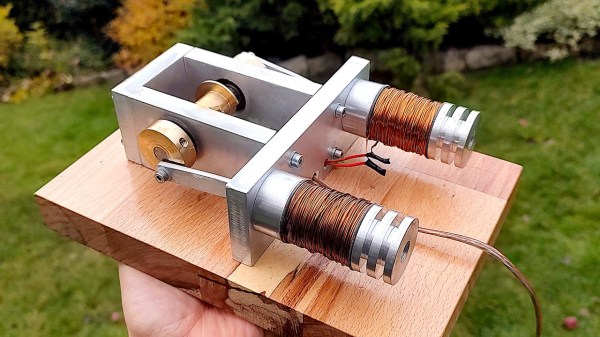
You may have seen an air powered engine at some point, but most are made out of some sort of metal. This engine, however, is made entirely out of wood (and fasteners). One might wonder how a design like this was conceived, but this may be explained by [Woodgears.ca's] tagline: “An engineer’s approach to woodworking.”  It should also be noted that this is actually [Matthias'] sequel to  “Wooden Air Engine 1.

The engine itself is a neat device in that it uses power from compressed air (or suction from a vacuum cleaner) to make the piston and connecting rod cycle back and forth to spin a flywheel.  The other connecting rod is used to switch which side of the “clyinder” received air pressure (or vacuum).  A really neat mechanical assembly, and one that took a good amount of skill to make out of wood.  Check out the video after the break to see how it all works!

If you’d like your woodworking to be more automatic, check out this post about how to set up a CNC router for your personal use.

Engine Hacks – A DIY Methane Generator

posted Sep 11th 2011 6:00am by
filed under: chemistry hacks, Engine Hacks, green hacks

Engine Hacks Theme banner

All “methane generator” jokes aside, This one actually serves a useful purpose. Although not an engine hack per se, methane can be used to run an engine. As the traditional method of powering an internal combustion engine, gasoline, gets more and more expensive, alternatives will have to be found. If you happen to live on a farm, or have access to a source of organic waste, this method could serve as a viable one.

One would need quite a bit of waste, as each kilogram yields around 400 liters of methane gas. This amount is enough to run a gas light for around 4 hours. Any sort of useful engine would require quite a bit more than this (chicken farm possibly?).

A process for converting waste to fuel is illustrated in the video after the break. Extreme caution should be used if attempting to do something like this. There is a danger of not only flammable gas leaking and catching on fire or exploding, but the organic material can be quite toxic as well. Read the rest of this entry »


Engine Hacks: Build a turbojet from junkyard parts

posted Sep 10th 2011 6:00am by
filed under: Engine Hacks

Turbo chargers from cars are readily available and easily modified, so why not modify a turbo into a jet engine?

While [Mike]‘s junkyard jet made the rounds on the Internet over a decade ago, the theory behind the homebrew turbojet is still sound. After pulling a turbo out of a 1983 Nissan Pulsar, [Mike] built a combustion chamber out of 2-inch pipe fittings. The propane fuel is ignited with a simple motorcycle spark plug and produces a hot and powerful blast of air twenty feet from the exhaust.

We suppose [Mike] wasn’t satisfied with such a puny engine made out of junk, so he decided to step it up a notch and improve his engine. After some development, [Mike] managed to build another jet out of a larger turbo that doesn’t require a constant spark. The newer engine produces ‘hurricane force wind’ 10 feet from the exhaust. We’re not sure how much thrust that translates into, but we’re a little surprised this engine hasn’t been mounted to a go-kart yet.

Check out the walk through and demo of the junkyard jet after the break.

Read the rest of this entry »

Engine Hacks – Tesla turbines

posted Sep 9th 2011 6:00am by
filed under: Engine Hacks, news

Engine Hacks Theme banner

You probably weren’t expecting a project based on [Nikola Tesla's] work to show up during the Engine Hacks theme. Most people know of him because of his pioneering work with high voltage equipment. Never the less, [Tesla] designed a device that later became known as the Tesla Turbine. Tesla turbines are made out of a series of thin disks attached to a central rotor. Air or steam is injected into the closed turbine housing at the outer edge of the disks. It swirls around through the turbine blades and eventually exits near the rotor. This type of turbine can achieve very high rotational speeds but doesn’t have a lot of torque, which limits their usefulness. Check out this instructable that shows you how to build your own Tesla turbine out of hard drive platters.

We have featured a Tesla turbine in the past on Hackaday. In this previous post, [Rick] shows us how to carve a pumpkin with a skill saw blade that is powered by one of these turbines.

Engine Hacks: Riquimbilis, or: what we’d do if we couldn’t buy a car

posted Sep 8th 2011 6:00am by
filed under: Engine Hacks, transportation hacks

Engine Hacks Theme banner

After the United States enacted a near-total economic embargo against Cuba in 1962, American export of Detroit Iron came to a halt. Since then, some Cubans have been lucky enough to own a classic Chevy or Buick. Soviet imports of Volgas stopped in the 1990s. With a dearth of any sort of motorized transport (and a public transport system that’s even worse than America’s), some Cubans went with the only reasonable solution: they built Rikimbilis, bicycles and engines hacked together into a moped.

Most rikimbilis are based around Chinese bicycles with a motor ‘obtained’ through ‘non-conventional means’. The exhaust can be fabricated from just about any metal tube available, and a plastic soda bottle is the gas tank of choice. Everything on these bikes is done for reasons of economy and availability, and the fuel efficiency is unbeatable with some rikinbilis getting 120 mpg.

Because they’re not especially safe, Riquimbilis are illegal in Cuba, but the police generally turn a blind eye to their use. Lately the Cuban government has begun cracking down on riquimbilis, but with not many cars to go around these machines of necessity will most likely continue plying Havana boulevards.


Engine Hacks: Electric drill made into a trolling motor

posted Sep 7th 2011 6:00am by
filed under: Engine Hacks, tool hacks, transportation hacks

We knew our engine hacks theme would come down to an argument over the difference between “a motor” and “an engine” so after much deliberation, name calling, restraining orders, and a duel we’re happy to put up [Berto]‘s DIY trolling motor made out of an electric drill. The project is probably inspired by [Berto]‘s collapsible amphibious e-scooter that used the same electric drill propulsion setup.

The build is just a few pieces of wood, drill rod, some hardware and a prop. Definitely not the most complicated build. This isn’t the speediest motor ever when attached to a canoe, and isn’t meant to be a primary means of propulsion. That’s not a problem for this build – trolling motors aren’t designed to be fast or powerful. There’s no word on how much thrust [Berto]‘s motor can put out, but it is a nice bit of MacGyverism to build a boat motor out of spare parts.

Check out the build walk though video after the break to see the motor in action.

Read the rest of this entry »

Engine Hacks: Snow chucking — because snow blowing is for commoners

posted Sep 6th 2011 6:00am by
filed under: Engine Hacks

Engine Hacks Theme banner

Winter’s coming, and you don’t want to be outdone by your neighbor’s new snow blower. We think it’s pretty safe to say you’ll be the envy of gearheads throughout the neighborhood if you can build your own snow blower around a V8 engine. [Kai Grundt] is a metal fabricator by day and a horror movie prop yard implement builder by night. He pulled the engine out of his Chevy truck and then filled in parts around it to make this 412 HP snow blower.

The tank treads that it rides are each have their own dedicated hydraulic pump, making it easy to drive and steer this 800 pound whale. One of the first orders of business for the beast was to throw snow from two houses away, burying his buddy’s car. That’s the price you pay for laughing in a guy’s face when he describes his next project. It sounds like [Kai] was planning on selling kits so you could more easily replicate the build, but we couldn’t find any additional info on that. If you’ve got the details, please let us know by leaving a comment.

[Thanks Danman1453]

Engine Hacks: A pulse jet UAV by any other name would still be a cruise missile

posted Sep 5th 2011 6:00am by
filed under: Engine Hacks, gps hacks

Imagine our surprise when we learned [Bruce Simpson], who made headlines in 2003 with his $5000 DIY cruise missile, is still alive, not illegally interned in a black ops prison, and still doing what he does best: building really awesome remote-control airplanes.

The first successful mass-produced pulse jet aircraft was the German V-1 flying bomb. The V-1 had a very primitive guidance system, but the unmanned pulse jet aircraft quickly evolved into a few target drones used by the US Air Force. There was never any significant advancement towards improving the fuel consumption, noise level, or heat signature of pulse jets, so they were superseded by the superior turbojet. Despite their failings, pulse jets are remarkably easy to build and amazingly fast.

Instead of being antagonized by the New Zealand and United States governments, [Bruce] spends most of his time now working on pulse jet projects. He’s flown quite a few modified R/C planes and has an electronic Engine Control Unit for his jets. One of his most impressive projects is the 100 pound thrust pulse jet that was later attached to a go-kart. His no weld version of a pulse jet can be built in even the most minimalist work shop and is the epitome of an easy-to-build jet engine.

To get an idea of how fast [Bruce]‘s planes can be, check out his Long-EZ R/C pulse jet in action after the break.

Read the rest of this entry »


Hack a Day serves up fresh hacks each day, every day from around the web as well as hacking related news.

Send us your hacks


Hacks

Resources