posted May 3rd 2010 3:19pm by
Mike Szczys
filed under:
iphone hacks,
ipod hacks

A method to Jailbreak the new 3.1.3 iPhone rom is here and it does away with tethering. Tethering is the problem that arose from the blackra1n exploit requiring a computer to reboot the iPhone. Although we saw a hardware workaround for that, it’s much nicer to do away with the issue completely. The new exploit is called Spirit and we found the site was getting hammered earlier so you should check out the writeup over at Redmond Pie if you can’t get through with the link at the top.
[Thanks Xb0xGuru via iPhone Hacks]
posted Apr 28th 2010 9:00am by
Phil Burgess
filed under:
android hacks,
classic hacks,
cons,
hardware,
iphone hacks,
ipod hacks,
led hacks,
linux hacks,
news,
robots hacks

Ah, the heady aroma of damp engineers! It’s raining in Silicon Valley, where the 2010 Embedded Systems Conference is getting off the ground at San Jose’s McEnery Convention Center.
ESC is primarily an industry event. In the past there’s been some lighter fare such as Parallax, Inc. representing the hobbyist market and giant robot giraffes walking the expo. With the economy now turned sour, the show floor lately is just a bit smaller and the focus more businesslike. Still, nestled between components intended to sell by the millions and oscilloscopes costing more than some cars, one can still find a few nifty technology products well within the budget of most Hack a Day readers, along with a few good classic hacks and tech demos…
Read the rest of this entry »
posted Apr 6th 2010 10:00am by
Mike Szczys
filed under:
ipod hacks,
teardown

Sure, tearing down devices to see what components are in there is fun. But tearing down the components themselves is even more fun. iFixit sent off their iPad guts to be laid bare after they were done with their iPad teardown. We’ve seen pictures of stripped chips in the past, but the work that Chipworks is doing for iFixit is quite amazing. Get the skinny on just about every part in there from the package markings and the die photos provided in their analysis.
The iPad has already been rooted, but you never know what power can be unlocked if you know what you’re working with. We’re thinking of the 50MHz to 100Mhz oscilloscope hack.
posted Apr 3rd 2010 3:13pm by
Jakob Griffith
filed under:
ipod hacks,
peripherals hacks,
teardown

Its been quite a while since we’ve featured something from iFixit. But when we saw they had torn apart the next greatest Apple product, the iPad – released today, and how everyone on our team loves it, we thought why not also let our user base enjoy the destruction informative teardown as well.
In both the original and the FCC teardown, we see some awesome features and tricks Apple implemented. Most notably the two separate 3.75V lithium polymer cells, not soldered to the motherboard, allowing users to easily replace the battery if need be. However, in the opposite respect, more components than ever are being epoxied to the board, making the iPad much more rugged.
We’re left wondering, with everyone able to see the beautiful insides, does it change anyone’s mind on getting an iPad? Or would you rather make your own?
posted Apr 1st 2010 10:14am by
Mike Szczys
filed under:
iphone hacks,
ipod hacks

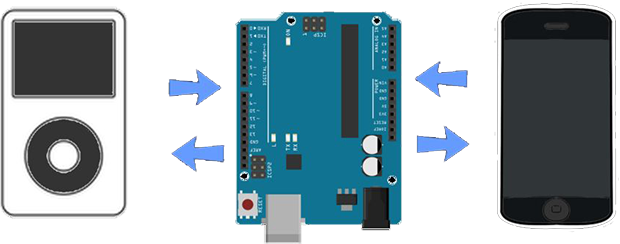
[David Findlay] has been hard at work on his Arduino iPod remote library and is now showing off some Wii Nunchuck control in the video after the break. When we looked in on his work in September he was using a Staples Easy Button to control the iPod. Now he’s added all of the functionality for iPod simple remote mode, and most of the advanced mode.
Advanced mode works well with his iPod Photo but the iPhone just returns errors. We know that Apple uses some tricks to keep unauthorized accessories out, so we hope that [David] finds a way to sniff out the necessary accessory protocols from an approved model.
Read the rest of this entry »
posted Mar 29th 2010 11:57am by
Mike Szczys
filed under:
iphone hacks,
ipod hacks

It seems a bit late to the party, but Microchip has just announced a family of PIC development boards for Apple products. The three offerings include a digital audio development kit, 8-bit accessory development and charging kit, and a 16-bit accessory development and charging kit for iPhone or iPod.
We’ve seen a lot of homebrew Apple addons that use microcontrollers. This not only takes the hardware interface to the next level, it does it with Apple’s blessing. But somehow that doesn’t seem like quite as much fun.
[Thanks Juan]
posted Feb 17th 2010 10:43am by
Mike Szczys
filed under:
ipod hacks

This track is awful, someone skip it! This project does just that with a wave of your hand. A laser beam shines across a room and, when obstructed, it sends a command to an iPod. One wave pauses playback, two waves skips to the next track, and a constant obstruction jumps backward one track.
They’re using a textile-compatible electronics platform called Schemer. This is the first time we’ve run across this product which uses a modular system to connect devices via a 1-wire communications bus.
No matter what hardware you use the concept is what interests us. There’s no shortage of iPod remote projects to draw on as examples. This method seems a bit more fun than banging your head for track changes or slapping wildly at an over-sized remote. We’re just a bit concerned about the power consumption of the laser-pointer, perhaps an IR beam would be a more economical choice?
posted Feb 13th 2010 12:00pm by
Mike Szczys
filed under:
ipod hacks

The headphone remote for the third generation iPod shuffle has a special chip that identifies it to the iPod itself. [David Carne] posted an in-depth report about the process he used to reverse engineering that protocol. He’s discovered that the remote uses a peculiar signal to identify it as authentic when the device powers up. We’ve talked about Apple’s use of peripheral authorization before and it seems this is no different. [David] did manage to emulate the authentication using an ATmega88. If you’ve got a shuffle 3G sitting around this info will allow you to operate it with a microcontroller in your next project.