[Rosenberger31] did a nice job of adding a USB port to his 2010 Toyota Prius. He removed the access door on the console where the traditional “cigarette lighter” 12 volt port is located. A Dynex 12-volt to USB adapter was piggy-backed onto the power lines and the USB connector was then fit into the blank accessory plate next to it.
There is no data connection here, the port only provides 5v regulated power to devices plugged into it. None the less, it is still a pretty nice looking alternative to having a power adapter hanging out of the dash all the times. If you try this, heed one of the warnings from the comments and make sure you add a switch if you vehicle powers the 12 volt port even when the car is not running.
This makes us wonder: will this void your warranty?
Reader [Philippe] tipped us off about this video showing a set of subway steps being turned into a piano keyboard (english translation). The creators wanted to make taking the stairs rather than riding the escalator a bit more fun. They added pressure sensors to each step, then covered them with white and black keys to resemble a keyboard. When a passenger puts their weight on a step, the corresponding pitch is played out loud.
We may have lied in the title as this doesn’t really compare to hearing Josh Bell play for pocket change at your train stop. But coming across this setup on an otherwise mundane commute would really brighten up our day.
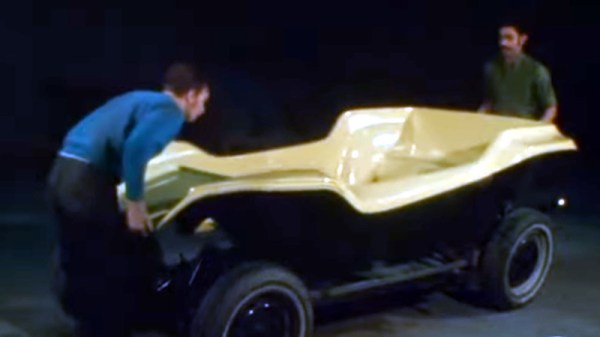
Who wouldn’t want a DeLorean, honestly it has to be the one of the coolest cars around, what with its gull wing doors and stainless steel siding. Joking aside [Tom Neiland] and [Dave Delman] went even further, creating eD, the electric DeLorean. It contains around 910 pounds of deep cycle lead batteries, custom transmission adapter plate, and a WarP 9 DC motor controlled by a water cooled 2000 amp Z2K-HV, all together to produce 200 horsepower reaching over 85 miles per hour.
The project cost ended up around $18,000 and they plan to add even more including a digital dash and Lithium batteries to extend the cars travel distance from the currently limited 30-40 miles on a single charge. Unfortunately the two couldn’t get their flux capacitor working, but we feel Dr. Brown would still be proud. Check out a video after the break and the writeup at Jameco.
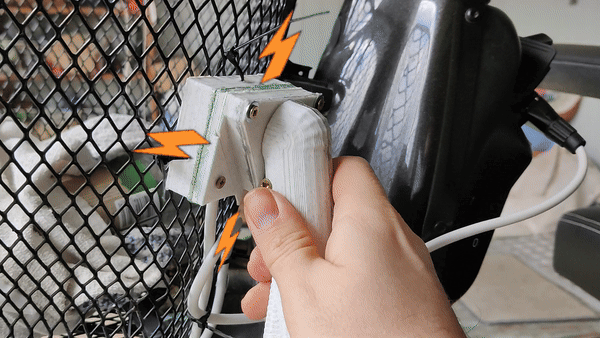
Want to be visible when cycling at night? [Neon Dean] came up with this possible solution, which he cruised on at Nuit Blanche. Its a bicycle with neon lights mounted on every surface possible. [Dean], who gave a similar treatment to his car, explained how it worked. All of the tubes take their power from a 12VDC battery he carries in a fanny pack. 12V is a far too low voltage to power the tubes, so a step up transformer is used to bring that number way up. [Dean] also decided to install a neon tube on each wheel. In order to deliver power to them, he mounted a rotor on each wheel, with two conductive tracks running close to the edge of each rotor. Two strips of steel act as brushes (in a manner similar to those on slot cars), and deliver the stepped-up power to the tubes. One creative, but perhaps not so bright, idea is [Dean]’s neon tube helmet.
As part of a “disruptive technologies” course at the United States Military Academy, [Roy D. Ragsdale] produced a working prototype of a Google Street View-like system called PhotoTrail. Like its corporate-backed inspiration, the system captures georeferenced 360-degree panoramas that can be viewed interactively in a web browser…but at a hardware cost of only around $300. [Ragsdale’s] prototype is based entirely on consumer-grade off-the-shelf components and open source software, all tied together by the yin and yang of DIY: foam core board and a few Python scripts.
This article from IEEE Spectrum magazine provides some background on the selection of parts and construction of the system, including a hardware shopping list and a list of links to all of the open source packages used.
The PhotoTrail prototype is surprisingly small and lightweight. A vehicle isn’t even required; the camera array can be carried overhead by a single person, making it possible to capture remote locations. But [Roy] expects future revisions to be even smaller and less obtrusive, perhaps mounted to a headband. Mount Everest awaits!
This jet powered carousel is brought to you by the Madagascar Institute. They convene, or collide, to create large scale art, sculptures, and rides. This one seems to fit the last definition. The two gentlemen are strapped to a jet powered carousel. It actually looks pretty fun, but we would have been needing some fresh shorts after the jet bursts into flames near the end. He didn’t seem too concerned, he wasn’t screaming and flailing his arms at least.
[Terence Bordelon] sent in his impressive UAV (Unmanned Arial Vehicle). The hack is a culmination of his other projects. It can be turned to fully automatic at the flip of a switch. It will fly itself to gps way points, land, and take off. The UAV has a range of 100km thanks to his home built RF Unit which runs on ham bands. The brains of the setup is his custom IMU (Inertial Measurement Unit). The unit is controlled by his ground station which either allows him to fly it normally or toggle through the various modes. [Terrence] is also a game developer and has worked on many popular titles such as Zoo Tycoon 2 and Ratchet and Clank.
in 1983, [Steve Roberts] packed up a Tandy 100 laptop and a 5-watt solar panel, fleeing suburbia on his recumbentbicycle on what would become a 17,000 mile journey that forever cemented his place in the geek pantheon…not just as a technology hacker, but as one of the preeminent “life hackers,” pursuing his own dreams on his own terms and inspiring others to do the same.
In this 1989 video, recently unearthed by Hack a Day, [Roberts] reflects on the first 16,000 miles of his voyage, detailing some of the technology that went into his then-current ride, the Winnebiko II.
[Jair2k4] learned the hard way not to lend out your expensive GPS to untrustworthy people. His Garmin 200 was returned with a broken USB port and unable to charge. Luckily, all it took was some inventive thinking and he had it repaired in no time. By breaking open a Nokia cellphone car charger, he had a source of 5 volts. After that, it was only a matter of soldering the connections. However, not content with the design he pulled out a Dremel and mounted it in his 1991 Suzuki Sidekick. Quick, dirty, and actually working afterwords, just the way we like it.
We were a little surprised when we learned the Mazda RX7’s high beams were controlled by ECU, compared to typical cars using just a toggle switch. Ubermodder [Trent Bruce] realized how much of a pain in the rear end this can be if the ECU ever burns out, meaning no brights. By using a D-Flip Flop setup in a toggle configuration, he is able to control his once lost high beams. He also points out that if you plan to do any other electronic modifications to the RX7, you should be sure to pay attention to the unusual ground switching and the other crazy wiring under the hood.