posted Feb 27th 2009 5:25pm by
Eliot Phillips
filed under:
home hacks,
news,
wireless hacks

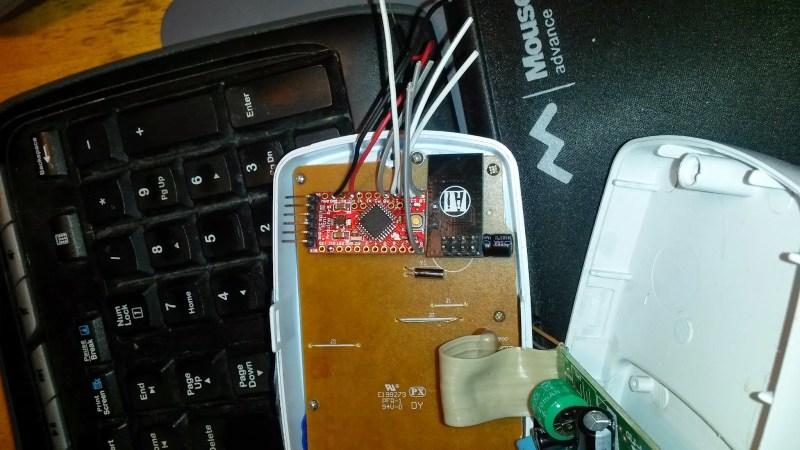
The team behind the the Tweet-a-Watt/Wattcher just won first prize at the Greener Gadgets design competition. The device is a hacked Kill A Watt that transmits power consumption using an XBee. After checking out DVICE’s preview of the competitors yesterday, we’re happy to see a prototype win instead of just a concept sketch.
posted Jan 24th 2009 8:30pm by
Eliot Phillips
filed under:
home hacks,
tool hacks

You probably saw [Phillip Torrone] and [Limor Fried]’s twittering Kill A Watt earlier this week. It was an entry in the Core77/Greener Gadgets Design Competition. We saw a little bit about how it was assembled, but now they’ve posted a full guide to assembling the hardware. Each Kill A Watt gets an XBee radio that transmits back to a receiver that logs the power usage. The difficult part when putting this design together was the XBee required 50mA when transmitting. This is well above the Kill A Watt’s internal power supply. They remedied this by adding a 10,000uF supercap to act as a rechargeable battery. The daily twittering is just a side-effect of the project. The Kill A Watts transmit every 2 seconds, so you’ll get a very accurate report of your power usage. This is a great project for renters who can’t permanently modify their power infrastructure. Each Kill A Watt can support quite a few appliances since they’re rated for 15A, ~1800W.
posted Dec 27th 2008 8:19am by
Eliot Phillips
filed under:
cons,
peripherals hacks,
solar hacks
posted Nov 10th 2008 10:00am by
Eliot Phillips
filed under:
home hacks,
misc hacks

Come on, folks. If we keep tearing apart everything that’s handed to us, we’ll never get nice things. SparkFun got their mitts on two Kill A Watts and proceeded to plug them into everything and then dismantled them to see how they work. The Kill A Watt keeps track of how much power is used over time. The largest load they found was their soda machine using 500W (should probably add a motion sensor to that). They plugged a meter on either side of a UPS and found out that it uses 5W just to charge. On the inside of the meter, there isn’t anything too substantial. One unlabeled IC runs the whole show.