Unreasonably bright bike light apparently hunts deer

posted Oct 22nd 2009 1:00pm by Mike Szczys
filed under: led hacks, transportation hacks

ureasonably-bright-bike-light

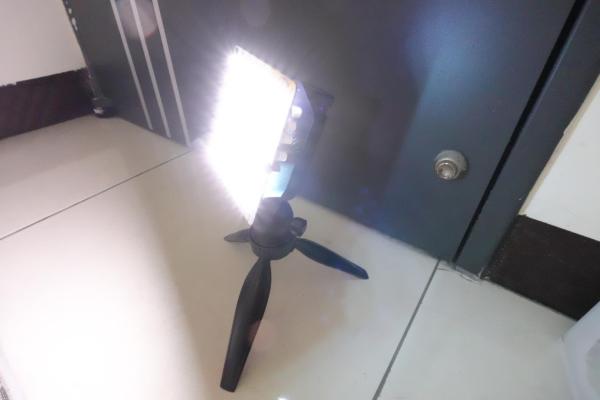
[Jukka] wanted a bike light that wasn’t afraid to go into the woods during the dark winter. He put together a lamp that uses eight 3 Watt LEDs to pump out 1680 lumens (english translation). The high power LEDs were mounted on a large aluminum heat sink and use lenses to optimize the beam of light. The system uses a 2 amp driver board that he assembled himself. Power is provided by sixteen AA Nickel Metal Hydride batteries that are housed along with the driver circuit in a water bottle.

This more than doubles the output of the last bike light we thought was too bright. Where will this lumen-arms-race stop?

[Thanks Sami]

Halloween prop: portable black light

posted Oct 2nd 2009 10:00am by Caleb Kraft
filed under: home hacks, wearable hacks

blacklight

[Joshua] wrote in to show us this great Halloween tip. He wanted to take his 4 foot long black light along with him on Halloween. You can buy portable versions, but he realized he had enough parts laying around to slap together a portable one himself. He pulled the inverter from a scanner light and wired it up to a couple of 9 volt batteries. Knowing he would probably need a fresh set during the night, he actually wired in some extras with a switch to control which was powering the unit. We know this isn’t the best solution, but you could probably toss this together in just a few minutes.


700 lumen LED bike lamp

posted Sep 3rd 2009 4:10pm by Mike Szczys
filed under: led hacks, transportation hacks

700_lumen_bike_lamp

We’ve seen bright bike lamps before. This one caught our eye because it needs a heat sink while in operation. [700lumenLED] built a super bright light for his bike that features an aluminum enclosure and heat sinks to protect the LEDs against overheating.  Some nice work was done incorporating the 12v battery into a bike bottle with the power switch and a dimming potentiometer attached to the bottle cap.

210 LED lamp

posted Aug 24th 2009 11:00am by Jakob Griffith
filed under: home hacks, led hacks

full-mountedLeds

Current fluorescent lamps are great for lighting large areas using very few Watts; however, LEDs are far more efficient at producing light and have less of an impact upon the environment considering there is no mercury within them. [Andrew] sent in his team’s LED florescent bulb. The first revision utilized 87 LEDs, but to increase output the second revision uses 210. The assembly can’t actually be placed in current fluorescent lamp ballasts and must use a 12 volt 1 amp power supply, but perhaps future versions will correct for this. Another problem is the relatively small viewing angle, and while there is a diffuser, we’re wondering if they have any other ideas to spread the light and adjust for the color temperature without reducing output? We wonder how it compares to some of the commercially available LED florescent lamps.

Moon phase light modification

posted Aug 19th 2009 7:46am by Caleb Kraft
filed under: arduino hacks, home hacks

In this project, a moon phase light is modified to show the actual moon phase based off of your computer’s internal clock. From the factory, these moon lights are updated via an infra red remote control. He pulled the brains from the clock and replaced them with an Arduino. He then runs a program that updates the Arduino based off of the system clock. He has also added an internal clock to maintain the settings so constant updates are not required. It would have been nice to retain manual functions via the remote so you could press a button for a full moon without having to change your system time.

[via littlebirdceo]


Sticky light

posted Aug 4th 2009 12:39pm by Zach Banks
filed under: laser hacks, multitouch hacks

light

With the availability of webcams and projectors, multitouch and interactive demos have become increasingly popular because they’re so easy. Students at the University of Tokyo took a new approach that uses lasers instead. They created Sticky Light, which uses mirrors, a laser, and a single photodetector. Unlike camera-tracking setups, this system requires no visual processing. The laser moves around and bumps into dark objects, sticking to them. It can follow drawings on the table or objects in space, such as shirt designs. They also created a few basic games and a demo that makes sounds based on the movement of the spots. Video of the project after the break.

Read the rest of this entry »

Greenhouse guard

posted Jul 24th 2009 2:04pm by Zach Banks
filed under: arduino hacks, home hacks

pid

[Seth King] sent in his latest hack where he used an Arduino to regulate various aspects of a greenhouse. He has sensors for soil and air temperature as well as light and moisture. He built a custom circuit that uses relays to power fans, lights, and heaters. Using timers and the sensor data, the devices can be triggered to create the perfect environment for sprouts. He hopes to make the whole thing wireless by integrating XBees, but for now he ran a USB cord to his computer.

Related: Automatic grow light

Simple, elegant, lemon battery

posted Apr 5th 2009 11:47am by Caleb Kraft
filed under: led hacks

lemon

[Madaeon] pointed us toward this entry for the Instructables Epilog challenge. While this may not be extremely complex, or have as many wires as our typical post, it is a fantastic example of thinking outside the box. How many lemon batteries have we seen? A lot. This one stands out as being more elegantly displayed and functional at the same time. In its final form, you sprinkle lemon juice on it’s petals and it lights up. If you ever find yourself in the position of teaching someone about electronics, remember this project. Sometimes aesthetics can make a dull simple project take on a life of its own.


Light to sound converter

posted Jan 4th 2009 10:16am by Eliot Phillips
filed under: digital audio hacks, misc hacks

lightnoise

[Alex] built what he calls a light to sound converter. It reacts differently depending on the type of light: remote controls, light bulbs, TV screens, etc. A photodiode is used with an amplifier to pick up the light change. That signal is dumped through a dual opamp. He swapped in several different types of photodiodes and settled on the BPW34 intended for visible light. He’ll be incorporating this into a much larger project.

Cast concrete RGB lamp

posted Dec 22nd 2008 10:10am by Caleb Kraft
filed under: home hacks, led hacks

lamp

[matthew venn] shows us how to create this cool RGB LED lamp. There’s nothing groundbreaking here, but some good information on casting the base out of concrete.  The body of the lap is formed by two thin rods folded in half, stuck in holes in the base, with a lycra sleeve slid over them. The final effect is quite nice and can be controlled by 3 knobs recessed in the front of the base. Information on the actual circuit used is very limited, as there are so many tutorials out there for that, but he does show how he mounted it all, and plans on releasing the source code soon.

Hack a Day serves up fresh hacks each day, every day from around the web and a special How-To hack each week.

Send us your hacks