Magnetic digital scale

posted Jan 21st 2011 11:29am by
filed under: tool hacks

Above you see a solenoid being used as a digital scale. The magnetic field from the coil in the base levitates the platform above, where a load to be measured is place. This floating platform has a permanent magnet in it, hovering above a hall effect sensor in the base. As the distance between that magnet and the sensor changes, the measurable magnetic field changes as well. The hall effect sensor is linear so the measured value can easily be correlated with a weight. In the video after the break [Vsergeev] demonstrates the device using test weights to show off its 0.5 gram resolution. He thinks that with a few hardware improvements he could easily achieve 0.1g accuracy.

Read the rest of this entry »

Flaming guitar hero

posted Jan 5th 2011 6:00am by
filed under: arduino hacks, home entertainment hacks

[Chris Marion] knew he wanted to play with fire, or more accurately with fireball spewing valves, but he need a good project in which he could use them. Inspiration finally struck and he built this controller that matches fireballs to the fret buttons on a Guitar Hero controller. There’s quite a lot that goes into this but we think that he hit a home run. The basic components are a manifold with electronically actuated valves, another manifold for the pilot lights, and a modified Guitar Hero controller.

To interface the controller he used an Arduino along with [Bill Porter's] PS2 library to read signals from the buttons. But the real labor intensive part of the build came with the manifold. There’s a hardware store’s worth of fittings and flexible copper pipe that go into that assembly. In the end this all came together in just one week.

[Thanks Bill]


RC plane built using pieces of an RC car

posted Dec 11th 2010 12:24pm by
filed under: toy hacks

This hack’s old as dirt to be sure, but new to us and a great accomplishment. The plane above, which is meant to fly without an operator, has been given RC control thanks to parts from that little car. The transmitter and receiver pair are the obvious transplant, but how do you add steering to a $7 plane that wasn’t manufactured to have that feature? The tail was cut and reconnected with mylar hinges to turn it into a rudder. A rare earth magnet and a coil are also thrown into the mix to provide movement. Basically this is a simple solenoid where the coil pushes against the magnet when energized, actuating the rudder. This in combination with an upgraded motor allows for both speed control and yaw. It doesn’t look like you can control roll and pitch but what more can you really expect?

This would be a nice first step on that path to building an epic flying camera rig.

[Thanks Rob]

Make your own solenoids, then play the xylophone

posted Dec 2nd 2010 12:00pm by
filed under: Microcontrollers, musical hacks

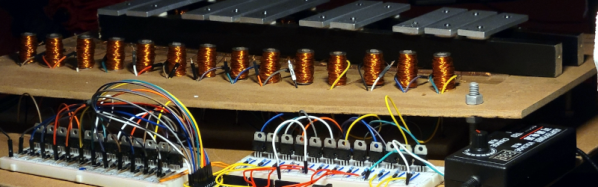
Learn to manufacture your own solenoids and then use them to play the xylophone by watching the tutorial video after the break. [Humberto Evans] and the team at Nerd Kits do a great job of not only manufacturing the coils, but the xylophone itself. The bars are machined from some aluminum stock and they take you down the rabbit hole with they why’s and how’s of engineering the keys.

We’re unlikely to replicate this machining process but the solenoids are another story all together. Starting at about 3:30 you can learn about designing, building, and using these little marvels. They’re basically an electromagnetic cuff with a metal slug in the middle. The solenoid seen above uses a body milled from HDPE and wrapped with magnet wire. The slug in the center is steel, with a few rare-earth magnets at the top. When you run current through the coil it repulses the magnets on the slug, witch then strikes the xylophone key. Using a MOSFET and a protection diode, actuating them is as simple as sending a digital high from your microcontroller of choice.

We’ve seen solenoids used to play a vibrophone before, but those were commercial units. Making your own hardware is far more hardcore.

Read the rest of this entry »

Build a confetti cannon for your next party

posted Nov 8th 2010 3:00pm by
filed under: misc hacks

[Scott] built a confetti canon to spice up the party. It’s pneumatic and re-purposes a fire extinguisher as the air tank. He had a refillable extinguisher that used water instead of chemical retardant. After emptying the water and ensuring all of the pressure had been release he swapped the hose and nozzle for a sprinkler solenoid valve. Securing the extinguisher’s actuator lever with a pipe clamp holds the internal valve open, leaving the solenoid to control the pressure release. This way the canon can be fired electronically, or manually.

This type of solenoid valve is a popular choice with pneumatic canons. We suppose you could even adapt this for use as a T-shirt cannon.

[Thanks BoBeR182]


Typewriter as I/O; lets you play Zork

posted Nov 1st 2010 11:00am by
filed under: peripherals hacks

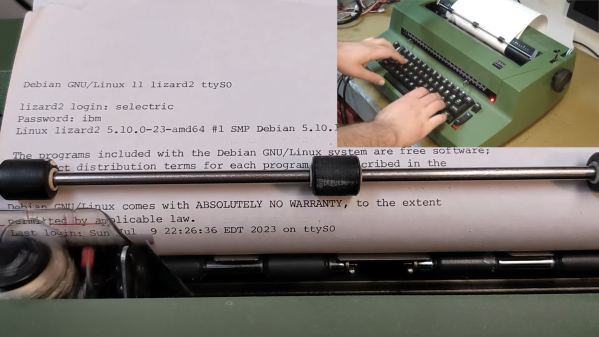
Okay, for many the fact that this typewriter plays Zork on paper instead of a CRT is the fascinating part of this hack. But we love the implementation that makes the keys of the device an input and output.

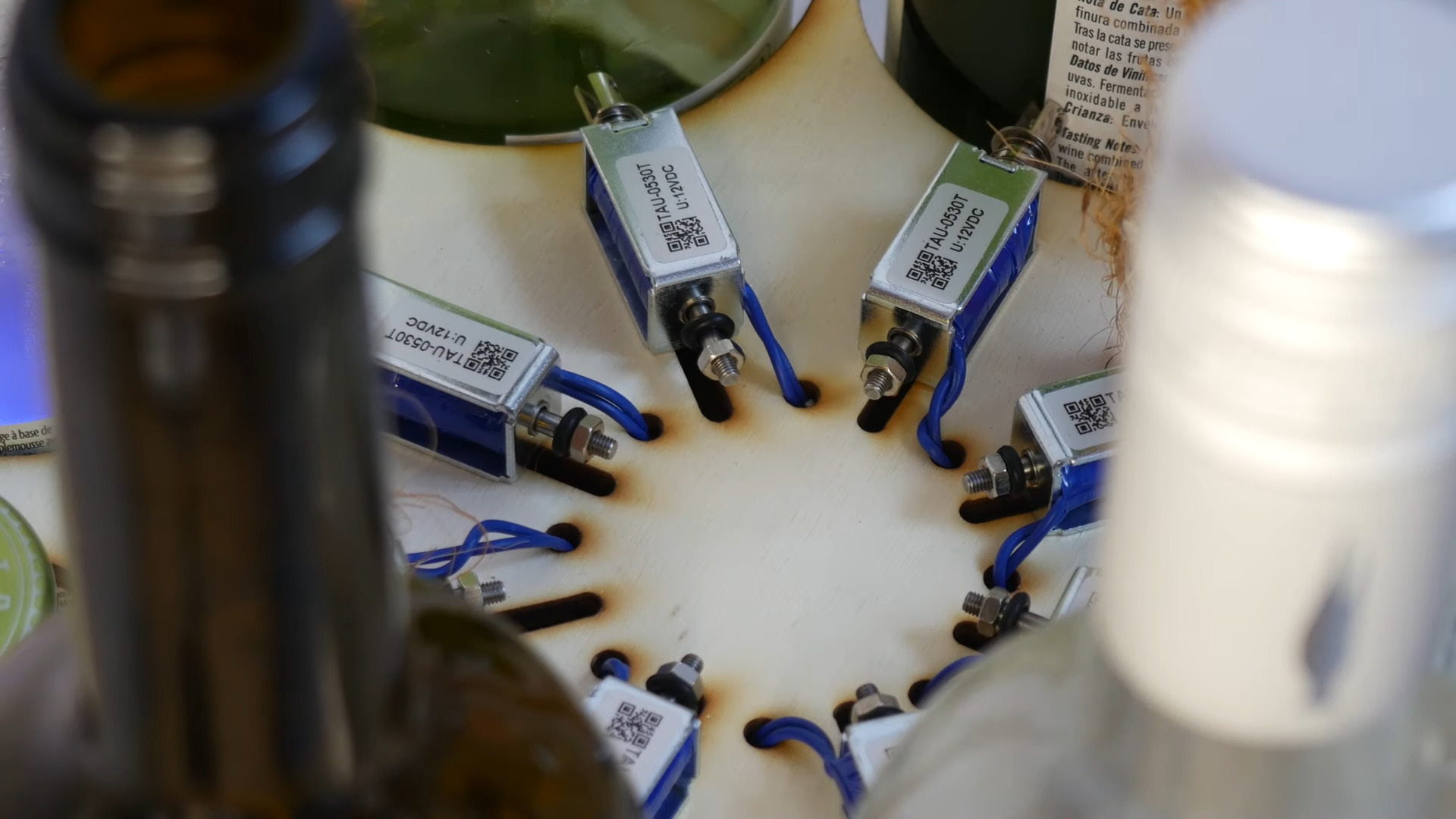
The electric typewriter has been fitted with a solenoid for each key (wow, that’s a lot of work). In the image above you can see they are housed on plywood platforms behind the typewriter and connect using a piece of mono-filament fishing line. This flexible connection means the solenoids have no adverse effect when you want to do the typing instead of the Arduino which drives the solenoids. [Johnathan M. Guberman] took advantage of this, adding a resistor for each key. When depressed the key completes a circuit with the resistor, acting as the input. In this way, you can play Zork with a piece of paper as the monitor, typing for the input, and watching the typewriter magically pound out responses. See it happen after the break.

Read the rest of this entry »

Web controlled sprinkler automation

posted Sep 16th 2010 10:00am by
filed under: green hacks

[Doug] needed to update his watering system to comply with his city’s new water saving ordinance. The old system wasn’t capable of being programmed to water only on even or odd calendar days. Rather than purchase a replacement he decided to build his own sprinkler controller. It needed to switch 12V solenoids, a job that’s not too hard to design for. Rather than re-invent the wheel, he modified a previous controller design. It is basically an Arduino and Ethernet shield on a his own etched board. In addition to the ATmega328 and an ENC28J60 (for ethernet connectivity) there is a bank of transistors to drive the watering solenoids. Now he has a web interface that controls the watering schedule and is fully in compliance with the new city code.

If you need another way to save when watering your grass you should take a look at the sidewalk-avoiding sprinkler.

Replacing the driver board in an old-school door chime

posted Sep 1st 2010 7:40am by
filed under: home hacks

[Dan Kouba's] parents replaced their doorbell button with one that lights up and found that the chime wouldn’t stop sounding after the button was pushed. These lighted buttons use an incandescent bulb in parallel with the button (a piece of hardware we’ve hacked in the past). It draws a small amount of current which isn’t enough to trigger the chime, but it is just enough that the chime unit reacts as if the button press never stopped. His parents asked what he could do about this and after some investigation he build a replacement board for the chime unit based around an ATtiny26L. The board monitors the voltage drop across a resistor in the doorbell circuit. When the comparator on the AVR detects a rise in the voltage drop across the resistor it rings the chimes, actuating the solenoids with a set of PNP transistors. [Dan] sent us all of the details which you can check out after the break.

Read the rest of this entry »


Hack a Day serves up fresh hacks each day, every day from around the web as well as hacking related news.

Send us your hacks


Hacks

Resources