Cordless Drill Overhaul

drill_upgrade

[Alexander.m] shows us how to do a major overhaul on a cordless drill, replacing pretty much everything but the case. He needed some more power, but found the price tag of the bigger drills to be prohibitive. He opted for a more hacked together approach and used a  24 volt 1.4 hp hobby motor as a drive. He had to make a custom enclosure for the batteries too. The final result may not be the prettiest thing in the world, with that giant battery pack on the bottom, but it probably gets the job done pretty well and cost less than half of what a new one would have.

Disposable Camera Nixie Tube Driver

nixie_camera

Disposable cameras are quite cheap, and include circuitry that produces very high voltages. Because of this, they have been harvested for many projects. We’ve seen them used for coil guns and large high voltage power supplies, even for fixing rechargeable batteries that won’t charge. The latest in the long list of uses is to create nixie tube drivers. [the_don125] shows us how to use a single disposable camera to power 2 to 3 medium sized Nixie tubes. Be careful, as we said before, this project deals with high voltage.

Baby Twitters Via Kicks

twitter-1

[Corey Menscher] built the Kickbee while attending ITP this Fall. It monitors his pregnant wife’s belly and updates Twitter, a microblogging service, every time the baby kicks. The device makes everyone aware of the baby’s movement, not just the expectant mother. It can also log the baby’s activity to monitor development. The sensors are piezos held in place with an elastic band. They’re connected to an Arduino Mini which connects to a host computer using a BlueSMIRF bluetooth module. The host Mac does the logging and twittering.

This is one of the many projects on display at the ITP Winter Show.

[Thanks, @readiness via Boing Boing]

How-to: Programmable Logic Devices (CPLD)

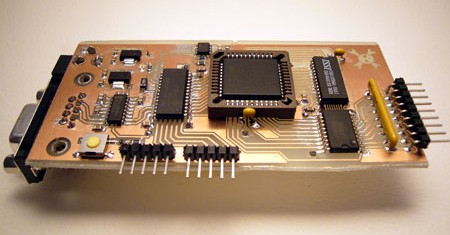
Complex programmable logic devices (CPLDs) contain the building blocks for hundreds of 7400-serries logic ICs. Complete circuits can be designed on a PC and then uploaded to a CPLD for instant implementation. A microcontroller connected to a CPLD is like a microcontroller paired with a reprogrammable circuit board and a fully stocked electronics store.

At first we weren’t sure of the wide appeal and application of CPLDs in hobbyist projects, but we’ve been convinced. A custom logic device can eliminate days of reading datasheets, finding the ideal logic IC combination, and then waiting for chips to arrive. Circuit boards are simpler with CPLDs because a single chip with programmable pin placement can replace 100s of individual logic ICs. Circuit mistakes can be corrected by uploading a new design, rather than etching and stuffing a new circuit board. CPLDs are fast, with reaction times starting at 100MHz. Despite their extreme versatility, CPLDs are a mature technology with chips starting at $1.

We’ve got a home-etchable, self programming development board to get you started. Don’t worry, this board has a serial port interface for working with the CPLD, and doesn’t require a separate (usually parallel port) JTAG programmer.

Continue reading “How-to: Programmable Logic Devices (CPLD)”

Xbox 360 Jasper In The Wild

jasper_5

[Ben Heck] has written up what he calls a “super unboxing” of the new jasper Xbox 360.  The “jasper” refers to a new graphics processor that is supposed to be smaller and more reliable. They have been hard to find, but [Ben] shows us how to spot them. Simply look at the sticker on the back of the unit that shows voltage/current. If it uses 12.1 Amps instead of 14.2, it has the jasper.