Diving Deep Into The Game Boy LCD Protocol

[Craig] wanted to make the original Game Boy LCD screen do his bidding so he sniffed out the data protocol that it uses. We were amused when he mentions that there’s an army of people out there looking to build pointless crap as part of a hobby. Guilty. And he goes on to outline why this LCD screen is a great resource for hobbiests.

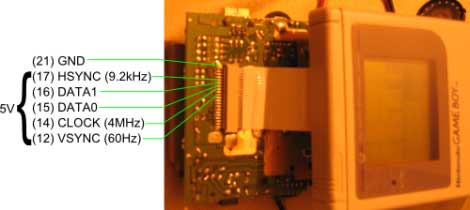
As you can see in the pinout above, it uses 5V logic, with a 4 MHz data clock. These traits are both very friendly to a wide range if inexpensive microcontrollers. If you know how to address the display it should be very easy to use. Furthermore, the low pin count is thanks the to a 4-shade grayscale screen, limiting the data pins to just two. [Craig] hooked up his Saleae Logic probe to capture communications and walks us through what he discovered. During this process he proved to himself that he had figured out the protocol by exporting captured data from the logic probe and reassembling it into an image on his computer.
Single-motor Walker For Santa-Pede Challenge Inspiration

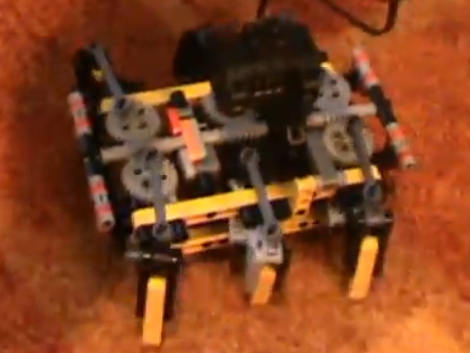
This LEGO hexapod uses just one motor for motion. In the video after the break you can see that what [Valetnin Bauer] accomplished is almost magical, using just 210 parts. A central drive shaft uses worm gears to transfer motion to each of the legs. The limb mounting technique results in a sort of rowing motion that closely mimics what you’d expect to see from a biological hexapod.

We thought this might provide some inspiration for the Buy Break Build: Santa-pede challenge. Sure, using LEGO is a lot easier than reusing Santa parts. But a lot can be accomplished with a little creativity. Another point of inspiration might be this one-motor walker that should be a snap to adapt to the challenge. Better get going, just twenty days let until the project deadline!

Continue reading “Single-motor Walker For Santa-Pede Challenge Inspiration”

Wireless Doorbell Rings A Real Bell

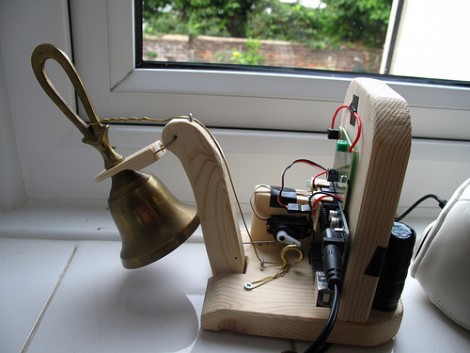
Tired of hearing that flat sounding wireless doorbell when visitors happen to come by? Don’t get rid of it, improve it by adding a real bell. This hack rigs up a small hand bell to the wireless doorbell receiver. It was prototyped using LEGO pieces to shake the sound out of the bell, but the finished version uses a servo motor on a wooden frame. An Arduino monitors the wireless receiver, driving the servo when a transmission from the front door button is received.

Traditionally door bells have actually been chimes that are struck with solenoids. We appreciate this rendition because it adds an element of kinetic art to the home, laying bare the functional hardware instead of hiding it in a box. Don’t miss the demonstration after the break.

Continue reading “Wireless Doorbell Rings A Real Bell”

Robotic Mobility For The Little Ones

Researchers at the University of Delaware are helping disabled kids by designing robot transportation for them. Exploring one’s environment is an important part of early development. Disabilities that limit mobility can prevent young children from experiencing this. Typically children are not offered a powered wheelchair until they are five or six years old, but adding intelligent technologies, like those found in the UD1, makes this possible at a much younger age. Proximity sensors all around the drive unit of the robot add obstacle avoidance and ensure safety when used around other children. When confronted with an obstacle the UD1 will stop, or navigate around it. The unit is controlled by a joystick in front of the rider but it can also be overridden remotely by a teacher, parent, or caregiver.

[via Robot Gossip]

Monotron Openly Monophonic

Famous synth manufacturer Korg has released the schematics (get them here if you don’t like to fill out forms) for their wee little Monotron for all to see and use! This is great news for anyone looking to build up a synth from scratch or to circuit bend their existing monotron. The filter circuits alone would be fun to add to an existing electronics setup.

Granted there are already many examples of monotron mods out there, but that shouldn’t stop you from experimenting with your own variations. Now with the schematics you can make fundamental changes to the architecture of the synth all from the comfort of your own CAD software. Want more oscillators? Distortion? It’s all out there for you to explore. We’re very interested to see how far people will run with this. And big ups to Korg for recognizing the value of hacking!

[via Retrothing]

Continue reading “Monotron Openly Monophonic”

Kinect Open Source Driver Demo And Hacking


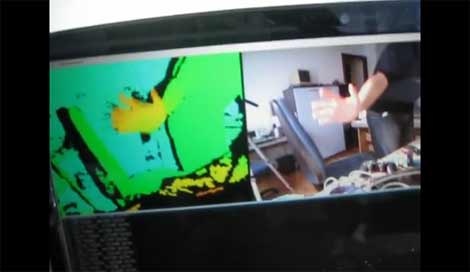
The competition for the first Open Source driver for the Kinect is heating up.  [Marcan42] has released a driver that does video and depth.  He was able to do this without an Xbox and you can see it in action after the break. [LadyAda] has been hard at work as well, recording and dumping the data, and even writing a “hello world” that utilizes the motors in the Kinect.
We don’t know for sure how [Marcan42] recorded his data, but we can see [Ladyada] is using a high speed Beagle USB 480 to record the data going both ways between the Xbox360 and the Kinect.  That’s the kind of toy we would like to have sitting around. For those who don’t know what all the fuss is about, there’s a contest to see who can get an open source driver out there first. The prize has grown every time Microsoft says something bad about it.

[thanks Rapps]

Continue reading “Kinect Open Source Driver Demo And Hacking”

Permanent Root Exploit Found For G2

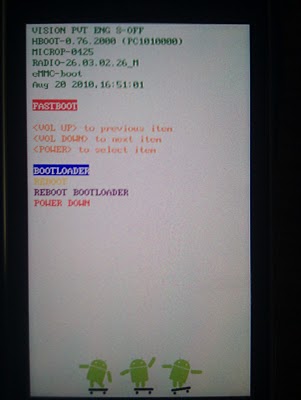
The g2 has finally been rooted. Even though a temporary root exploit was found shortly after the phones release, a NAND lock prevented modifying the non-volatile RAM for a permanent root. Some controversy surrounded the g2 when it was erroneously thought to have a rootkit protecting the OS.  Supposedly the rootkit would watch for changes to the file system and then reset the phone to default settings when any unauthorized changes were made.  On the other hand a NAND lock functions by fooling the operating system into thinking there isn’t any memory available, essentially “locking” the memory in key areas.  Once it was discovered to have the NAND lock it was only a matter of time before the g2 was permanently rooted.  NAND locks have become a popular (and unsuccessful) deterrent employed by device makers to stop the jailbreaking comunity.  While this exploit is nothing groundbreaking it is another notch in the belt for the jailbreaking community and a welcome benefit to g2 users.