Chip And Pin Broken And Other Security Threats

Another exploit has been found in the Chip and PIN system.  The exploit is a man-in-the middle attack that wouldn’t take too much know-how to pull off. You can watch the BBC report on the issue or check out the paper (PDF) published by the team that found the vulnerability. A stolen card resides in a reader that connects to a dummy card via a small cable. When the dummy card is inserted into a card reader, any PIN can be used to complete the transaction. The chip on the original card gets confirmation that the sale was completed via signature and the vendor’s card reader gets confirmation that the pin was correct. The UK based Chip and PIN system seems like a great idea, but it has had its share of security loopholes. This makes us wonder how hard it is to roll out security patches to the hardware readers in the system.  Obviously this needs to be patch but does it take a technician visiting each terminal to flash an upgrade?

Switching to the topic of wide-scale attacks, we caught the NPR interview with [James Lewis] on Wednesday when they discussed the growing threat of Cyberterroism. He feels an attack on the US electrical grid is currently the biggest threat and will happen in the next ten years. Obviously taking the grid down would endanger lives and bring things to a standstill; traffic lights, refrigeration, heat, etc. We’re just glad that when asked if he thinks there is already malicious code residing in the control system, he doesn’t think that’s the case.

[Thanks to Whatsisface and Mcinnes]
Teletype Machine From An Electric Typewriter

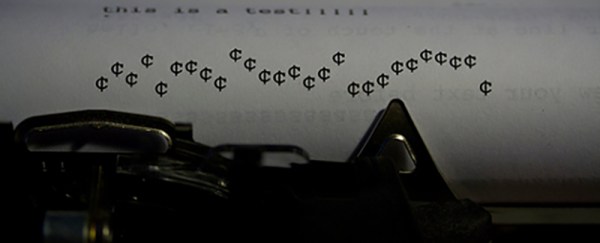
This project, by an unknown hacker, patches into an electric typewriter and uses it as a Teletype. An AVR ATmega168 microcontroller patches into the key matrix of the typewriter which allows it to artificially type. Now, data can be sent over a serial connection to the AVR for output on the typewriter.

We’re not quite sure what this is going to be used for.  We’ve seen hacks like this for Twitter reading in the past but he makes no mention of that type of use. Personally, we’d like to have this just to “print” out the occasional letter. Typewriters are so rarely used these days it would be a bit peculiar to get a letter that has the dimpled impressions associated with slamming a die into a piece of paper.

Keyboard Keepalive

[youtube=http://www.youtube.com/watch?v=Zq25CTEJEMQ]

We’re not going to debate the necessity of this one. [Todd] plays online games that will log you out after a few minutes of inactivity. To resolve this, he has created a circuit that mimics keyboard activity at a preset interval. While he notes that there is software for this, he points out that many games block the software. They can’t block legitimate keyboard activity.

[via HacketGadgets]

Dexterous Hexapod Clarification

[youtube=http://www.youtube.com/watch?v=O3ovrT8pWww]

This tip was submitted by [Mike], with the original information seen in this post. When I passed the story along to our writer [Mike Szczys] I didn’t send along the entire email conversation. This bot is noteworthy because it has taught itself to walk. In the build log you can learn about how it has created its gait and altered it based off of the vision. There are also some great pictures of prototypes there too. While we can all agree that it isn’t as impressive looking initially as the A-Pod, remember that it wasn’t programmed to look impressive.

HUD For Real Life Capture-the-flag

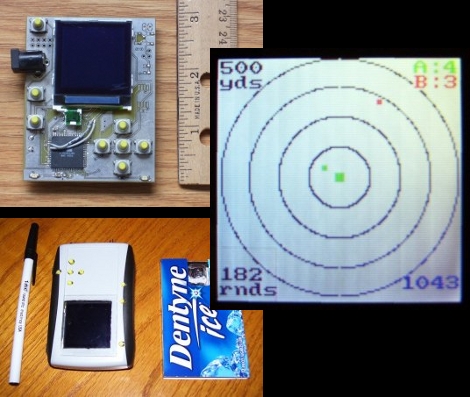
If you’ve played any of the Splinter Cell games you’ll remember the PDA that [Sam Fisher] carried around with him.  What if you could have one of your own when playing capture-the-flag? [Brad] has created the ZephyrEye as an electronic command and communications device for real-life games.

Each player carries around their own unit. The ZephyrEye has a GPS module, Xbee module, LCD screen, and control buttons. This allows a player to setup one of several different games, map out the game field including base locations and flag locations, and monitor a time limit and scoring. Other players can join the game in progress. The best part? The GPS modules report tracking to each handheld and act as radar for your team and the enemy team. We’ve got a couple of demo videos after the break.

Words can’t describe how delighted this would have made us back in the day. We don’t play outside with the other neighborhood kids anymore (insert dirty-old-man joke here) but that might change just because of this device. We may end up joining [Barney Stinson] for some amazingly awesome laser-tag games after all.

[Brad’s] posted hardware information and source code so that you can use to throw together a dozen or so units. We think the next version should incorporate a wearable display.

Continue reading “HUD For Real Life Capture-the-flag”

Veteran Robot Features Eight Legs And BeagleBoard

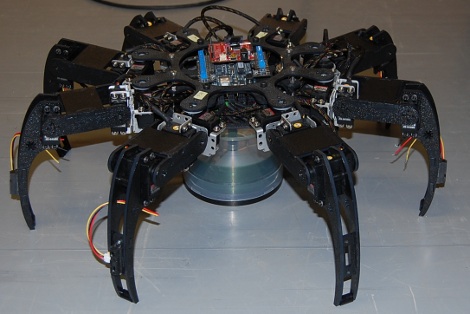
This spider-bot was built by [Zhanx] during his deployment in Iraq. He didn’t have prior hardware building experience and started out on this project when he received an Arduino to play with in September. Must be a fast learner! The parts are laser-cut from ABS plastic and connected to 24 servos. He sourced an SSC-32 serial servo control board to take care of the motor connections.

[Zhanx] has since migrated from the Arduino to a BeagleBoard which you can see perched atop the body in the video after the break. This should give him plenty of speed and power to improve the movement routines. There’s some nice work here but adding rubber feet, like on yesterday’s hexapod, wouldn’t hurt.

Continue reading “Veteran Robot Features Eight Legs And BeagleBoard”

Use An Analog Oscilloscope To Display Digital Logic

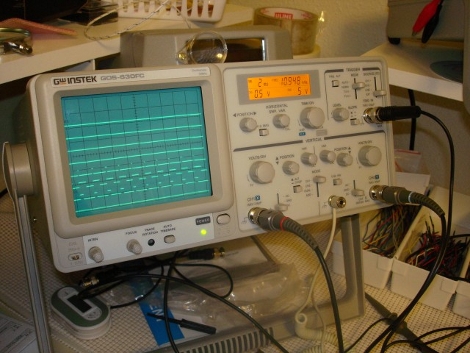
[Mike Bradley] wanted to use his oscilloscope to display 8 channels of digital signals. Alas, the analog unit didn’t have this capability. Not to worry, he threw together an adapter module that does the trick. Using a PIC 18F26K20 microcontroller he inputs four or eight channel digital logic (at 5V) and filters the output to an analog signal that the oscilloscope can interpret. What you see in the photo above is the result.