Blinky Headgear

[Everett Tom] added some blinking LEDs to his visor while honing his PCB design skills at the same time. He started with the TI eZ430-F2013 for prototyping the blinking circuit along with its mode toggle buttons. Once this was worked out he used BatchPCB (a low-cost professional board fab option) to manufacture a board. The final design hosts an MSP430 F2013 microcontroller as well as the voltage regulator circuit that draws power from the 9V battery that hides inside the head band next to the board.

You guessed it, video after the break.
Continue reading “Blinky Headgear”

Arduino Levitation

Here’s the proof that Arduino is a tool for serious prototyping and not just a toy. [Norbert Požár] built a magnetic levitation device that combines an Arduino with an electromagnetic driver circuit and a magnetic field sensing circuit. Unlike other other levitation setups that use optical sensing, this implementation uses a hall effect sensor on the electromagnet to maintain the distance between it, and the permanent magnet it is holding in midair. Check out the embedded video after the break and browse through the overview page so see how pleasing it is to do away with a frame around the floating object. This makes us wonder if it could be inverted in a way similar to that magnetic scale.

Continue reading “Arduino Levitation”

Motion Activated Monitor Wakeup

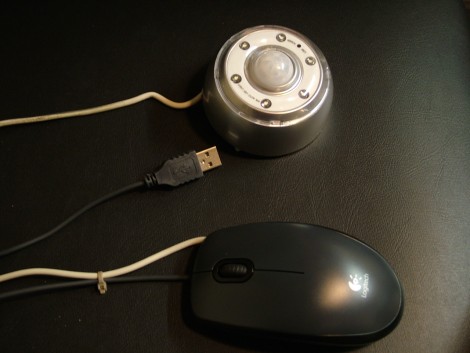
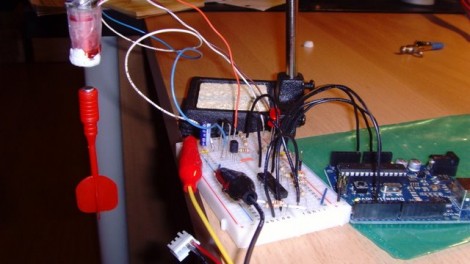
This hardware is used to keep a computer monitor awake when there is motion in the room. The monitor displays important information for firefighter in the vehicle bay, but only needs to be on when they are getting ready to go out on a call. The solution is a simple one, a PIR sensor combines with a mouse for motion sensitive input. When the PIR sensor detects motion it causes a mouse button click via a 2N3904 transistor. Now the monitor will not waste power or have burn-in over the long term, but whenever someone is in the room it will be displaying the information that the emergency workers need to know.

[Thanks Andy]

Blasting Off With GPS

Launching model rockets is a good time, but more often than not, it’s hard to tell how high the rocket went or how fast it moved – both essential facts when bragging about your latest flight. [Chris] recently built a GPS-based altimeter for the USC Rocket Propulsion Lab, so that they could track the performance of their latest project. The circuit is based off a Picaxe 18x and uses a GPS module to obtain NMEA altitude data. Once the data is obtained, it is stored on an external EEPROM to be read back after the rocket has been recovered.

[Chris] unfortunately does not have any pictures of the board he built, but he has made his circuit diagram and source code available. He reports that the logger worked perfectly aside from a small bit of time where the GPS module temporarily lost its satellite lock.

If you are interested in reading more about flight data recording and telemetry, be sure to check this out.

Three Digit Binary Clock

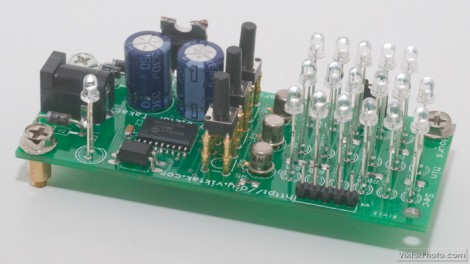
Here’s a three digit binary clock that [Viktor] designed. It uses a multiplexed display to drive one digit at a time with a PIC 16F628A. The video after the break shows it ticking away, display hours, minutes, and seconds in blue LEDs. You may be wondering why those LEDs are not flush to the board? [Viktor] took the project one step further than most binary clock projects, designing a PCB to fit into the enclosure of an old laptop PSU and then having the board manufactured. With options like DorkbotPDX groups orders its has become quite inexpensive to do this and it’s really good practice for when you need to design a highly complicated board for that super-fantastic project of the future.

Continue reading “Three Digit Binary Clock”

Toy Helicopter Charging Fix

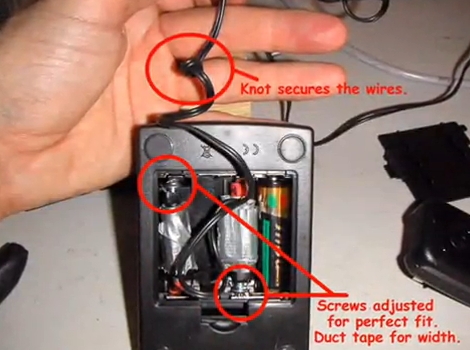
[Onefivefour] was surprised that his E-flite Blade MCX radio controlled helicopter came with a charger that used AA batteries to recharge the lithium batteries in the flying unit. Yeah, that’s a bit crazy. He set out to modify the base unit to work with AC power. There are four batteries inside this base unit, one of them powers the charge detector circuit and the others are used to juice-up the chopper’s rechargeable cells. He took a 5V regulated charger from a Motorola cellphone and modified it to interface with the contacts for the three AA cells. Like the Magic Trackpad hack, he did this without altering the holder by cutting a couple of pencils to length and attaching the positive and negative contacts from the AC charger to them. Check out the video after the break for a walk though, noting how he still has the option to go back to battery power if he so chooses.

Continue reading “Toy Helicopter Charging Fix”

RF Control From Just About Any Device

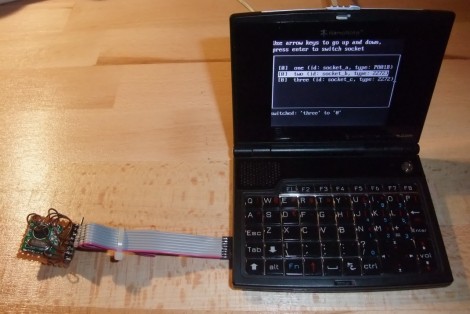
[Mirko] is working on a library that will allow you to add RF control to just about any device. The only requirement is that the device be capable of running a Linux kernel, and that it have a few GPIO pins available. One example is fairly straight forward, a Netgear router. Many, if not most routers run a Linux kernel natively and most have solder points on the board for unused IO pins so patching into the hardware is very straight forward. Less obvious and much more impressive is the hack seen in the image above. [Mirko] built an SD card adapter cable and uses the contacts in the card reader to bit bang four-wire SPI to communicate with that RF module.