Juggling With Kinect

kinect_juggling

Some of the Kinect hacks we have featured here are quite useful in the realm of assisted living, others showcase what can be done with the clever application of video filters. Some…are just plain fun.

This pair of Kinect hacks are not necessarily going to win any awards for usefulness, but they are big on fun. [Tom] put together a neat juggling application that watches for your hands to disappear behind your back, generating a glowing ball once they return to the camera’s field of vision. The balls can be tossed away or juggled as you can see in the video below. It looks like it could be pretty fun and most definitely easier than chasing balls around while learning to juggle.

[Tom’s] hack was based off code he saw demonstrated in a video by YouTube user [hogehoge335]. His application for the Kinect allows him to replicate the Kamehameha attack from Dragonball Z, flowing hair and all.

Check out the videos below for a demonstration of both Kinect hacks, and swing by the respective Google Code sites if you want to give them a try.

Continue reading “Juggling With Kinect”

FBI Tracking Device Found; Disassembled

[ifixit] has apparently grown tired of tearing apart Apple’s latest gizmos, and their latest display of un-engineering has a decidedly more federal flair. You may have heard about Yasir Afifi’s discovery of a FBI-installed tracking device on his car back in October of last year. Apparently, the feds abandoned a similar device with activist Kathy Thomas. Wired magazine managed to get their hands on it, and gave it to ifixit to take apart. There’ve even posted a video.

The hardware itself isn’t that remarkable, it’s essentially a GPS receiver designed before the turn of the century paired with a short range wireless transceiver. The whole device is powered by a set of D-sized lithium-thionyl chloride batteries which should be enough juice to run the whole setup for another few decades–long enough to outlast any reasonable expectations of privacy, with freedom and justice for all.

Double Barreled Air Cannon

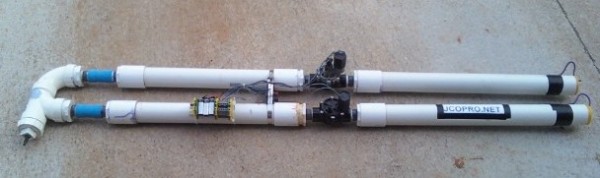
[Jeremy] wrote in to show off his latest creation. he has built a two barrel pneumatic air cannon. Eschewing the traditional approach of having a single barrel and pressure chamber for his spud gun, [Jeremy] wanted to have a double barreled version. Since he was doing this pneumatically, he had to rig up a way to maintain pressure in each barrel independently of each other, as well as trigger them independently. While we can all agree that one way valves and sprinkler valves aren’t ground breaking, it is nice to see it all laid out and tested. We now have the blueprints if we were so inclined to create our own version.  You can see him testing it out by filling the chambers with water and sploooshing that all over the place after the break.

Continue reading “Double Barreled Air Cannon”

Jeri Ellsworth’s Shooting Gallery

Back with another interesting vidoe, [Jeri Ellsworth] once again brings us an amusing and educational hack. This time she’s made a “shooting gallery” in the style of the old arcade games that actually used projectiles. In her version however, she’s using LEDs in the targets which are detected by the gun.  In an effort to keep the feel the same, she rigged up a pinball bell to ding at the appropriate times and it is quite effective.

As usual, she does a great job of breaking everything down and explaining how it all works. She shows us around her prototype so you can see how it is constructed, if you can make it through the solder gun shootout in the beginning.  If she were to continue with this project beyond the functional prototype stage, we’d love to see small video clips being displayed for the targets pepper’s ghost style. Maybe we’re just having fond memories of Time Traveler.

A Friendly Spiderbot Named Chopsticks

chopsticks_the_spiderbot

After seeing his fair share of hexapod-style bots on the Internet, [Russell] decided he wanted to build one of his own. One of the downsides to building these robots is the cost. He often saw them constructed from laser cut parts and very expensive servos. Rather than blow hundreds upon hundreds of dollars on the bot, [Russell] decided he could a lightweight bot on the cheap using chopsticks and polymorph modeling plastic.

His octopod robot is aptly called “Chopsticks” and utilizes 28 different servos to control its motions. 24 servos are used for its legs, 3 more are reserved for head movements, while a single additional servo manipulates the robot’s mandibles. The robot’s legs and main structure are composed of chopsticks, while the polymorph is used for feet, servo mounts, and pretty much anywhere else chopsticks just wouldn’t do.

[Russell] even added a set of eye stalks to complete the spider theme, arming them with IR compound eyes for object tracking. The robot is quite interactive as you can see in the video below.

Keep reading to see a video of Chopsticks, or swing by his Let’s Make Robots site if you get a chance – he has a pretty detailed construction journal as well as plenty of videos showing his spider bot in action.

Continue reading “A Friendly Spiderbot Named Chopsticks”

Roll Your Own Capacitors

diy_caps

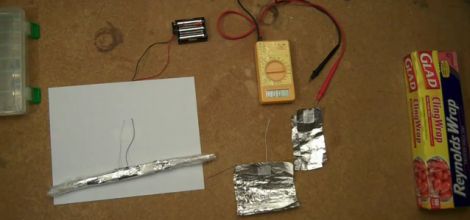
Rolling your own electronics components can be fun, but can also help in explaining how certain items actually work. [Addie] from The Toymakers recently set off to figure out how capacitors work, by making her own.

She understood the general concept behind capacitors and how they are constructed, but she wanted to see how it was done first-hand. To construct her capacitor, she selected aluminum foil as her conductor, and saran wrap as the dielectric. She admits that her first attempt was a failure, but undaunted, she carried on. Friends suggested that her conductors were a bit too small to hold any reasonable charge, so she tried larger sheets of aluminum foil to no avail.

She kept at it and found success after using several feet of foil to construct her capacitor. She charged it with a handful of AA batteries and was excited to see her multimeter come to life when she touched the leads to the cap.

While you likely wouldn’t use a hand-made capacitor in your next build, it is a fun experiment to do with children interested in learning about electronics.

[via Adafruit blog]

Continue reading “Roll Your Own Capacitors”

Synkie: The Modular Synth For Video

The folks at [anyma] have been working on an analog video processor called Synkie for a while now, and we’re amazed a project this awesome has passed us by for so long.

Like a Moog or Doepfer synth, the Synkie was developed with modularity in mind. So far, [anyma] has built modules to split and combine the sync and video signals, and modules to invert, add, subtract, mix, filter and amplify those signals. The end result of all this video processing produces an output that can look like a glitched Atari, art installation, and scrambled cable station all at the same time.

The Synkie’s output reminds us of the original Doctor Who title sequence, and actually this idea isn’t far off the mark – both use video feedback that will produce anything from a phantasmagoric ‘flying through space’ aesthetic to a fractal Droste effect visualization. We’re impressed with Synkie’s capabilities, but we’re astounded by the [anyma] crew’s ability to control a video signal in real time to get what they want.

Check out a video of the Synkie after the jump. There’s also more footage of the Synkie in action on the Synkie Vimeo channel.

Continue reading “Synkie: The Modular Synth For Video”