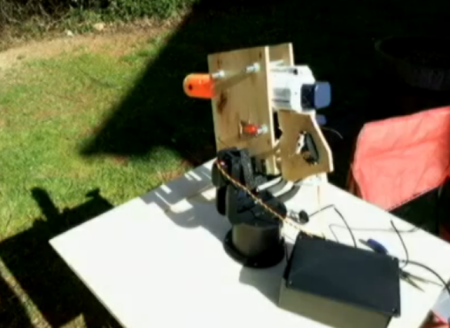
Birdwatching Meets A Computer-Controlled Water Cannon, Awesomeness Ensues

squirrel turret

Sure, squirrels may bother the average home owner, but few have attempted as creative a way to control them as this automated water turret. Check out the video after the break to see how this was accomplished, but if you’d rather just see how the squirrels reacted to getting squirted, fast forward to around 16:00. According to [Kurt] he was sure this would be his solution, however, his conclusion was that “squirrels don’t care.”

As for the presentation, it’s more about how to use [OpenCV], or Open Source Computer Vision. It’s quite a powerful piece of software, especially considering that something like this would cost thousands of dollars in a normal market.  An Arduino is used to interface the computer’s outputs to the real world and control a squirt gun. If you’d rather not program something like this yourself, you could always simply use a garden hose as someone suggests just after the video. Continue reading “Birdwatching Meets A Computer-Controlled Water Cannon, Awesomeness Ensues”


Connecting Toy Blocks With A Universal Construction Set

We were all children at one time, and surely some of us remember the pain of trying to make one type of building block work with another type of block. The folks at the Free Art and Technology Lab have an answer for your inner child: adapters that connect any type of building block to any other type of building block.

The project is called the Free Universal Construction Kit. This  “gee, I wish I thought of that ideas” is a set of 79 play set adapter that allow any child to mix up their Duplo, Fischertechnik, Gears! Gears! Gears, K’Nex, Krinkles, Lego, Lincoln Logs, Tinkertoy, ZomeTool, and Zoob building sets in any way imaginable. Most of these adapters are up on Thingiverse, ready to be printed out with a 3D printer or sent to Shapeways.

An interesting aspect of the work of the F.A.T. Lab is the legal and intellectual property aspect; since this is the product of reverse-engineering several building sets,  it’s entirely possible the manufactures of these toys wouldn’t want adapters out in the wild. The team really covered their bases, though. Of the ten toy systems included, eight are no longer patent protected, much to the chagrin of the company behind MEGA Bloks. Adapters for the  two remaining systems – Zoob and ZomeTool – won’t be released until the patents run out in 2016 and 2022, respectively.

Check out the video after the break for the wonderful ‘a-ha moment’ one of the inventors had when watching his 4-year-old son playing with Tinker Toys and K’Nex.

Continue reading “Connecting Toy Blocks With A Universal Construction Set”

When Console Modders Face Off, Only Good Things Happen

sega-multi-gen

We really love when friendly competition leads to excellent hacking. Not too long ago, we showed you a nicely done Sega Genesis portable put together by console hacker [Downing] who challenged fellow hacker [EVIL NOD] to a build off. The two were hacking Sega consoles, [Downing’s] for personal use, while [EVIL NOD] was working on a commissioned build.

As you might have guessed, [Downing] finished first, but that doesn’t mean [EVIL NOD’s] console is anything but spectacular. His Sega Multi Gen is a portable Genesis console modified to play both NTSC and PAL games. It features a large 5” PSOne screen as well as the guts from an official 6-button Genesis game pad. The case was vacuum formed by [Downing], and is another example of his fine workmanship. The console looks as if it’s had the controller melted right into its face – a design that is sure to give you the authentic feel of sitting in front of your TV mashing away at the buttons.

Check out the video below to see an unboxing video that [EVIL NOD] put together before sending the console out to its new owner.

Continue reading “When Console Modders Face Off, Only Good Things Happen”

Tearing Down A Failed LED Bulb

todd-harrison-led-bulb

[Todd Harrison] was thinking of replacing some incandescent light bulbs in his house with LED models, so and his wife picked up a single candelabra bulb to test before they spent the cash to swap them all out. The bulb died in about a week’s time, so [Todd] got out his trusty electronic disassembly device (his hammer), sharing his post-mortem examination with us.

After taking a cursory look at it, [Todd] found that the circuit powering the bulb was not overly complicated. A small bridge rectifier along with a few caps and resistors are all that was used to power the device, making it’s failure a bit puzzling. When [Todd] wired it up to his power supply, the bulb lit up, much to his surprise. His best guess as to why it died is that the shrink wrap around the PCB managed to cause a short, though he also noticed that one of the bridge rectifier’s legs was not soldered down.

He started tooling with the light to find out more about it, but he managed to blow out a handful of LEDs in the process. All in all the LED lighting swap was a disappointment, but at least he had some fun along the way!

Continue reading if you’re interested in seeing [Todd’s] diagnosis in its entirety.

Continue reading “Tearing Down A Failed LED Bulb”

Android Rolled Into Linux Kernel 3.3

The latest version of the Linux kernel was just released on Sunday, and there’s a little bonus which we think is worth considering. It seems that many changes from Android made their way into version 3.3 of the Linux kernel.

This may not sound like much, but it’s a great example of the power of open source. Since device specific changes based on the Linux kernel must be released under the same license, hardware manufactures are compelled to release their sources. But normally this would only help you if you have the expertise to slog through their code and find the parts that you need for whatever purpose you have in mind. But with these changes being rolled into the main kernel you should be able to run your own distributions on Android devices relatively easy; hardware support is already in there. Of course there’s still a lot of expertise that goes into cross-compiling an OS.

This may have the potential to open up old Android hardware as a development platform. Think of how Chumby hardware has been used in robotics projects. Now what if your old Bluetooth and WiFi enable cellphone had a stock kernel that was as easy and open to use in your own projects?

[Thanks Adam]

Never Miss Your Transport With This Bus Arrival Notifier

[John Graham-Cumming] was all set to start a new project based on the Raspberry Pi. Well, that was until shipment was delayed due to manufacturing issues. Not to fret, he transitioned over to a router board which displays the arrival countdown for mass transit bus service.

He based the build on a web page the Transport for London provided. You can load it up and see if your bus is running on time or not. There’s no published API, but by studying the source code from the site [John] was able to figure out how the JSON commands were formatted.

The next step is building a standalone device to pull the data and display it. The board seen above is from a Linksys WRT54GL router. This longtime favorite has a serial port header which can be driven from the Linux kernel. He wired up a jack on the router’s case, and uses an extension cable to get from it to the 7-segment displays mounted in a model of the bus. Since there’s four digits the display can tell you minutes until the arrival of two different buses.

[Thanks Pseudo Lobster]

Hot Dirt Keeps Your Plants Happy In The Winter Months

[Craig] tried heating his greenhouse last winter, but really only managed to push the limits of his utility bills. This time around he took a different approach by building a system to warm the soil in which his vegetation is planted.

The core of the system is this box which houses the plants. It is lined with heating tape along the bottom which warms a layer of dirt. The plants are in pots, but since those are surrounded by the dirt it doesn’t really inhibit the warming properties of the soil. The controller takes into account the temperature inside the box, as well as ambient temperature in the greenhouse. When it’s a bit too cold the controller will close the lid, which is covered with translucent plastic. This makes sure the temperature around the plants won’t fall below about 41.5 degrees Fahrenheit.

This really takes the work out of caring for you plants in the winter. What would have been a multiple-times-per-day visit can be limited to every day or two. Now he just needs to expand this to regulate temperature and humidity in the greenhouse itself, kind of like this other hack.