FLORA: A Better Arduino LilyPad

[Ladyada] has been working on FLORA, her wearable electronics platform, for a few months now. Even though it has just been announced the specs look much better than the previous queen of the hill, the Arduino LilyPad.

Going down the spec sheet for both the FLORA and the LilyPad, we see that FLORA has twice as much flash and SRAM as the LilyPad. The LilyPad has more options for I/O, but [Ladyada]’s FLORA has the benefit of not using an ISP header for programming; FLORA is completely USB-compatable. FLORA is also about a quarter-inch in diameter smaller than the LilyPad, something to take into account when you’re going for a wearable project.

On top of Bluetooth, GPS, accelerometer, compass and other modules planned for FLORA ( it doesn’t look like they’re available yet, though), FLORA has USB HID support so it can operate as a USB keyboard, mouse, MIDI device, or connect to a cell phone. If you’ve ever wanted a keytar cardigan, this is the board for you.

Check out [Ladyada]’s video demo of a LED-equipped fabric after the break.
Continue reading “FLORA: A Better Arduino LilyPad”

Trashed Hard Drive? Why Not An Engraved Clock?

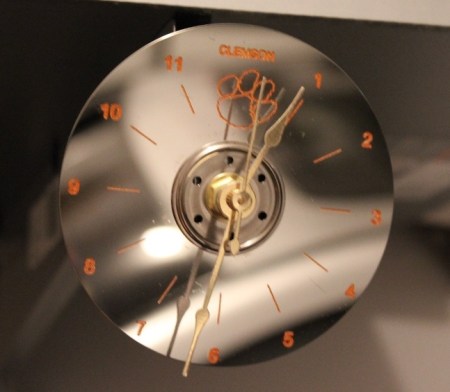
So your hard drive quit working.  Don’t despair, with a “little” work your disk can be repurposed into a clock like the one seen above. I made this clock after several iterations of various success, including the first revision, which was simply the platter with a clock kit from a hobby store screwed into the middle. Still a very neat effect, but if you want to actually tell what time it is, it helps to have the numbers available.

For this, you’ll need some sort of CNC machine (a kit-build router in this case), and some way to generate the Gcode to get everything cut correctly. A guide to how the logo was eventually turned into something a machine could understand is provided here. Of course if you’re not sure what logo would look good on your clock, you can always skip a few steps and engrave the our logo. In this [HAD] article, it’s conveniently provided in .dxf format, which can be converted by a CAM (computer-aided manufacturing) program into code that your machine can understand.

Check out after the break for a video of two “platter clocks” being engraved using these methods: Continue reading “Trashed Hard Drive? Why Not An Engraved Clock?”

Computing With The Command Line

Here’s something we thought we would never see: computing with just pipes, /dev/zero, and /dev/null.

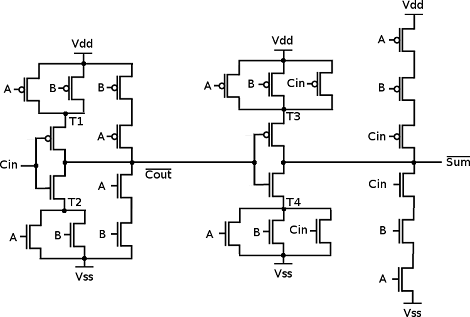
As a thought experiment, [Linus] imagined a null byte represented an electron. /dev/zero would have an infinite supply of electrons and /dev/null would make a wonderful positive power supply. With a very short program (named mosfet.c), [Linus] can use Linux pipes to control the flow of electrons between /zero and /null. [Linus] used mosfet.c with a very short shell script to create a NAND gate. From there all bets were off. He ended up creating a D flip-flop4-bit adder and a counter.

From a bit of cursory research, Linux has a maximum pipe capacity of 1,048,576 bytes and the maximum number of PIDs is 4,194,304 (correct us if we’re wrong). [Linus]  can theoretically build some of the classic CPUs of the 70s and 80s with his pipe logic. An Intel 486 is just out of reach, though. If you give someone a NAND or a NOR they’ll eventually build a computer; we thought we’d never see this, though.

A Talking Reverse Geocache Puzzle Box

Here’s a talking reverse geocache puzzle box which [Erv Plecter] built as a wedding gift for his friends. The box itself isn’t really the gift, but a surprise delivery system for a collection of cash from the couple’s circle of friends to go toward the honeymoon. We think this is about fifty times more fun that getting a fat envelope of bills. Who would really expect to find cash inside once you finally get to the target location?

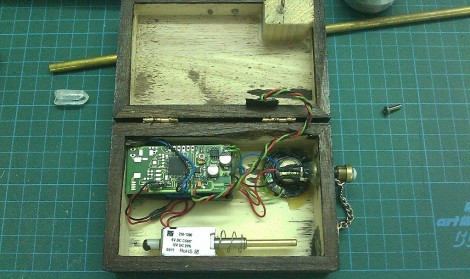
Unlike the other geocache box we saw recently, this one has no display to show you clues to the destination. Instead, it plays back audio clips which [Erv] recorded himself. They’re quite tongue-in-cheek which is another nice personal touch. The pin seen protruding out of the right side of the box can be removed to play a clue and check the location. It’s connected by a little chain to a 5 euro-cent piece which conceals an emergency release mechanism for the lid. The device is powered with a Lithium battery and can be recharged without opening the box via a USB port in the side.

We’ve embedded the video demonstration of the box after the break.

Continue reading “A Talking Reverse Geocache Puzzle Box”

Numerous Quiz Buttons Built On The Cheap

[Sprite_TM] was tapped to build a rather large quiz buzzer system. Judging from his past work we’re not surprised that he seemed to have no trouble fulfilling the request. As the system is not likely to be used again (or rarely if it is) he found a way to finish the project that was both quick and inexpensive.

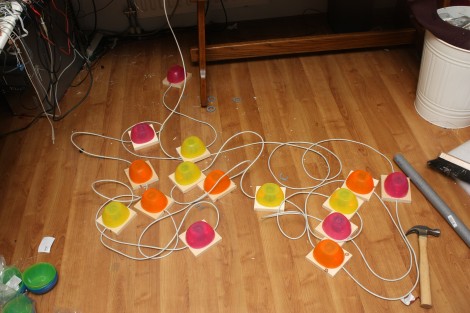
Each buzzer consists of a base, a button (both mechanical and electrical), and a couple of LEDs to indicate who buzzed in first. The mechanical part of the button uses a plastic bowl from Ikea and a wooden dowel surrounded by some pipe insulation. A momentary push switch is glued on the top of that dowel, and the insulation projects above that just a bit. This way it acts as a spring. The Dowel has been sized so that the bowl lip will hit the wooden base just as it clicks the switch.

As you can see, all of the buzzers are interlinked using Ethernet cable. The real trick here is how to read 14 buttons using just one CAT5 cable. This is done with the clever use of a 4×4 button matrix for a total of 16 buttons. The matrix also includes the LEDs for each buzzer. Since CAT5 has four twisted pairs this works out perfectly.

Looking for a more robust system thank this? Here’s a pretty nice one.

Simple Machining Process Repairs Broken Control Knob

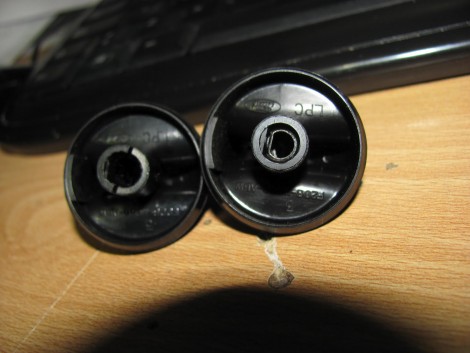
[Francisco] is helping his mother with a repair to the headlight knob on her Ford Ranger. Above you can see the broken knob on the left, and what it is supposed to look like on the right (taken from [Francisco’s] own vehicle for reference). We’ve encountered split shafts on plastic knobs before and decided it was not something that could be fixed. But he didn’t give up so easily. He mentions that you can purchase a replacement for a few bucks, but he has the means to repair the knob by machining a metal bushing.

The idea is that you mill a metal ring whose inner diameter matches what the outer diameter of the plastic shaft should be. By inserting the broken knob in the ring, the plastic is held tightly together as if it had never broken. In the video after the break [Francisco] uses a metal pencil body from his junk box and a mini-lathe to cut the bushing to length, and mill the inner diameter to his specifications.

He talks about the difficulty of getting replacement parts in Chile, where he lives. But we think this kind of thrift is a great example for all hackers. If you’ve got the tools why not use them? And if you don’t have them, here’s a great excuse to procure them!

Continue reading “Simple Machining Process Repairs Broken Control Knob”

FPGA Snake Game Uses No VHDL At All

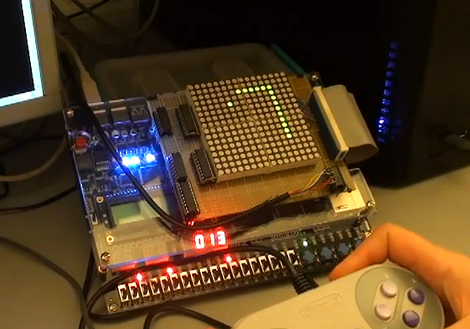
We’re really not supposed to start a feature like this; but this hack is awesome. It’s a game of Snake implemented by an FPGA dev board. It uses a 16×16 LED matrix as the display and an SNES controller for input. So far it sounds like a very normal version of the game. But as you start to hear how it works in the presentation after the break you fall in love with what’s going on here.

First of all, it’s not written in VHDL — the predominant programming language for FPGAs. Instead, [Darrell] used the schematic-only approach to build the logic. Okay, that’s starting to get more interesting. As he continues to explain the circuit we get to see how the control input works (pretty simple since the SNES controller uses a parallel-to-serial shift register) and how the display is multiplexed. But the actual game logic is where things really take off. Each pixel in the display has its own individual logic circuit. Basically every cell is its own processor which reacts both to what is passed into it, as well as to a random seed. That seed system is called the ‘bucket brigade’ and passes a chance to spawn a piece of food from one cell to the next. All of this together makes for one simple game that is eloquently executed. Continue reading “FPGA Snake Game Uses No VHDL At All”