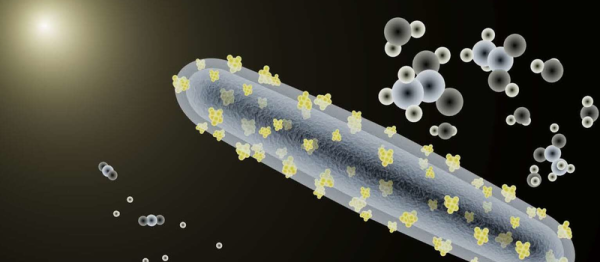
This is weird science. Researchers at Lawrence Berkeley National Laboratory have taken some normal bacteria and made them photosynthetic by adding cadmium sulfide nanoparticles. Cadmium sulfide is what makes the garden-variety photoresistor work. That’s strange enough. But the bacteria did the heavy lifting — they coated themselves in the inorganic cadmium — which means that they can continue to grow and reproduce without much further intervention.
Bacteria are used as workhorses in a lot of chemical reactions these days, and everybody’s trying to teach them new tricks. But fooling them into taking on inorganic light absorbing materials and becoming photosynthetic is pretty cool. As far as we understand, the researchers found a chemical pathway into which the electrons produced by the CdS would fit, and the bacteria took care of the rest. They still make acetic acid, which is their normal behavior, but now they produce much more when exposed to light.
If you want to dig a little deeper, the paper just came out in Science magazine, but it’s behind a paywall. But with a little searching, one can often come up with the full version for free. (PDF).
Or if you’d rather make electricity, instead of acetic acid, from your bacteria be our guest. In place of CdS, however, you’ll need a fish. Biology is weird.
Headline images credit: Peidong Yang





 running a calculus function on an Arduino presents a seemingly impossible scenario. In this article, we’re going to explore the idea of using derivative like techniques with a microcontroller. Let us be reminded that the derivative provides an instantaneous rate of change. Getting an instantaneous rate of change when the function is known is easy. However, when you’re working with a microcontroller and varying analog data without a known function, it’s not so easy. Our goal will be to get an average rate of change of the data. And since a microcontroller is many orders of magnitude faster than the rate of change of the incoming data, we can calculate the average rate of change over very small time intervals. Our work will be based on the fact that the average rate of change and instantaneous rate of change are the same over short time intervals.