CNC Your Own PCBs With A 3D Printed Mill

Yes, you can whip up a design for a printed circuit board, send it out to one of the many fab houses, and receive a finished, completed board in a week or two. There are quick-turn assembly houses that will manufacture a circuit board and populate it for you. But sometimes you need a board now, and that’s when we get into home PCB fabrication. You can do this with either etching or milling, but [Renzo] has a great solution. He built a 3D printed milling machine that will make a printed circuit board.

The design of this tiny micro mill is based on a handheld rotary tool, also called a Dremel, but that’s like Kleenex, so just buy a Proxxon. This mill is designed with 3D printed T-track and constructed with linear bearings on smooth rods with standard NEMA 17 stepper motors and herringbone gears for little to no backlash. There is quite a bit going on here, but lucky for us [Renzo] has a video tutorial of the entire build process available for viewing below.

We’ve previously seen some of [Renzo]’s previous efforts in homemade PCB fabrication, up to and including applying green soldermask with the help of Fritzing. This is good, very good, and the only thing that really separates this from manufactured PCBs is the lack of plated through holes. That’s just a bit of graphite and electroplating away, and we’re looking forward to [Renzo]’s further adventures in making PCBs at home.


Continue reading “CNC Your Own PCBs With A 3D Printed Mill”

Cambridge Mini Uncon: Robots, Light Boxes, PCB Watches, And Retro Computers

At Hackaday, we are nothing without our community. We meet up at conferences, shows, and camps, but one of our favourite way to congregate is with the Unconference format. It’s an event where you can stand up and give an eight-minute talk about what is important to you, and what you are working on.

Thank you to the Cambridge Makespace for hosting our most recent a Mini Unconference. Let’s take a look at the excellent talks and demos that highlighted the day!

Continue reading “Cambridge Mini Uncon: Robots, Light Boxes, PCB Watches, And Retro Computers”

Hackaday Podcast 013: Naked Components, Shocking Power Supplies, Eye-Popping Clock, And Hackaday Prize

Editors Mike Szczys and Elliot Williams geek out about all things hackerdom. Did you catch all of our April Fools nods this week? Get the inside scoop on those, and also the inside scoop on parts that have been cut in half for our viewing pleasure. And don’t miss Mike’s interview with a chip broker in the Shenzhen Electronics markets.

We rap about the newly announced Hackaday Prize, a word clock to end all other word clocks, the delights of transformerless power supplies, and tricks of non-contact voltage testers. You’ll even find an ode to the App Note, as well as a time when electronics came in wooden cases. And who doesn’t love a Raspberry Pi that grinds for you on Nintendo Switch games?

Take a look at the links below if you want to follow along, and as always, tell us what you think about this episode in the comments!

Take a look at the links below if you want to follow along, and as always, tell us what you think about this episode in the comments!

Direct download (60 MB or so.)

Continue reading “Hackaday Podcast 013: Naked Components, Shocking Power Supplies, Eye-Popping Clock, And Hackaday Prize”

A Zelda Compilation Album On A Cartridge

The Zelda series of games are known for their exciting gameplay, compelling story, but also their soundtracks. From fast-paced boss battles, to scenes of emotional turmoil, these tunes have been pumped out millions of Nintendo consoles over the years. [Tyler Barnes] has been a fan for a long time, and decided to produce a compilation of some of these tracks – delivering it on cartridge, of course.

The music was created using the Music Macro Language, and encoded into the NSF format ready to play on the Nintendo Entertainment System. [Tyler] has coded a menu system that allows the user to pick which tracks they wish to listen to. There’s some pretty parallax animations as well, along with an easter egg for those who know the games well enough to unlock it.

[Tyler] hopes to burn a few EEPROMs and send out some custom carts, either using donor carts or fresh builds. If you’re a fan of NES music but need your C64 fix as well, there’s a solution for that too. Video after the break.

Continue reading “A Zelda Compilation Album On A Cartridge”

Countdown To The GPS Timepocalypse

There’s a bug about to hit older GPS hardware that has echos of Y2K. Those old enough to have experienced the transition from the 1990s to the 2000s will no doubt recall the dreaded “Year 2000 Bug” that was supposed to spell the doom of civilization. Thanks to short-sighted software engineering that only recorded two digits for year, we were told that date calculations would fail en masse in software that ran everything from the power grid to digital watches. Massive remediation efforts were undertaken, companies rehired programmers whose outdated skills were suddenly back in demand, and in the end, pretty much nothing actually happened.

Yet another epoch is upon us, far less well-known but potentially deeper and more insidious. On Saturday April 6, 2019 — that’s tomorrow — GPS receivers may suffer from software issues due to rollover of their time counters. This could result in anything from minor inconvenience to major confusion, with an outside chance of chaos. Some alarmists are even stating that they won’t fly this weekend, for fear of the consequences.

So what are the real potential consequences, and what’s the problem with GPS in the first place? Unsurprisingly, it all boils down to basic math.

Continue reading “Countdown To The GPS Timepocalypse”

But Can Your AI Recognize Slugs?

The common garden slug is a mystery. Observing these creatures as they slowly emerge from their slimy lairs each evening, it’s hard to imagine how much damage they can do. With paradoxical speed, they can mow down row after row of tender seedlings, leaving nothing but misery in their mucusy wake.

To combat this slug menace, [Tegwyn☠Twmffat] (the [☠] is silent) is developing this AI-powered slug busting system. The squeamish or those challenged by the ethics of slug eradication can relax: no slugs have been harmed yet. So far [Tegwyn] has concentrated on the detection of slugs, a considerably non-trivial problem since there are few AI models that are already trained for slugs.

So far, [Tegwyn] has acquired 5,712 images of slugs in their natural environment – no mean feat as they only come out at night, they blend into their background, and their slimy surface makes for challenging reflections. The video below shows moderate success of the trained model using a static image of a slug; it also gives a glimpse at the hardware used, which includes an Nvidia Jetson TX2. [Tegwyn] plans to capture even more images to refine the model and boost it up from the 50 to 60% confidence level to something that will allow for the remediation phase of the project, which apparently involves lasers. Although he’s willing to entertain other methods of disposal; perhaps a salt-shooting turret gun?

This isn’t the first garden-tending project [Tegwyn] has tackled. You may recall The Weedinator, his 2018 Hackaday Prize entry. This slug buster is one of his entries for the 2019 Hackaday Prize, which was just announced. We’re looking forward to seeing the onslaught of cool new projects everyone will be coming up with.

Continue reading “But Can Your AI Recognize Slugs?”

Building An Army Of ESP32 Air Quality Sensors

The ESP8266 and its heavyweight sibling the ESP32 are fantastic boards to develop with as they allow you to quickly and easily get a project online. Just tack a few sensors and some LEDs on them, and you’re well on the way to producing your own “Internet of Things”. The real challenge is utilizing the incredible capabilities these boards offer us to do something meaningful.

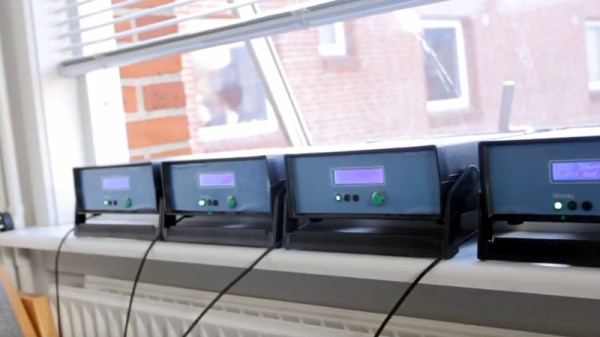
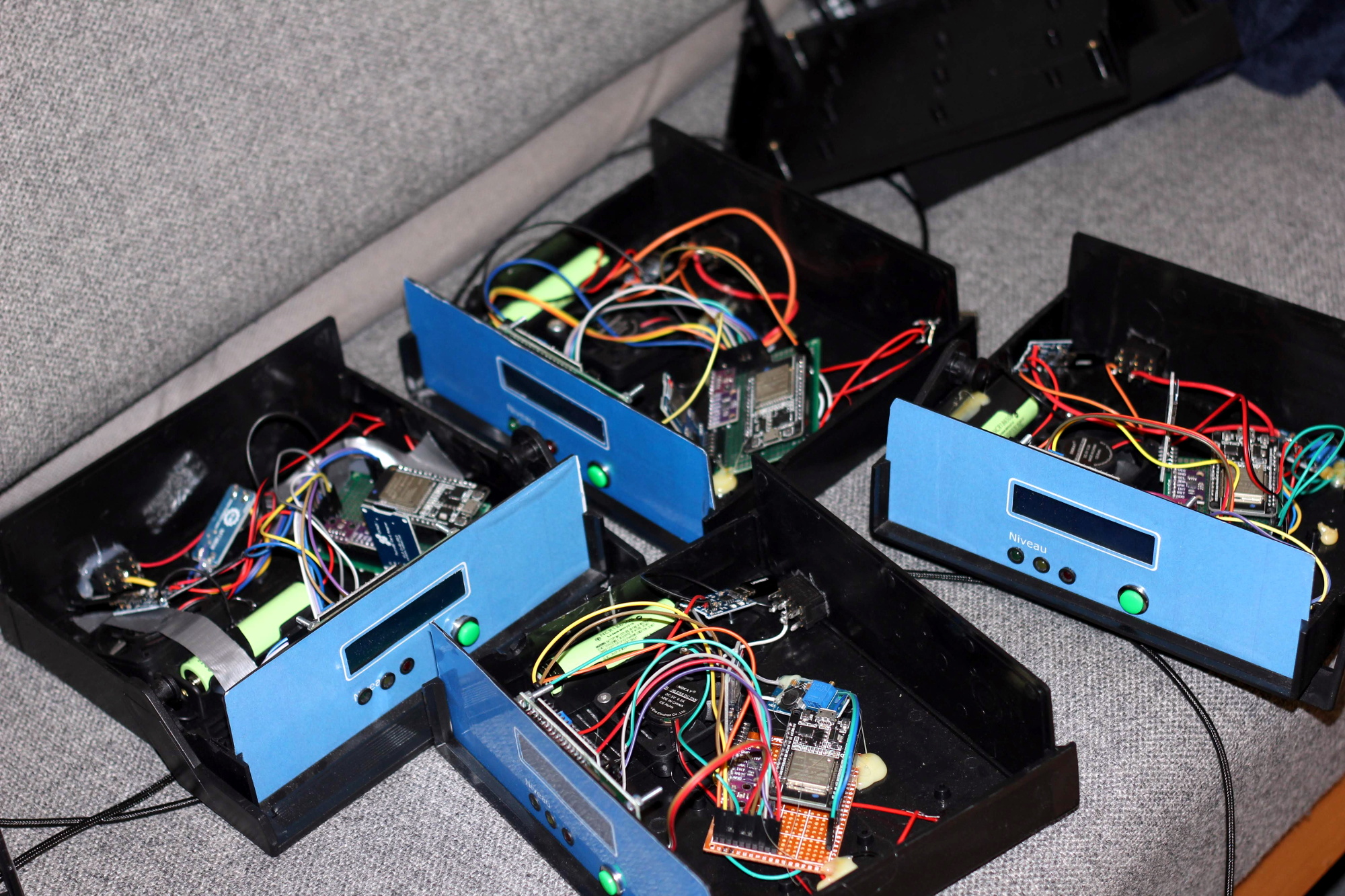
Judging by what he’s got so far, we think [Samuel Klit] is well on his way. He’s using the ESP32 and some off-the-shelf modular components to create an Internet-connected air quality monitoring station. But he’s not just building one or two of them, he’s building enough so they can be distributed and collect data over a wide area. Who knows, perhaps you’ll be building one next.

[Samuel] is using the CCS811 sensor which can pick up potentially harmful Volatile Organic Compounds (VOCs) and determine carbon dioxide concentrations, as well as a BMP280 sensor to read ambient temperature and atmospheric pressure. There’s also an SD card reader for local data storage, a 1602 LCD display that provides a basic user interface, and the electronics required to support the 18650 Li-Ion batteries which power the unit for up to 12 hours on a charge. Everything’s held in a professional looking enclosure that we’ll be sure to add to our next AliExpress order.

Collecting data is one thing, but what do you do with it once you’ve got it? To that end, each node runs a web interface that not only allows you to view current hardware status and download the locally stored data, but also provides an easy to understand visual representation of the environmental conditions. To get around the limited storage space for web assets on the chip, [Samuel] is calling out to Chart.js to inject some slick graphics into the web interface on-demand. The web interface is a particularly nice touch, and an excellent use of the power and capabilities offered by the ESP32.

We’ve previously seen air quality sensors added to Taxi cabs in Peru, the homes surrounding Barcelona’s Plaza del Sol, and of course [Radu Motisan] has done incredible work towards the goal of creating city-wide environmental monitoring networks. With increasingly capable technologies, it looks like citizens are studying the world around them in greater numbers than ever before.

Continue reading “Building An Army Of ESP32 Air Quality Sensors”