Biological Hacking In The 19th Century Or How The World Almost Lost Wine

While it isn’t quite universal, a lot of people enjoy a glass of wine now and again. But the world faced a crisis in the 1800s that almost destroyed some of the world’s great wines. Science — or some might say hacking — saved the day, even though it isn’t well known outside of serious oenophiles. You might wonder how biological hacking occurred in the 19th century. It did. It wasn’t as fast or efficient, but fortunately for wine drinkers, it got the job done.

When people tell me about new cybersecurity threats, I usually point out that cybercrime isn’t new. People have been stealing money, tricking people into actions, and impersonating other people for centuries. The computer just makes it easier. Even computing itself isn’t a new idea. Counting on your fingers and counting with electrons is just a matter of degree. Surely, though, mashing up biology is a more recent scientific advancement, right? While it is true that CRISPR can make editing genes a weekend garage project, people have been changing the biology of plants and animals for centuries using techniques like selective breeding and grafting. Not as effective, but sometimes effective enough.

Continue reading “Biological Hacking In The 19th Century Or How The World Almost Lost Wine”

Disrupting Cell Biology Hack Chat With Incuvers

Join us on Wednesday 5 June 2019 at noon Pacific for the Disrupting Cell Biology Hack Chat with Incuvers!

A lot of today’s most successful tech companies have creation myths that include a garage in some suburban neighborhood where all the magic happened. Whether there was literally a garage is not the point; the fact that modest beginnings can lead to big things is. For medical instrument concern Incuvers, the garage was actually a biology lab at the University of Ottawa, and what became the company’s first product started as a simple incubator project consisting of a Styrofoam cooler, a space blanket, and a Soda Stream CO2 cylinder controlled by an Arduino.

From that humble prototype sprang more refined designs that eventually became marketable products, setting the fledgling company on a course to make a huge impact on the field of cell biology with innovative incubators, including one that can image cell growth in real time. What it takes to go from prototype to product has been a common theme in this year’s Hack Chats, and Noah, Sebastian, and David from Incuvers will drop by Wednesday to talk about that and more.

join-hack-chatOur Hack Chats are live community events in the Hackaday.io Hack Chat group messaging. This week we’ll be sitting down on Wednesday June 5 at 12:00 PM Pacific time. If time zones have got you down, we have a handy time zone converter.

Click that speech bubble to the right, and you’ll be taken directly to the Hack Chat group on Hackaday.io. You don’t have to wait until Wednesday; join whenever you want and you can see what the community is talking about.

Recovering Data From Floppies With Errors

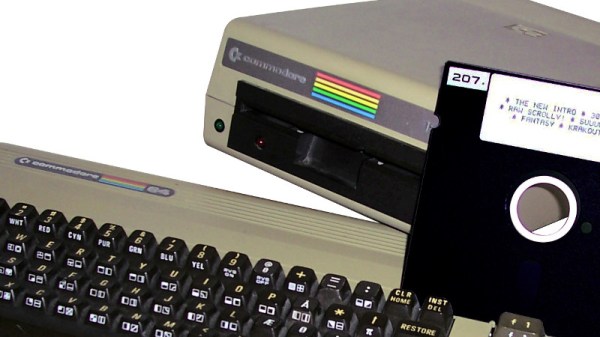
Those of us of advancing years will remember the era of the floppy disc. Maybe not that of the 8-inch drive, but probably its 5.25-inch and certainly its 3.5-inch cousins. Some will remember the floppy disc fondly, while for others there will be recollections of slow and unreliable media with inadequate capacity, whose ability to hold data for any length of time was severely questionable. Add three decades to the time a disc has spent in storage, and those data errors become frequent. The life of a retrocomputing enthusiast hoping to preserve aged software is made extremely difficult by them, and [] has a few tips to help with recovery.

It’s written with specific reference to Commodore 5.25-inch floppies, but aside from some of the specific software, the techniques could be applied to any discs. Most interesting is his explanation of the mechanisms that lead to bad discs or bad sectors, before he looks at some of the mitigations that might be employed. Cleaning the disc or the drive head with alcohol is explored, then taking a dump of the raw data for detailed inspection and disassembly in search of checksum errors. If in your youth a floppy disc was just something you put in a drive and you never investigated further, perhaps this piece will fill in some of the gaps.

If the thought of a stack of Commodore 64 floppies fills you with dread, how about using an emulator?

Header image: PrixeH [CC BY-SA 3.0].

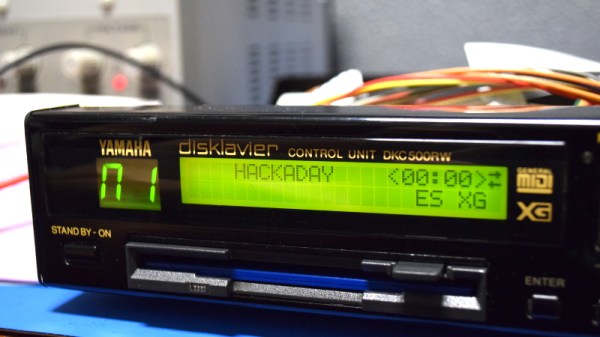
Repairdown: Disklavier DKC500RW Control Unit

If you’ve been kind enough to accompany me on these regular hardware explorations, you’ve likely recognized a trend with regards to the gadgets that go under the knife. Generally speaking, the devices I take apart for your viewing pleasure come to us from the clearance rack of a big box retailer, the thrift store, or the always generous “AS-IS” section on eBay. There’s something of a cost-benefit analysis performed each time I pick up a piece of gear for dissection, and it probably won’t surprise you to find that the least expensive doggy in the window is usually the one that secures its fifteen minutes of Internet fame.

DKC500RW installed on right side.

But this month I present to you, Good Reader, something a bit different. This time I’m not taking something apart just for the simple joy of seeing PCB laid bare. I’ve been given the task of repairing an expensive piece of antiquated oddball equipment because, quite frankly, nobody else wanted to do it. If we happen to find ourselves learning about its inner workings in the process, that’s just the cost of doing business with a Hackaday writer.

The situation as explained to me is that in the late 1990’s, my brother’s employer purchased a Yamaha Mark II XG “Baby Grand” piano for somewhere in the neighborhood of $20,000. This particular model was selected for its ability to play MIDI files from 3.5 inch floppy disks, complete with the rather ghostly effect of the keys moving by themselves. The idea was that you could set this piano up in your lobby with a floppy full of Barry Manilow’s greatest hits, and your establishment would instantly be dripping with automated class.

Unfortunately, about a month or so back, the piano’s Disklavier DKC500RW control unit stopped reading disks. The piano itself still worked, but now required a human to do the playing. Calls were made, but as you might expect, most repair centers politely declined around the time they heard the word “floppy” and anyone who stayed on the line quoted a price that simply wasn’t economical.

Before they resorted to hiring a pianist, perhaps a rare example of a human taking a robot’s job, my brother asked if he could remove the control unit and see if I could make any sense of it. So with that, let’s dig into this vintage piece of musical equipment and see what a five figure price tag got you at the turn of the millennium.

Continue reading “Repairdown: Disklavier DKC500RW Control Unit”

I Went To The Moon And All I Got Was This Lousy T-Shirt

It’s been a long time coming but [Fran] finally has a DSKY display, a replica of the user interface display found in the Apollo Guidance Computer. The best part? It’s a t-shirt.

This build is a long, long, time in the making first beginning in 2015 when Fran started investigating the DSKY of the Apollo Guidance Computer. At the time, there were reproductions, but honesty they were all terrible. The reproductions used off-the-shelf seven-segment LEDs or light pipes. The real DSKY was a work of art and at the time probably the most complex electroluminescent display ever created. This led [Fran] to a very special trip to the annex of the Air and Space Museum where she was allowed to inspect a real DSKY display. She got all the measurements, and with some non-destructive investigation, she was able to piece together how this very special display was put together.

With that information, [Fran] was able to figure out that this display was a fairly complex series of silk screens. If it’s silk screen, you can put it on a t-shirt, so that’s exactly what [Fran] did. This used a DIY silk screen jig with phosphorescent inks. It’s not an electroluminescent display, but it does glow in the dark.

While this DSKY t-shirt does glow in the dark, that means it’s not an electroluminescent display like the original DSKY. That said, screen printed electroluminescent displays on a t-shirt aren’t unheard of. Several years ago, a screen printing company did a few experiments with EL displays on wearables. Of course, if you want a real electroluminescent DSKY display, [Ben Krasnow] has a very modern reproduction of the screen printed display. The electronics of [Ben]’s project do not resemble what flew to the moon in any way whatsoever; the original DSKY had relays. That said, we’ve never been closer to a modern recreation of the display from an Apollo Guidance Computer, and we have [Fran] and [Ben]’s work to point us forward.

Continue reading “I Went To The Moon And All I Got Was This Lousy T-Shirt”

Tearing Apart Pulse Transformer Switches

If you like mechanical keyboards, you like switches. Historically, switches were weird, with strange capacitive rubber dome switches in Topre boards, buckling springs in the IBM Model M, and beamsprings in earlier IBM keyboards. This teardown of an HP signal generator has the weirdest keyboard switches ever. They’re being called pulse transformer switches, but they are the strangest, weirdest, and most complicated keyboard switch we’ve ever seen

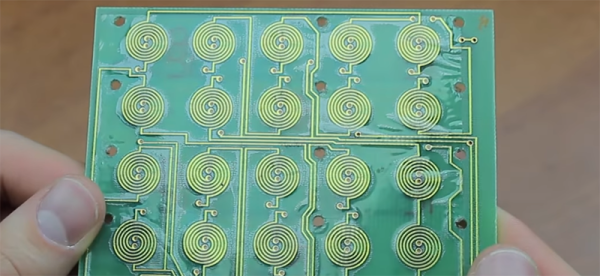
Mechanically, these keys are mounted on a 1×5 plastic frame with a plunger that presses down on a (brass?) photoetched plate. Mechanically, this is effectively a metal dome keyboard that simply presses a springy bit of metal against a contact on a printed circuit board. That’s the mechanical explanation, the electrical theory of operation is much, much weirder.

Electrically, this keyboard consists of a printed circuit board with two coils underneath each key. The circuit is wired up so two keys are ‘read’ at the same time with a pulse from a multiplexer. This pulse induces a current in the ‘sense’ coil of two individual keys which is sent to a comparator. If both keys are not pressed, the comparator sees a positive and a negative voltage which cancels out, meaning no keys are pressed. If one key is pressed, the metal dome shorts out the transformer underneath the keyboard, meaning only one voltage is seen by the comparator, and that key is registered as being pressed.

This is some crazy keyboard circuitry, and I do not say that lightly. There are ‘acoustic’ keyboards out there which consist of a row of keys striking a metal bar with an acoustic transducer on each end. By measuring the time it takes for the sound of a keypress to reach either end of the metal bar, a keypress can be registered. This is weird and expensive to build, and it’s still simpler than a pulse transformer switch. Check out the video below.

Continue reading “Tearing Apart Pulse Transformer Switches”

Animated Pixel Lamp Is A Must For Any Chiptuner’s Bedroom

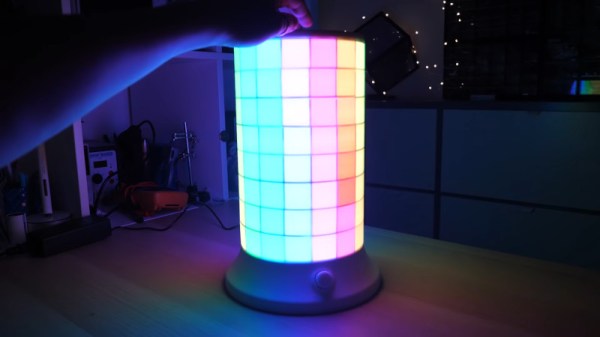
Lamps are quite often simple things, designed to light an area and perhaps add a touch of style to a room. Of course, it’s 2019 now, and we don’t need to settle for just that. We can have wildly colored animated lamps if we want to! (French Youtube link, embedded below.)

The lamp in question is the work of [Heliox], who knows her way around an LED or two (hundred). In this build, a string of WS2812 addressable RGB LEDs are hooked up to an Arduino Mega brain. The LEDs are fitted into a round lamp body, with a rectangular diffuser for each one. This creates an attractive pixellated effect and gives the animations a charming 8-bit quality. A thin outer shell is 3D printed in white plastic to further diffuse the light. The top of the lamp rotates an internal potentiometer to control mode selection. There’s also a brightness knob on the bottom if things get a touch too intense.

It’s a tidy build that uses 3D printing and addressable LEDs to quickly and easily create a lamp with a fun retro aesthetic. We could imagine this making a great piece for a hip sitcom apartment. We fully expect to see similar lamps on sale in the next couple of years. Video after the break.

Continue reading “Animated Pixel Lamp Is A Must For Any Chiptuner’s Bedroom”