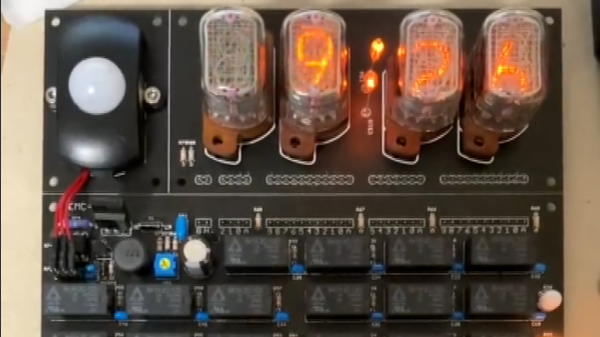
A black PCB with four numeric Nixie tubes on the top, showing 9:26. Under them, a group of black relays is located.

Relay-Driven Nixie Clock Gets You To Stop Scrolling

We don’t often get a Tips line submission where the “Subject” line auto-translates as “Yoshi Yoshi Yoshi”, linking to a short video by [Yasunari Industries] (embedded below). For many, it might be hard to tell what this is at a first glance – however, if the myriad of relays clacking won’t draw your attention, the four Nixie digits on the top definitely will! The gorgeous black PCB has two buttons on the bottom, incrementing hour and minute hours respectively, and observant readers will notice how the LEDs near the relays respond to binary-coded-decimal representation of the digits being shown. This appears to be a relay-based clock with Nixie tubes for digit outputs, and on a scale from “practical” to “eye candy”, it firmly points towards the latter!

The project’s description is quite laconic, but it’s fun to try to figure out what is what based off the few pictures available. The top part with the Nixies and the PIR sensor (presumably for conserving the Nixie tube resources) is V-scored, and a small jumper PCB on the back connects the Nixie module to the relay board – likely, we might see these boards reassembled in a different form-factor, or perhaps find their way into [Yasunari Industries]’ different projects altogether! We can see a Digispark board in the bottom right corner, and wonder if, with addition of that, this board is able to function as a standalone clock — hopefully it does, because that’s one gorgeous addition. And, of course, it all couldn’t happen without help of a bunch of red wires on the back of the board – the author says that some segments were reversed, and the high-voltage PSU section of the board was mis-wired.

Nixie tubes have a dedicated fan base over here, and we keep covering projects that find yet unexplored ways to use Nixies, such as a circular FFT display, or a high-speed camera calibration fixture. Sometimes, Nixie tubes feel like this special sauce you can add to your creation, which explains their popularity in all kinds of barely even counting-adjacent projects, like this TODO indicator. And when we run out of Nixies, we find ways to imitate them – whether it’s with tiny IPS displays, or with layered laser-cut acrylic!

Continue reading “Relay-Driven Nixie Clock Gets You To Stop Scrolling” →

The PawPet board in a 3D-printed case, with a d-pad on the right and four buttons on the left. On its small monochrome screen, there's a cat-like pet looking at you.

Reject Modernity; Return To Tamagotchi

Browsing through the recent projects on Hackaday.io, we’ve found this entry by [NanoCodeBug]: a single-PCB low-power trinket reviving the “pocket pet” concept while having some fun in the process! Some serious thought was put into making this device be as low-power as possible – with a gorgeous Sharp memory LCD and a low-power-friendly SAMD21, it can run for two weeks on a pair of mere AAA batteries, and possibly more given a sufficiently polished firmware. The hardware has some serious potential, with the gadget’s platform lending itself equally well to Arduino or CircuitPython environments, the LCD being overclock-able to 30 FPS, mass storage support to enable pet transfer and other PC integrations, a buzzer for all of your sound needs, and an assortment of buttons to help you create mini-games never seen before. [NanoCodeBug] has been working on the hardware diligently for the past month, having gone through a fair few revisions – this is shaping up to be a very polished gadget!

There’s no wonder that people love to start Tamagotchi-like projects – something special happens when an electronic device invokes the same feelings that we’d get while caring for our own pet, and this project does justice to the idea. With homebrew Tamagotchi projects, there’s a trend – once hardware is finished, the software doesn’t always get to a usable stage, feeling more like an afterthought. There’s a hacker twist that should help us subvert this trend, however – [NanoCodeBug] has shared all sources with us in a GitHub repository! If you would like to help with the “software” part, you can start working on that with just a few breakouts. The board files are also there, if you feel like the boards are marvelous enough for your liking to go through modern-day component sourcing pains.

Hackers have been playing with the “pocket pet” concept here and there, to delightful and unconventional results. If you’re on the lookout for other serious Tamagotchi recreation projects, this one takes the cake – otherwise, check out this furry Tamagotchi-like Tribble pet, disarming in its cuteness! If you’re one of our mischief-minded hackers, we have two posts to keep you entertained – one about dumping ROM on newer Tamagotchi toys, and another about building a WiFi-cracking one. And when it comes to the spirit of “what we have on hand” builds, this giant desktop-sized LED matrix Tamagotchi fits the bill pretty well!

Three pendants that the article is describing, on a drafting mat.They're heart-shaped red PCBs with LEDs all around its perimeter, two CR2032-like batteries in its center.

Heart-Shaped Heartwarming Valentine’s Day Pendant

This is no ordinary heart-shaped PCB pendant project! To us, it’s also symbol representing the striking amount of love that [SaltyPaws] has put into its design and documentation. He tells us that he designed it for the two daughters he is raising, as an electronics and general STEAM introduction – with outstanding educational and aesthetic qualities, giving insights into a wide range of topics while looking . The PCB is mostly through-hole, making for easy soldering and quick return on the effort investment. The project is thought-out beyond the PCB, however – this pendant is designed to be wearable day-to-day, which is why it’s accompanied by a 3D-printed frame, protecting its wearer from sharp PCB edges and through-hole lead ends!

Open-sourcing things is a gift, and today, we are also the recipients. [SaltyPaws] has open-sourced everything involved – PCB files, 3D cover files, firmware, BOM, everything you would need to build your own version. All of this is in a GitHub repository, with detailed sourcing and assembly instructions in the README.md – we couldn’t ask for more! If you have loved ones that would take delight in putting such a pretty pendant together, you have about a week to order the PCBs – after that, Chinese New Year will likely thwart your plans!

Looking for more accessories that double as electronics projects? We’ve covered a wide variety, even when it comes to pendants alone – check out this edge-lit fluorescent acrylic educational Maker Faire accessory, or this circuit sculpture BEAM-inspired bird-imitating one, or this tiny SAMD21-powered pendant with an IPS LCD!

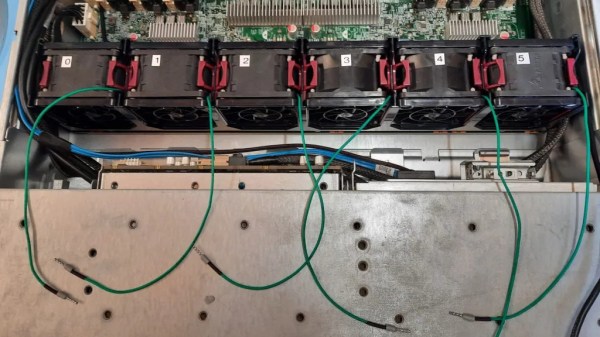
A HP Proliant 360 g6 server with its lid taken off, showing separate green wires coming out of every fan, enabling Dave's modification

Domesticating Old Server Hardware In The Age Of Shortages

Our own [Dave Rowntree] started running into bottlenecks when doing paid work involving simulations of undisclosed kind, and resolved to get a separate computer for that. Looking for budget-friendly high-performance computers is a disappointing task nowadays, thus, it was time for a ten-year-old HP Proliant 380-g6 to come out of Dave’s storage rack. This Proliant server is a piece of impressive hardware designed to run 24/7, with a dual CPU option, eighteen RAM slots, and hardware RAID for HDDs; old enough that replacement and upgrade parts are cheap, but new enough that it’s a suitable workhorse for [Dave]’s needs!

After justifying some peculiar choices like using dual low-power GPUs, only populating twelve out of eighteen RAM slots, and picking Windows over Linux, [Dave] describes some hardware mods needed to make this server serve well. First, a proprietary hardware RAID controller backup battery had to be replaced with a regular NiMH battery pack. A bigger problem was that the server was unusually loud. Turns out, the dual GPUs confused the board management controller too much. Someone wrote a modded firmware to fix this issue, but that firmware had a brick risk [Dave] didn’t want to take. End result? [Dave] designed and modded an Arduino-powered PWM controller into the server, complete with watchdog functionality – to keep the overheating scenario risks low. Explanations and code for all of that can be found in the blog post, well worth a read for the insights alone.

If you need a piece of powerful hardware next to your desk and got graced with an used server, this write-up will teach you about the kinds of problems to look out for. We don’t often cover server hacks – the typical servers we see in hacker online spaces are full of Raspberry Pi boards, and it’s refreshing to see actual server hardware get a new lease on life. This server won’t ever need a KVM crash-cart, but if you decide to run yours headless, might as well build a crash-cart out of a dead laptop while you’re at it. And if you decide that running an old server would cost more money in electricity bills than buying new hardware, fair – but don’t forget to repurpose it’s PSUs before recycling the rest!

An artistic representation of a red Moon, hovering over the Earth

Is That The Moon Worming Its Way Into Your BIOS?

When facing a malware situation, the usual “guaranteed solution” is to reinstall your OS. The new developments in malware world will also require you to have a CH341 programmer handy. In an arguably inevitable development, [Kaspersky Labs] researchers have found an active piece of malware, out in the wild, that would persist itself by writing its bootstrap code into the BIOS chip. It doesn’t matter if you shred the HDD and replace it with a new one. In fact, so-called MoonBounce never really touches the disk at all, being careful to only store itself in RAM, oh, and the SPI flash that stores the BIOS code, of course.

MoonBounce is Microsoft-tailored, and able to hook into a chain of components starting from the UEFI’s DXE environment, through the Windows Loader, and finishing as a part of svchost.exe, a process we all know and love.

This approach doesn’t seem to be widespread – yet, but it’s not inconceivable that we’ll eventually encounter a ransomware strain using this to, ahem, earn a bit of extra cash on the side. What will happen then – BIOS reflashing service trucks by our curbsides? After all, your motherboard built-in BIOS flasher UI is built into the same BIOS image that gets compromised, and at best, could be disabled effortlessly – at worst, subverted and used for further sneaky persistence, fooling repairpeople into comfort, only to be presented with one more Monero address a week later.

Will our hardware hacker skills suddenly go up in demand, with all the test clip fiddling and SOIC-8 desoldering being second nature to a good portion of us? Should we stock up on CH341 dongles? So many questions!

This week’s installment of “threat vectors that might soon become prevalent” is fun to speculate about! Want to read about other vectors we might not be paying enough attention to? Can’t go wrong with supply-chain attacks on our repositories! As for other auxiliary storage-based persistence methods – check out this HDD firmware-embedded proof-of-concept rootkit. Of course, we might not always need the newfangled ways to do things, the old ways still work pretty often – you might only need to disguise your malicious hardware as a cool laptop accessory to trick an average journalist, even in a hostile environment.

Continue reading “Is That The Moon Worming Its Way Into Your BIOS?” →

A bird-shaped yellow PCB with legs wound out of wire, perched on its creator's arm. The bird has a lot of through-hole components on it, as well as an assortment of different-colored LEDs.

Printed Circuit Bird Family Calls For Us To Consider Analog

On our favourite low-attention-span content site, [Kelly Heaton] has recently started sharing a series of “Printed Circuit Birds”. These are PCBs shaped like birds, looking like birds and chirping like birds – and they are fully analog! The sound is produced by a network of oscillators feeding into each other, and, once tuned, is hardly distinguishable from the bird songs you might hear outside your window. Care and love was put into making this bird life-like – it perches on Kelly’s arm with legs woven out of single-strand wire and talons made out of THT resistors, in the exact same way you would expect a regular bird to sit on your arm – that is, if you ever get lucky enough. It’s not just one bird – there’s a family of circuit animals, including a goose, a crow and even a cricket.

Why did these animals came to life – metaphorically, but also, literally? There must be more to a non-ordinary project like this, and we asked Kelly about it. These birds are part of her project to explore models of consciousness in ways that we typically don’t employ. Our habit is to approach complex problems in digital domains, but we tend to miss out on elegance and simplicity that analog circuits are capable of. After all, even our conventional understanding of a neural network is a matrix of analog coefficients that we then tune, a primitive imitation of how we assume human brains to work – and it’s this “analog” approach that has lately moved us ever so closer to reproducing “intelligence” in a computer.

Kelly’s work takes a concept that would have many of us get the digital toolkit, and makes it wonderfully life-like using a small bouquet of simple parts. It’s a challenge to our beliefs and approaches, compelling in its grace, urging us to consider and respect analog circuits more when it comes to modelling consciousness and behaviours. If it’s this simple to model sounds and behaviour of a biological organism, a task that’d have us writing DSP and math code to replicate on a microcontroller – what else are we missing from our models?

Kelly has more PCBs to arrive soon in preparation for her NYC exhibit in February, and will surely be posting updates on her Twitter page! We’ve covered her work before, and if you haven’t seen it yet, her Supercon 2019 talk on Electronic Naturalism would be a great place to start! Such projects tend to inspire fellow hackers to build other non-conventional projects, and this chirping pendant follows closely in Kelly’s footsteps! The direction of this venture reminds us a lot of BEAM robotics, which we’ve recently reminisced upon as something that’s impacted generations of hackers to look at electronics we create through an entirely different lens.

Continue reading “Printed Circuit Bird Family Calls For Us To Consider Analog” →

A Zhengbang Pick&Place machine, with a Virustotal 53/69 result and "53 security vendors and 1 sandbox flagged this file as mailcious" crudely overlaid on top of the image

Zhengbang Pick & Places Your Confidential Data In The Bag, Slowly

Isn’t it convenient when your pick-and-place machine arrives with a fully-set-up computer inside of it? Plug in a keyboard, mouse and a monitor, and you have a production line ready to go. Turns out, you can have third parties partake in your convenience by sharing your private information with them – as long as you plug in an Ethernet cable! [Richard] from [RM Cybernetics] has purchased a ZhengBang ZB3245TSS machine, and in the process of setting it up, dutifully backed up its software onto a USB stick – as we all ought to.

This bit of extra care, often missed by fellow hackers, triggered an antivirus scanner alert, and subsequently netted some interesting results on VirusTotal – with 53/69 result for a particular file. That wasn’t conclusive enough – they’ve sent the suspicious file for an analysis, and the test came back positive. After static and dynamic analysis done by a third party, the malware was confirmed to collect metadata accessible to the machine and send it all to a third-party server. Having contacted ZhengBang about this mishap, they received a letter with assurances that the files were harmless, and a .zip attachment with replacement “clean” files which didn’t fail the antivirus checks.

It didn’t end here! After installing the “clean” files, they also ran a few anti-malware tools, and all seemed fine. Then, they plugged the flash drive into another computer again… to encounter even more alerts than before. The malware was equipped with a mechanism to grace every accessible .exe with a copy of itself on sight, infecting even .exe‘s of the anti-malware tools they put on that USB drive. The article implies that the malware could’ve been placed on the machines to collect your company’s proprietary design information – we haven’t found a whole lot of data to support that assertion, however; as much as it is a plausible intention, it could have been a case of an unrelated virus spread in the factory. Surprisingly, all of these discoveries don’t count as violations of Aliexpress Terms and Conditions – so if you’d like to distribute a bunch of IoT malware on, say, wireless routers you bought in bulk, now you know of a platform that will help you!

This goes in our bin of Pretty Bad News for makers and small companies. If you happen to have a ZhengBang pick-and-place machine with a built-in computer, we recommend that you familiarize yourself with the article and do an investigation. The article also goes into details on how to reinstall Windows while keeping all the drivers and software libraries working, but we highly recommend you worry about the impact of this machine’s infection spread mechanisms, first.

Supply chain attacks, eh? We’ve seen plenty of these lately, what’s with communities and software repositories being targeted every now and then. Malware embedded into devices from the factory isn’t a stranger to us, either – at least, this time we have way more information than we did when Supermicro was under fire.

Editor’s Note: As pointed out by our commenters, there’s currently not enough evidence to assert that Zhengbang’s intentions were malicious. The article has been edited to reflect the situation more accurately, and will be updated if more information becomes available.

Editor’s Note Again: A rep from Zhengbang showed up in the comments and claims that this was indeed a virus that they picked up and unintentionally passed on to the end clients.