The Continuing Adventures Of A Project That Will Be Stolen

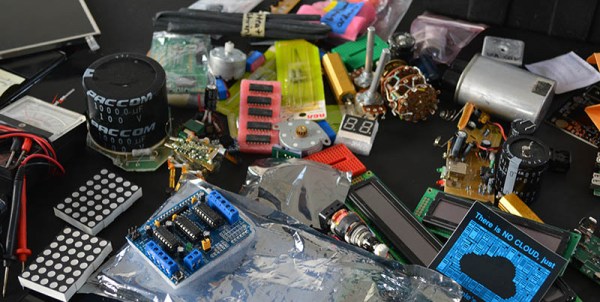
Imagine if the Snap-on tool truck wasn’t filled with hand tools. Imagine if that Snap-on truck was a mobile electronics surplus shop. That’s the idea behind the Travelling Hacker Box. It’s a box, shipped from hacker to hacker, filled with weird and esoteric components, enough parts to build a 3D printer, and enough capacitors to stop an elephant’s heart.

If this is the first time you’ve heard about the Travelling Hacker Box, here’s the quick FAQ to get you up to speed. Has this been done before? Yes, yes it has. The Great Internet Migratory Box of Electronics Junk was a ‘thing’ done by Evil Mad Scientist back in the ‘aughts. Hackaday (or rather the old commander in chief Eliot) received one of these boxes, and sent it off to [Bre Pettis]. Keep in mind, this was in 2008. Is there more than one Travelling Hacker Box actively travelling? No. Because I don’t want to organize a second. Either way, the Travelling Hacker Box has two goals: distance travelled and number of people visited. With just one box, we can maximize both objectives. What are the current travel plans? That’s the next paragraph.

US-Trips
The travels of the Travelling Hacker Box Mk. 2

As of right now, the second version of the Travelling Hacker Box – the first box was stolen by some waste of oxygen in Georgia – has travelled at least 21,838 miles around the United States, visiting 11 prolific hackaday.io contributors in Wyoming, New York, Alaska, Hawaii, New Hampshire, Florida, Wisconsin, Maine, and California. The goal for the first dozen or so trips across the United States was to put miles on the box. 25,000 miles would be equivalent to a trip around the world using only US Postal Service flat rate boxes. Thanks to [Lloyd T Cannon]’s reinforcement of a medium flat rate box with canvas, foam, Kevlar, and custard, this iteration of the Travelling Hacker Box has held up spectacularly.

The goal for the next two months is to make a trip around the United States to maximize the number of US hackers who contributed to the box. This trip will start in Pasadena, CA, go up the west coast to Seattle, loop around the Canadian border to New England, go down the Eastern seaboard, across to Texas, over the desert, and land back at Home Base in Pasadena. From there, the Travelling Hacker Box is off to England, the EU, Asia, India, maybe Africa, and Australia.

While there are already a few people scheduled for this last trip around the US, more are needed. If you’re interested, check out the project on hackaday.io, request to join the project, send a message on the team chat, and generally bug me on the hackaday.io chat. There are plenty of spaces to fill in this last trip around the US and the current inventory is quite a haul. Not bad for a project that will eventually be stolen.

An Open Source Two Stroke Diesel

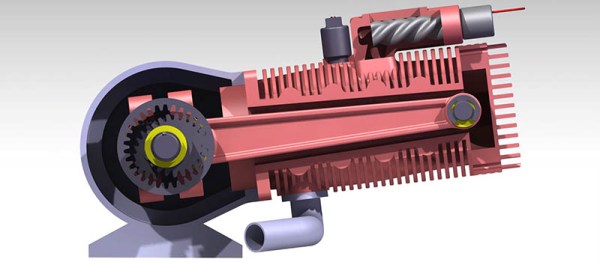
With a welder and a bunch of scrap, you can build just about anything that moves. Want a dune buggy? That’s just some tube and a pipe bender. Need a water pump? You might need a grinder. A small tractor? Just find some big knobby tires in a junkyard. Of course, the one thing left out of all these builds is a small motor, preferably one that can run on everything from kerosene to used cooking oil. This is the problem [Shane] is tackling for his entry to the 2016 Hackaday Prize. It’s an Open Source Two-Stroke Diesel Engine that’s easy for anyone to build and has minimal moving parts.

[Shane]’s engine is based on the Junkers Jumo 205 motor, a highly successful aircraft engine first produced in the early 1930s and continued production through World War II. This is a weird engine, with two opposed pistons in one cylinder that come very close to slamming together. It’s a great design for aircraft engines due to it’s lightweight construction. And the simplicity of the system lends itself easily to wartime field maintenance.

The Jumo 205 was a monstrous 12-piston, 6-cylinder engine, but for [Shane]’s first attempt, he’s scaling the design down to a 50cc motor with the intent of scaling the design up to 125cc and 250cc. So far, [Shane] has about 30 hours of simple CAD work behind him and a ton of high-level FEA work ahead of him. Then [Shane] will actually need to build a prototype.

This is actually [Shane]’s second entry to the Hackaday Prize with this idea. Last year, he threw his hat into the ring with the same idea, but building a working diesel power plant is a lot of work. Too much for one man-year, certainly, so we can’t wait to see the progress [Shane] makes this year.

The HackadayPrize2016 is Sponsored by:

Build Your Own GSM Base Station For Fun And Profit

Over the last few years, news that police, military, and intelligence organizations use portable cellular phone surveillance devices – colloquially known as the ‘Stingray’ – has gotten out, despite their best efforts to keep a lid on the practice. There are legitimate privacy and legal concerns, but there’s also some fun tech in mobile cell-phone stations.

Off-the-shelf Stingray devices cost somewhere between $16,000 and $125,000, far too rich for a poor hacker’s pocketbook. Of course, what the government can do for $100,000, anyone else can do for five hundred. Here’s how you build your own Stingray using off the shelf hardware.

[Simone] has been playing around with a brand new BladeRF x40, a USB 3.0 software defined radio that operates in full duplex. It costs $420. This, combined with two rubber duck antennas, a Raspberry Pi 3, and a USB power bank is all the hardware you need. Software is a little trickier, but [Simone] has all the instructions.

Of course, if you want to look at the less legitimate applications of this hardware, [Simone]’s build is only good at receiving/tapping/intercepting unencrypted GSM signals. It’s great if you want to set up a few base stations at Burning Man and hand out SIM cards like ecstasy, but GSM has encryption. You won’t be able to decrypt every GSM signal this system can see without a little bit of work.

Luckily, GSM is horribly, horribly broken. At CCCamp in 2007, [Steve Schear] and [David Hulton] started building a rainbow table of the A5 cyphers that is used on a GSM network between the handset and tower. GSM cracking is open source, and there are flaws in GPRS, the method GSM networks use to relay data transmissions to handsets. In case you haven’t noticed, GSM is completely broken.

Thanks [Justin] for the tip.

Stolen Tech: The Soviet Shuttle

The US Space Shuttle program is dead and buried. The orbiters can now be found in their permanent homes in the Air and Space Museum, Kennedy Space Center, and the California Science Center. The launch pads used by the shuttles over a career of 135 launches are being repurposed for vehicles from SpaceX and the Space Launch System. Yes, some of the hardware and technology will be reused for NASA’s next generation of heavy launch vehicles, but the orbiter – a beautiful brick of a space plane – is forever grounded.

The Space Shuttle was a product of the cold war, and although the orbiters themselves were never purely military craft, the choices made during the design of the Space Shuttle were heavily influenced by the US Air Force. The Soviet Union was keenly aware the United States was building a ‘space bomber’ and quickly began development of their own manned spaceplane.

While this Soviet Shuttle would not be as successful as its American counterpart — the single completed craft would only fly once, unmanned — the story of this spaceplane is one of the greatest tales of espionage ever told. And it ends with a spaceship that was arguably even more capable than its American twin.

Continue reading “Stolen Tech: The Soviet Shuttle”

Error Correction Of 3D Printers

From the very first RepRaps to the newest and latest printers off the Makerbot assembly line, nearly every consumer 3D printer has one significant shortcoming: it cannot recover from missed steps, slipped belts, or overheating stepper drivers. Although these are fairly rare problems, it does happen and is purely a product of the closed open-loop control system used in 3D printer firmware.

[Chris Barr] has come up with a rather clever solution to this problem. He’s designed a system that will detect and correct problems with the mechanics of 3D printers. It’s technically not a closed-loop control system, but it does allow him to get the absolute position of a nozzle on the build plate, detects error states, and can automatically calculate the number of motor steps per millimeter. It’s also much simpler than other closed loop control systems we’ve seen in the past, requiring only a few bits and bobs attached to the axes and to the printer controller board.

[Chris]’ system uses a magnetic encoding strip, a single chip, and a little bit of support circuitry. It’s actually not that much different from the moving axis on a desktop inkjet printer. It’s not closed loop, though; the firmware hack is only a ‘basic error correction’ that moves the nozzle back to where it should be. Although this is somewhat of a kludge, it is much simpler than refactoring the entire printer firmware.

In the video below, [Chris] demonstrates his solution for error correcting the printer by jerking his axis around during a print. The nozzle miraculously returns to where it should be, producing a usable part.

Continue reading “Error Correction Of 3D Printers”

Machines That Build Other Machines

When the RepRap project was founded in 2005, it promised something spectacular: a machine that could build copies of itself. RepRaps were supposed to be somewhere between a grey goo and a device that could lift billions of people out of poverty by giving them self-sufficiency and the tools to make their lives better.

While the RepRap project was hugely successful in creating an open source ecosystem around 3D printers, a decade of development hasn’t produced a machine that can truly build itself. Either way, it’s usually easier and cheaper to buy a 3D printer than to build your own.

[castvee8]’s entry into the 2016 Hackaday Prize does just what the RepRap project promised ten years ago. It’s all about building machines with the ability to reproduce, creating an ecosystem of machines to build household goods. The best part? You can 3D print most of the machines. It’s the RepRap project, but for mills, lathes, microscopes, and routers. It’s an entire shop produced entirely in a 3D printer.

The idea of creating a machine shop from the most basic building materials has been around for a while. At the turn of the last century, concrete lathes and mills bootstrapped industrial economies. Decades later, [David J. Gingery] created a series of books on building a machine shop starting with a charcoal foundry. The idea of building a shop using scrap and the most minimal tools is very old, but this idea hasn’t been updated to the era where anyone can buy a 3D printer for a few hundred dollars.

So far, [castvee8] has a few homemade machine tools on the workbench, including a lathe, a tiny mill easily capable of fabricating a few circuit boards, and a little drill press. They’re all machines that can be used to make other useful items, and all allow anyone to create the devices they need.

The HackadayPrize2016 is Sponsored by:

The State Of 3D Printing At MRRF

Only a few days ago, a significant proportion of the Hackaday crew was leaving Goshen, Indiana after the fourth annual Midwest RepRap Festival. We go to a lot of events every year, and even when you include DEF CON, security conferences, ham swap meets, and Maker Faires, MRRF is still one of the best. The event itself is an odd mix of people rallying under a banner of open source hardware and dorks dorking around with 3D printer. It’s very casual, but you’re guaranteed to learn something from the hundreds of attendees.

Hundreds of people made the trek out to Goshen this year, and a lot of them brought a 3D printer. Most of these printers aren’t the kind you can buy at a Home Depot or from Amazon. These are customized machines that push the envelope of what consumer 3D printing technology. If you want to know what 3D printing will be like in two or three years, you only need to come to MRRF. It’s an incubator of great ideas, and a peek at what the future of 3D printing holds.

Continue reading “The State Of 3D Printing At MRRF”