ARM Unveils New, High Efficency CPU

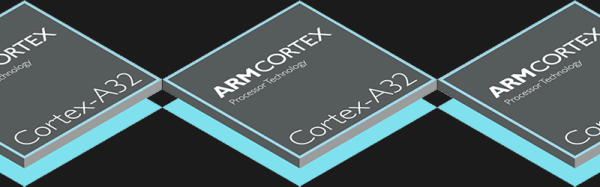
ARM has announced their latest IP core the Cortex A32. This 32-bit chip brings the benefits of the ARMv8-A architecture to low-power devices, ostensibly ones that will be the backbone of the Internet of Things.

For the last few years, the state of ARM CPUs has been firmly planted in the world of ARMv7 instructions. These chips, the Cortex A5, A7, A9, A15, and A17 are divided into ‘good, better, best’ segments, with the A7 pulling its weight as the processor in the Raspberry Pi 2, and a dual-core A15 finding its way into the latest BeagleBoard. While these CPUs are very capable, they don’t support the latest ARM architecture, ARMv8. For the last few years, the only ARM processors with the v8 architecture fell into the ‘better’ and ‘best’ segments. Although the A53, A57, and A72 chips are very capable, there hasn’t been a low power ARMv8 chip until this announcement.

So what does this announcement mean for the next generation of the Internet of Things, single board computers, and the wearable electronics of tomorrow? Absolutely nothing. Only the processor IP was released, and it will take at least a year for this core to make it into a chip. It will be 18 to 24 months until you can find this core in a consumer device. On the other hand, when these devices do appear, they will be significantly faster than current devices with a Cortex A5 and A7.
Breaking SimpliSafe Security Systems With Software Defined Radio

The SimpliSafe home security system is two basic components, a keyboard and a base station. Sensors such as smoke detectors, switches, and motion sensors can be added to this system, all without a wired installation. Yes, this security system is completely wireless. Yes, you can still buy a software defined radio for ten dollars. Yes, the device has both “simple” and “safe” in its name. We all know where this is going, right?

Last week, [Andrew Zonenberg] at IOActive published a security vulnerability for the SimpliSafe wireless home security system. As you would expect from an off-the-shelf, wireless, DIY security system, the keypad and base station use standard 433 MHz and 315 MHz ISM band transmitters and receivers. [Dr. Zonenberg]’s attack on the system didn’t use SDR; instead, test points on the transmitters were tapped and messages between the keypad and base station were received in cleartext. When the correct PIN is entered in the keypad, the base station replies with a ‘PIN entered’ packet. Replaying this packet with a 433 MHz transmitter will disable the security system.

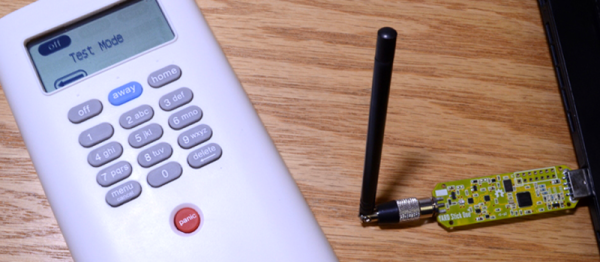
[Michael Ossmann] took this one step further with a software defined radio. [Ossmann] used a HackRF One to monitor the transmissions from the keypad and turned to a cheap USB SDR dongle to capture packets. Replaying keypad transmissions were easy, but with a little bit more work new attacks can be found. The system can be commanded to enter test mode even when the system is armed bypassing notifications to the owner.

It’s a hilarious failure of wireless security, especially given the fact that this exploit can be performed by anyone with $100 in equipment. With a little more effort, an attacker can execute a PIN replay from a mile away. Sadly, failures of security of this magnitude are becoming increasingly common. There will assuredly be more attacks of this kind in the future, at least until hardware manufacturers start taking the security (of their security products) seriously.

Rethinking Automated Bed Leveling For 3D Printers

Automatic bed leveling is the next killer feature that will be found on all commercial filament printers. It’s a problem that has been solved a few dozen times already; there are just so many ways you can go about it. The Printrbot uses an inductive sensor to determine the position of the metal bed in relation to the nozzle. The Lulzbot Mini touches the nozzle itself to four contacts on the corner of the bed. There are even a few projects that will mechanically level the bed with the help of a system of cams and springs. It’s a difficult problem, and none of these solutions are perfect. [mjrice] has been thinking about the problem, and he hit upon a solution that is simple, elegant, and can be replicated on a 3D printer. It’s the RepRap solution to 3D printing, and it looks cool, to boot.

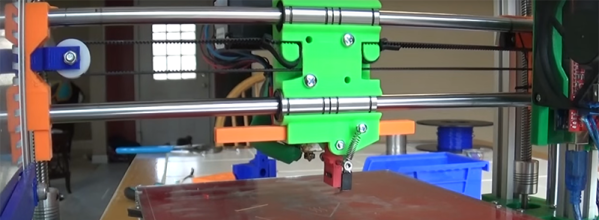
Instead of using the nozzle as a contact, getting an inductive sensor, or fabricating a baroque system of gears and cams, [mjrice] is doing this the old-fashioned way: a simple microswitch, the same type of switch you would find on the limit switches of any RepRap. Having a switch at the same Z position as a nozzle is an iffy idea, so [mjrice] made this switch retract into the extruder during printing, without using any motors, servos, or other electromechanical contrivances.

The key to this setup is a simple spring and a rack gear. When this rack gear is hit from the left side, it moves an arm and places the switch down on the bed. Hit the rack from the right side, and the switch folds up into the extruder. Combine this with a bit of G-code at the beginning of the print, and the switch will move down, figure out the actual height of the bed, and flip up out of the way. Beautiful, elegant, and the algorithms for bed leveling are already in most major printer firmwares.

You can check out the video of the mechanism below. It’s a great little device, and since it’s on a RepRap first, it’s not going to show up in a proprietary 3D printer next.

Continue reading “Rethinking Automated Bed Leveling For 3D Printers”

Variable Instruction Computing: What Is Old Is New Again

Every twenty to twenty-five years, trends and fads start reappearing. 2016 is shaping up to be a repeat of 1992; the X-files is back on the air, and a three-way presidential election is a possibility. Star Trek is coming back, again. Roll these observations back another twenty-five years, and you have The Outer LimitsStar Trek, and riots at the DNC convention in Chicago.

History repeating itself is not the exclusive domain of politics and popular culture. It happens with tech, too: the cloud is just an extension of thin clients which are an extension of time-sharing. Everything old is new again.

For the last few years, Soft Machines, a fabless semiconductor company running in stealth mode, released the first preview for an entirely new processor architecture. This new architecture, VISC, offers higher performance per Watt than anything available on the market. If you’ve been paying attention for the last decade or so, the future of computing isn’t 200-Watt space heaters that also double as powerful CPUs. The future is low power machines that are good enough to run Facebook or run some JavaScript. With servers, performance per Watt is possibly the most important metric. How will Soft Machines upend the semiconductor market with new processors and new architectures? If you know your history, it shouldn’t be a surprise.

Continue reading “Variable Instruction Computing: What Is Old Is New Again”

The Contrarian Response To Apple’s Need For Encryption

On December 2, 2015, [Syed Rizwan Farook] and [Tashfeen Malik] opened fire at a San Bernardino County Department of Public Health training event, killing 14 and injuring 22. This was the third deadliest mass shooting in the United States in recent memory, and began a large investigation by local, state, and federal agencies. One piece of evidence recovered by the FBI was an iPhone 5C belonging to one of the shooters. In the days and months after the shooting, the FBI turned to Apple to extract data from this phone.

A few days ago in an open letter to customers, [Tim Cook], CEO of Apple, stated they will not comply with FBI’s request to build a backdoor for the iPhone. While the issue at hand is extracting data from an iPhone recovered from the San Bernardino shooting, [Cook] says building a new version of iOS to extract this data would allow the FBI to unlock any iPhone. Needless to say, there are obvious security implications of this request.

Apple does not publish open letters to its customers often. Having one of the largest companies on the planet come out in support of privacy and encryption is nearly unprecedented. There is well-founded speculation this open letter to the public will be exhibit A in a supreme court case. Needless to say, the Internet has gone a little crazy after this letter was published, and rightly so: just imagine how better off we would be if AT&T said no to the NSA in 2002 – [Snowden] might just be another IT geek working for a government contractor.

CalvinThere is a peculiar aspect of public discourse that doesn’t make any sense. In the absence of being able to say anything interesting, some people have just decided to add a contrary viewpoint. Being right, having a valid argument, or even having evidence to support assertions doesn’t matter; being contrary is far more interesting. Look at any comment thread on the Internet, and you’ll find the longest comment chain is the one refuting the parent article. Look up the ratings for a cable news channel. You’ll find the highest rated show is the one with the most bickering. When is the last time you saw something from the New York Times, Washington Post, or LA Times on Facebook or your favorite news aggregator? Chances are, it wasn’t news. It was an op-ed, most likely one that was espousing a view contrary to either public opinion or public policy.


As with any headline event on the Internet, the contrarians have come out of the woodwork. These contrarians are technically correct and exceedingly myopic.

Continue reading “The Contrarian Response To Apple’s Need For Encryption”

The Voice Recognition Typewriter

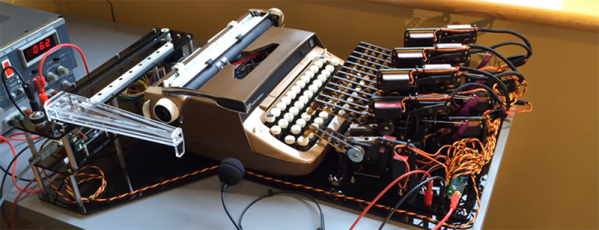
Typewriters with voice recognition have existed for over one hundred years; they were called secretaries. Robots are taking all the jobs now, and finally dictation and typing is a job that can be handled by a computer. [Zip Zaps] used an old Smith Corona typewriter to automate the process of turning dictation into print. Like a secretary hunched over an anachronistic IBM Selectric in the first season of Mad Men, this robot will take dictation and accept the overt sexism of a 1960s Manhattan ad agency.

Instead of the machinations of a few biological actuators, this typewriter is controlled with an array of servos driven by Pololu Maestro servo controller. There are twelve servos that move a small actuator down onto the keys, and another twelve servos that move the others above the correct row of the keyboard. The carriage return lever is actuated by a stepper motor, linear rail, and giant plastic lever.

While a robot that can use a typewriter is impressive, the real trick is getting it to take dictation. [Zip Zaps] used the built-in voice recognition found in Windows for this, streaming characters over a serial port to the Arduino-based electronics.

Does it work? Yes, surprisingly it does. Is it useful? Well, typewriters naturally have a cleaner, more analog tone about them, and you can’t replicate the typing experience of an old Smith Corona typewriter with a digital format. This build is just the natural extension of what digital electronics are capable of these days, and we look forward to seeing someone with this amazing device in our local Starbucks.

Continue reading “The Voice Recognition Typewriter”