Hackaday Links Column Banner

Hackaday Links: November 30, 2014

Tired of wiring up the power rails and serial adapter every time you build something on a breadboard? [Jason] has you covered. He put his Breadboard Buddy Pro up on Indiegogo, and it does everything you’d expect it to: power rails, USB to UART bridge, and a 3.3 V regulator. Oh, he’s not using an FTDI chip. Neat.

With Christmas around the corner, a lot of those cheap 3-channel RC helicopters are going to find their way into stockings. They’re cool toys, but if you want to really have fun with them, you’ll need to add a penny.

Here’s a crowdfunding campaign for a very interesting IoT module. It’s a UART to WiFi adapter that has enough free Flash and RAM to run your own code, GPIOs, SPI, and PWM functions. Wait a second. This is just an ESP8266 module. Stay classy, Indiegogo.

Mankind has sent space probes to the surface – and received pictures from – Venus, Mars, the Moon, Titan, asteroids Itokawa and Eros, and comet Comet 67P/Churyumov–Gerasimenko. In a beautiful bit of geological irony, every single one of these celestial bodies looks like a rock quarry in Wales. That quarry is now for sale.

Here’s something exceptionally interesting. It’s a browser plugin that takes a BOM, and puts all the components into a cart. Here’s the cool bit: it does it with multiple retailers. The current retailers supported are Mouser, Digikey, Farnell/Element14, Newark, and RS Components.

Want a death ray? Too bad, because it’s already been sold.

[Glasslinger] Builds Tiny Tubes

In the early days of transistors, RCA and GE were battling against silicon with ever smaller vacuum tubes. These tubes – Nuvistors, Compactrons, and some extremely small JAN triodes were some of the tiniest tubes to ever be created. [glasslinger], YouTube’s expert on DIY valves, is pretty close to beating the tiniest tubes that were ever manufactured. He’s created a miniature diode and triode that are about 1/4″ in diameter and 1″ long.

The most difficult part of making a vacuum tube is getting a perfect glass seal around the pins. For this, [glasslinger] is using very fine tungsten wire and glass beads. A bead is placed around each wire, mounted in a stand, and melted together with a torch.

A diode is simple as far as tubes go, requiring only a filament between two pins. [glasslinger] is just stringing a fine piece of wire between two pins and welding them on with a miniature spot welder. After that, it’s just an issue of melting a 1/4″ glass tube to the base of the tube, putting it under vacuum overnight, and sealing it shut.

Locking A Beer With A 3D Printer

Have a nice, refreshing IPA sitting in the fridge along with a ton of other beers that have ‘Light’ or ‘Ice’ in their name? Obviously one variety is for guests and the other is for hosts, but how do you make sure the drunkards at your house tell the difference? A beer bottle lock, of course.

Because all beer bottles are pretty much a standard size, [Jon-A-Tron] was able to create a small 3D printed device that fit over the bottle cap. The two pieces are held together with a 4-40 hex screw, and the actual lock comes from a six-pack of luggage padlocks found at the hardware store.

It’s a great device to keep the slackers away from the good stuff, and also adds a neat challenge to anyone that’s cool enough to know basic lock picking. Of course, anyone with a TSA master key can also open the beer lock, but if you’re hosting a party with guest who frequently carry master keys around with them, you’re probably having too good of a time to care.

Transferring Audio To An AVR At 12kbps

Back in the bad ‘ol days of computing, hard drives cost as much as a car, and floppy drives were incredibly expensive. The solution to this data storage problem offered by all the manufacturers was simple – an audio cassette. It’s an elegant solution to a storage problem, and something that has applications today.

[Jari] was working on a wearable message badge with an 8-pin ATTiny. To get data onto this device, he looked at his options and couldn’t find anything good; USB needs two pins and the firmware takes up 1/4 of the Flash, UART isn’t available on every computer, and Bluetooth and WiFi are expensive and complicated. This left using audio to send digital data as the simplest solution.

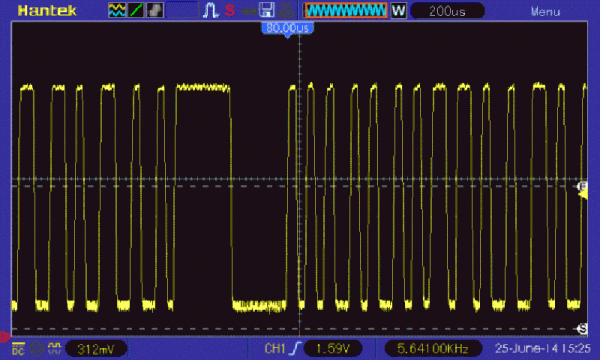
[Jari] went through a ton of Wikipedia articles to figure out the best modulation scheme for transferring data with audio. What he came up with is very simple: just a square wave that’s changed by turning a pin off and on. When the audio is three samples long without crossing zero, the data is 0. When it’s five samples long without crossing zero, the data is 1. There’s a 17-sample long sync pulse, and with a small circuit that acts as a zero crossing detector, [Jari] had a simple circuit that would transfer data easily and cheaply.

All the code for this extremely cheap modem is available on GitHub.

Mixer For Korg Volcas

Korg, everyone’s third or fourth favorite synth company, but one of the only ones that still in business, recently put out a new line of synths, drum machines, and groove boxes. They’re called Volcas, and they’re cheap, analog, and very cool. [Jason] has a few of these Volcas, and while he enjoys the small form factor, using an off-the-shelf mixer to dump send the audio from these machines to his computer takes up too much space. He created a passive mini mixer to replace his much larger Mackie unit.

The circuit for this tiny passive mixer is an exercise in simplicity, consisting of just a few jacks, pots, and resistors. [Jason] overbuilt this; even though the Volcas only have mono out, he wired the entire mixer up for stereo.

The enclosure – something that looks to be a standard Hammond die cast aluminum enclosure – was drilled out, and a lovely laser cut acrylic laminate placed on top. It looks great, and for anyone interested in learning soldering, you couldn’t come up with a better first project.

Recovering Colo(u)r From PAL Tele-recordings

You will never see every episode of Doctor Who, and that’s not because viewing every single episode would require a few months of constant binging. Many of the tapes containing early episodes were destroyed, and of the episodes that still exist, many only live on in tele-recordings, black and white films of the original color broadcast.

Because of the high-resolution of these tele-recordings, there are remnants of the PAL color-coding signal hidden away. [W.A. Steer] has worked on PAL decoding for several years, and figured if anyone could recover the color from these tele-recordings, he could.

While the sensors in PAL video cameras are RGB, a PAL television signal is encoded as luminance, Y (R+G+B), U (Y-B), and V (Y-R). The Y is just the black and white picture, and U and V encode the amplitude of two subcarrier signals. These signals are 90 degrees out of phase with each other (thus Phase Alternating Line), and displaying them on a black and white screen reveals a fine pattern of ‘chromadots’ that can be used to extract the color.

The Zork Virtual Machine Implemented In Hardware

ZorkHitchhiker’s Guide to the Galaxy, and all the other Infocom text adventures are much more clever than the appear at first glance. They actually run on a virtual machine, with all the code for the game files squirreled away in the Z-machine format. This is great if you’re writing a game for a dozen platforms; once you have an interpreter running on one system, the entire library of games can be shipped out the door.

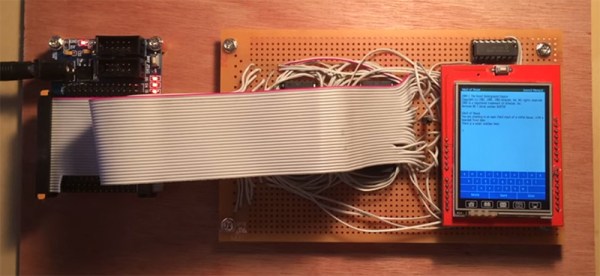
While the Z-machine has been ported to all the retrocomputers you can imagine and a few different brands of microcontrollers, no one has yet implemented the Z-machine in hardware. There’s a reason for this: it’s crazy. Nevertheless, [Charlie] managed to implement the Z-machine in an FPGA, using only a few extra commands for driving a display.

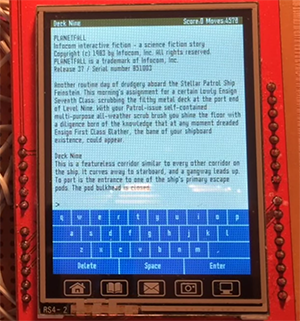
zork2The circuit is constructed with a $10 eBay special FPGA, the Cyclone II EP2C5. Other than that, it’s just some Flash, some RAM, a display, and a whole lot of wire. The standard Z-machine spec is followed, version 3 specifically, meaning this text adventure on a chip can run nearly every Infocom game ever written. The most popular ones, at least.

This isn’t [Charlie]’s first time in the ring with the Infocom Z-machine. He ported the Z-machine to a freakin’ pen a few years ago.

You can check out [Charlie]’s video demo below. Because there was a bit of extra space in the FPGA, [Charlie] managed to put a Mandelbrot implementation and Space Invaders in as an easter egg.

Continue reading “The Zork Virtual Machine Implemented In Hardware”