A Very Small HDMI Display

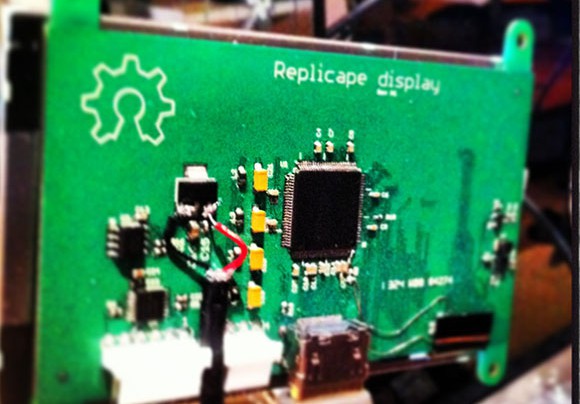
With dozens of pocket-sized ARM boards with HDMI popping up, we’re surprised we haven’t seen this before. [Elias] made a custom driver board that takes an HDMI input and displays it on a very tiny, high-resolution display from a cell phone.

The display used is the same as what comes stock in the HTC desire HD. With a resolution of 800×480, it’s more than enough for a basic desktop, and while it’s not a 1080p monster from a few flagship phones, it’s more than enough for most uses.

[Elias]’ board consists of a Himax display driver and a TI DVI receiver. Included on the board is an MSP430 microcontroller used for initializing the driver and display. This build was originally intended for the Replicape, a 3D printer driver board for the Beaglebone, but because the only connections to this board are HDMI and an SPI to the ‘430, this also works with the Raspberry Pi.

Automata And Wooden Gears

mechanism

While most animated machines we deal with every day – everything from clocks to cars to computers – are made of metal, there is an art to creating automated objects out of wood. [Dug North] is a creator of such inventions, making automata out of wooden gears, cogs, and cams.

[Dug]’s inventions are simple compared to turbine engines, but they still retain an artistry all their own. With just simple woodworking tools, he’s able to creating moving vignettes of everyday scenes, everything from a dog barking at a bird, to Santa Claus gracefully soaring over a house on Christmas Eve.

Below, you’ll find a video of [Dug]’s creation, ‘An Unwelcome Dinner Guest’ – an automated dog barking at a wooden bird. There’s also a video of him being interviewed by the awesome people at Tested last year at the World Maker Faire.

Continue reading “Automata And Wooden Gears”

Rocketduino, For High-G, High Altitude Logging

rocketduino

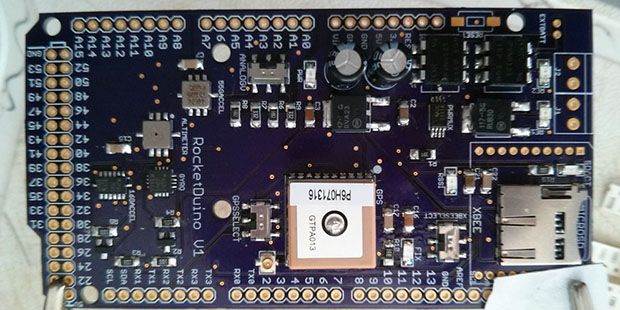
Although the thrill of launching rockets is usually found in their safe decent back to Earth, eventually you’re going to want some data from your flight. Everything from barometric pressure, GPS logging, and acceleration data is a useful thing to have, especially if you’re trying to perfect your craft. [zortness] over on reddit created a data logging board created especially for amateur rocketry, a fabulous piece of work that stands up to the rigors of going very fast and very high.

The design of the board is a shield for the Arduino Mega and Due, and comes with enough sensors for over-analyzing any rocket flight. The GPS logs location and altitude at 66Hz, two accelerometers measure up to 55 G. Barometric, temperature, and compass sensors tell the ground station all the data they would need to know over a ZigBee 900MHz radio link.

Because this is an Arduino, setting up flight events such as deploying the main and drogue chutes are as easy as uploading a bit of code. [zortness] built this for a 4″ diameter rocket, but he says it might fit in a 3″ rocket. We just can’t wait to see some videos of it in action.

Taking Picture Of Exploding Wire

wire

[Patrick] didn’t just want his name in lights. He wanted his name in glowing plasma explosions, made by sending thousands of volts through a very thin wire.

This project is an experiment in capturing high speed images of exploding wires. [Patrick] wanted to know if he could shape wires in such a way that they would explode into letters of plasma. Of course, photographic proof of this would be needed, and would make for an awesome logo in any event.

To get pictures of wire turning into plasma, [Patrick] first needed to construct the necessary electronics. A simple spark gap was constructed on a large plastic cutting board – an excellent high voltage insulator. The huge capacitors are charged with a pair of high voltage transformers, and the entire assembly is triggered with an optocoupler and a very beefy SCR.

Even though [Patrick] designed the system for a low propagation delay, there was still the matter of capturing an exploding wire on film. The camera delay varied by about 120μs, but with a really great camera trigger, [Patrick] eventually got some impressive pictures.

After getting the electronics and photography portion of the build down, [Patrick] turned to making letters out of expanding plasma. Simply shaping the wire into a letter shape before vaporizing it had no effect, so he turned to 3D printed channels to contain the plasma. After a few attempts, this actually worked, allowing him to form the letters L, U, and X in an expanding ball of vaporized wire.

3D Printed Bike Shifter

Shifter

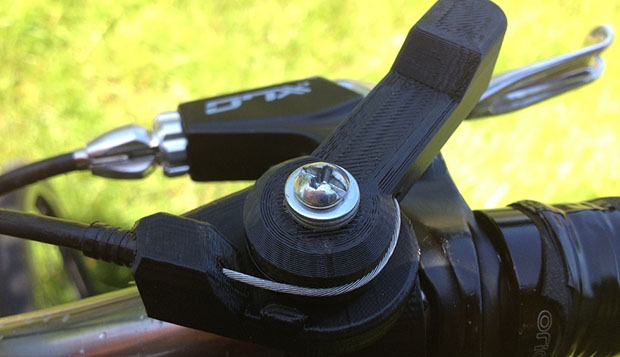
[Rich] is embarking on a fairly long bike trip in a few weeks – Seattle to Portland – and thought including some 3D printed gear on his ride would be a fun endeavor. His first idea was a printed belt drive, but the more he looked at that idea the less realistic it seemed. He finally hit upon the idea of creating a 3D printed bike shifter, and after an afternoon of engineering and printing, the shifter ended up working very well.

[Rich]’s shifter is actually a friction shifter. Instead of ‘clicking’ into position, this type moves the derailleur gradually. It’s much more tolerant of slight misalignment, and most touring bikes – the type that would embark on long journeys along the coast of the Pacific northwest – have these types of shifters.

Total printing time was about one and a half hours, and was attached to [Rich]’s bike with off-the-shelf hardware. He’s already put about 150 miles on his custom designed shifter with no signs of failure.

Putting Two Years Into One Bowl

bowl


Over the last few months, [Frank Howarth] has been putting a lot of effort into a gigantic sequoia log he started milling two years ago. He recently completed a wonderful chair, but in the years these gigantic blocks of lumber have been sitting around, he’s always had one project in the back of his mind: a giant wooden bowl made from this sequoia log.

The wood for this bowl came from a relatively small cutoff from the original sequoia log. [Frank] had initially cut this cutoff into a circle to let it dry for an eventual run on a lathe. The bowl blank was so big, though, that he needed to create a jig to trim off most of the excess and keep from wasting many hours with a gouge.

With a bowl this large – about 20 inches across – simply screwing it onto the lathe wasn’t an option. [Frank] had to construct a jig for his chuck, capable of holding the bowl by the rim so he could shape the bottom.

The end product, coated with linseed oil and beeswax, is a work of art. Making anything this size on a lathe takes a lot of skill, and we’re thankful for [Frank] sharing it with us.

Turning A Router Into An Arduino Shield

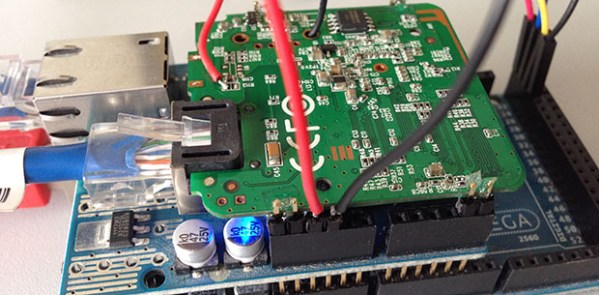
[Dirk] had a problem: while he already had an Arduino with an Ethernet shield, he needed WiFi for an upcoming project. Running a Cat5 cable was out of the question, and a true Arduino WiFi shield is outrageously expensive. He did, however, have a WiFi router lying around, and decided it would make a perfect WiFi shield with just a little bit of cutting.

The router [Dirk] used was a TL-WR702N, a common router found in the parts bins of makers the world over. Inspiringly, the size of the router’s PCB was just larger than the space between the Arduino’s pin headers. Turning the router into a shield is simply a matter of scoring the edge of the board and gluing on a few pins for mechanical strength.

Power and ground lines were soldered between the pin headers and the router, while data is passed to the Arduino and Ethernet shield through a short cable. It may not look pretty, but if it works in a pinch we can’t complain.