Bluetooth Morse Code Keyboard For The Disabled

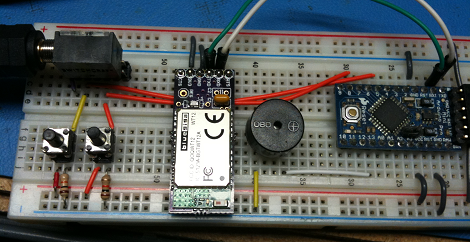
The team a Zunkworks wanted to build a device for people who can’t normally use a keyboard and mouse. The Bluetooth Morse code keyboard is what they came up with. This build gives the user full control over the keyboard and mouse using a single button or a sip & puff interface.

Continue reading “Bluetooth Morse Code Keyboard For The Disabled”

Robotic Gardener Takes Its Cue From Bomb Disposal Bots

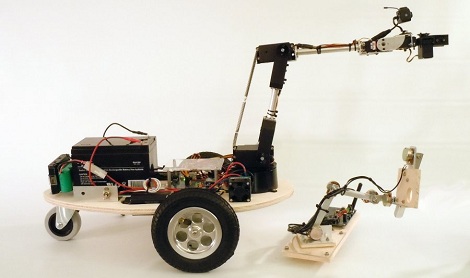
[Dave] posted some pictures and videos of his ‘Nuntius’ robot on the Propeller forums. From the pictures it’s an impressive build, but to really appreciate [Dave]’s skill, check out the Youtube demo.

The controller is a Propeller protoboard with bits of angle aluminum fastened together. Pots are positioned at the joints of the remote’s arm so the robot’s arm can mirror the shape of the remote. We usually see Armatron bots controlled via computer, or in the rare case of human control, a mouse. [Dave]’s build just might be one of the first remote manipulator builds we’ve seen on Hack A Day.

Continue reading “Robotic Gardener Takes Its Cue From Bomb Disposal Bots”

Toy Robot Hand Vastly Improved, Now More Offensive

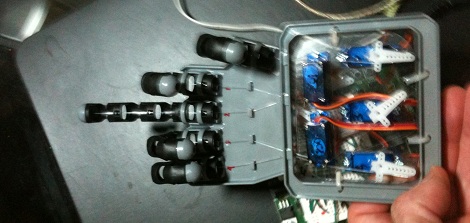
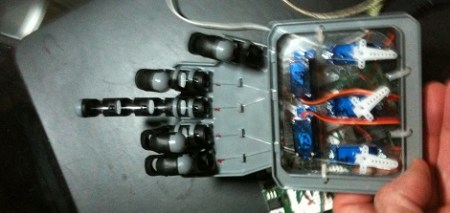
YouTube user [onefivefour] posted a video of his hacked up toy robot hand. These cheap robot hands usually only use one wire to move all five fingers. [onefivefour] improved upon the design and added five servos to allow independent control of each digit.

The servos are controlled by a PICAXE microcontroller, and [onefivefour] is willing to share the code. A few pressure sensors in the fingertips would turn this build into a great test bed for future development. It would also be great for an [Anakin Skywalker] Halloween costume if anyone on the planet ever wanted that specific costume.

[onefivefour] says he only spent $6 on his and while there’s more money sunk into the servos, it was probably a good investment. We love seeing hacked up pieces of plastic like the fully functional Wall-E or the dancing Androids. If you’ve got a toy hack in the works, drop us a line on our tip form.

Putting A PDP-10 On An FPGA

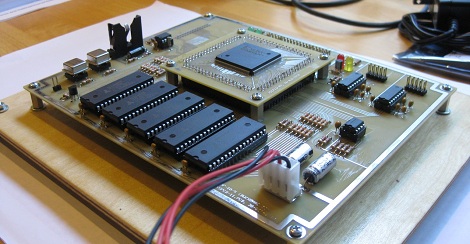
[dgcx] has been working on reimplementing a PDP-10/x on an FPGA for the last 2 and a half years. This surprised us because we’re only hearing about this project now.

After designing three versions, [dgcx] eventually ended up with a one-FPGA implementation of a PDP-10 and an awesome PDF writeup. Although PDP-10 emulators do exist, this project isn’t an emulation – the system actually has the 36-bit word length of the original, implemented on five 4096 kilobit SRAM chips. This is a fully functioning replica, and even has CHAOSNET implemented with a small Ethernet controller.

Continue reading “Putting A PDP-10 On An FPGA”

Live NBA Scoreboard With Huge 7-segment Displays

[Kianoosh] was in Las Vegas over spring break and was fascinated by the real-time sports scores displayed at the casinos. He figured that this would be an easy enough project to duplicate, so he built a gigantic NBA scoreboard that updates live from the NBA website.

The build uses the OS X Automator to pull scores down from the NBA’s mobile site. Sending this through a parser written in Java, the scores are then sent to an ATMega32 over an XBee. [Kianoosh] posted all the code and schematics, as well as a PDF writeup. Because the scoreboard is sport-agnostic, [Kianoosh] plans on writing new code for the NFL, MLB, and NHL. We’re really impressed with this build, and with the giant 7-segment LEDs, this would be a great addition to a sports bar (or really any bar).

Continue reading “Live NBA Scoreboard With Huge 7-segment Displays”

3D Printed Singularity Drive Platform

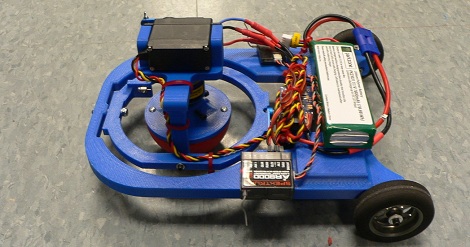
[Silas] is a student at Olin College and came up with a platform using the singularity drive system in his spare time.

We covered a LEGO build of a singularity drive earlier this month. Instead of wheels, treads or legs, this drive system has a hemisphere spinning along its vertical axis. Interestingly, the robot does not change the speed or direction of its drive motor at all. IEEE is now calling this drive system a “singularity drive,” because math.

Continue reading “3D Printed Singularity Drive Platform”

Building A One-instruction Computer

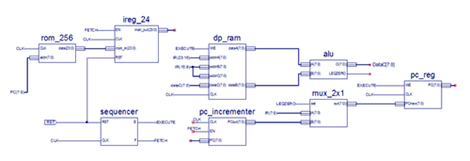
[Hasith] sent in this project where he goes through the process of designing a one instruction CPU in Verilog. It may not win a contest for the coolest build on Hack A  Day, but we really do appreciate the “applied nerd”  aspect of this build.

With only one instruction, an OISC is a lot simpler than the mess we have to deal with today. There are a few instructions that by themselves are Turing-complete (like Subtract and branch if negative, and Move). Designing an OISC with one of these instructions means it can also emulate a Turing machine.

Continue reading “Building A One-instruction Computer”