Sound Activated Flash For High Speed Photography

High speed video is everywhere these days, but the cameras and necessary equipment is a bit out of reach for a hobbyist. [Bassam] found a compromise and came up with a way to shoot high-speed photographs using a sound triggered flash.

Continue reading “Sound Activated Flash For High Speed Photography”

Ohm Sense Makes Sense Of Resistor Color Bands

[Alex Busman]’s first foray in iOS programming looks like a pretty useful tool. He came up with Ohm Sense, an iPhone app that will take a picture of a resistor and calculate the value based on the color bands. It’s a great tool that we wish we had when we were starting out. At 99 cents, the app is also much cheaper than the emotional cost of our relationship with Violet.

Continue reading “Ohm Sense Makes Sense Of Resistor Color Bands”

Building A Computer Out Of 555 Chips

[M. Eric Carr] came up with an interesting build for the 555 contest earlier this year, and we’re pretty sure that it would have kicked the winner of the complex category off the throne if it were completed. Although it’s a few months late, we’re happy to feature at least part of his 555-based computer on Hack A Day.

Continue reading “Building A Computer Out Of 555 Chips”

Using An LED Cube As An Audio Visualizer

[Isaac] sent in his mashup build of a LED cube combined with a graphic EQ meter. The build is fairly simple and from the video we can tell that his build would be a great installation in a dubstep venue. While it’s not the 9x9x9 cube possible with some judicious coding we think it’s a very fitting display for the intended purpose.

Continue reading “Using An LED Cube As An Audio Visualizer”

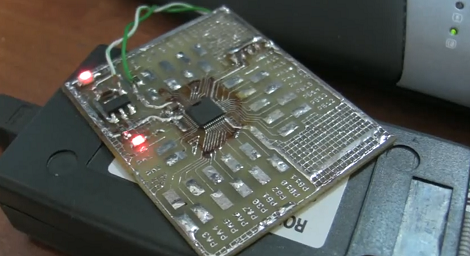
An ARM Dev Board You Can Make At Home


[BarsMonster] just challenged our conceptions of ARM development with his single-sided development board that’s loaded with an STM32F100 (PDF warning) ARM microcontroller. The board is remarkably simple – just a regulator, resistor and a few caps are necessary to get a $1 ARM μC up and running.

Continue reading “An ARM Dev Board You Can Make At Home”

Classic Game Cabinet Becomes A Drivable Car

[Garnet Hertz], a professor and “artist in residence” at UC Irvine, built a drivable Outrun arcade cabinet for an experiment in augmented reality.

The old fiberglass and wood cabinet was hacked up and the motors, wheels, and drive train from an electric golf cart were stuffed inside. The original steering wheel and pedals were used for the controls. Although the top speed of the in-game car is about 180 mph, that was brought down to a reasonable 13 miles per hour.

Continue reading “Classic Game Cabinet Becomes A Drivable Car”