Component Storage Roundup

It’s been suggested that the first self-replicating computer virus was a single IC that eventually expanded into multiple plastic component storage boxes. Organizing components by their values is a huge PITA as well. Here’s some solutions we’ve found:

Photo Boxes
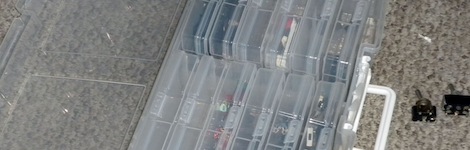
[Mathew] sent in his organization scheme that uses 4×6 photo boxes. Better get those boxes while they’re hot – we can’t remember the last time we used film.

Use a binder

This instructables uses binders for storage. Good for passives, but unless someone can find anti-static bags for a binder, we’ll keep our ICs separate.

The only way to organize resistors

[Johannes] stores his resistors on a sheet of styrofoam. The grid has the first color band on the left side and the second color band on the top. Extremely, extremely clever. We’re wondering why we Radio Shack didn’t come up with this in the 70s. The grid could be laid out on a log scale, though.

If Susan is lazy, why does she do all the work?

[D.C. Boyce] hacked up a couple of lazy susans, built frames out of 2x4s and mounted plastic component drawers on them. The result is probably more space than we’ll ever need. To keep things simple, he wrote a database program to keep track of everything.

DIY Segway Recycles Broken Electric Scooters

[Petter] built himself a DIY Segway out of a couple of cheap electric scooters. We’ve seen a couple of very nice Segway builds in the past like the all analog Segway, or the creepy walking version, [Petter]’s Segway build seems like it would be a useful human transport device.

The motors, chains, gears, and wheels are scavenged from a pair of electric scooters. Steering left and right is accomplished by tilting the handlebars left and right. The handlebars themselves are attached to the joint at a base that allows them to be taken on and off. We’re thinking this would be great for throwing a [Petter]’s Segway in the trunk of a car – a design feature the original Segway doesn’t have.

Continue reading “DIY Segway Recycles Broken Electric Scooters”

Digital Cootie Detector

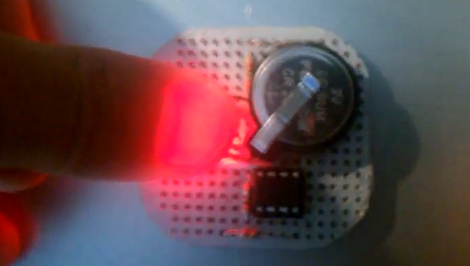
Kids love games of exclusion. This usually manifests itself in games of ‘keep away,’ having someone ‘catch cooties,’ or the ever-popular ‘No Brian club.’ [Rob] wrote in to tell us about the digital cootie detector he built. The cootie detector operates on galvanic skin response. It’s actually very similar to an E-Meter, although instead of Thetans this device measures something that actually exists.

Galvanic skin response is a measure of the skin’s conductivity. Skin conductivity changes because sweat glands will be activated when someone is nervous. This is a measure of psychological arousal, making it a great detector for games of exclusion – a kid who doesn’t want cooties will ‘psych themself out’ and give themselves cooties.

Continue reading “Digital Cootie Detector”

Guitar Becomes An Improved Color Organ

[Charles] wanted to put some LEDs in his guitar. He also wanted individual notes to output certain colors, but he couldn’t find any projects with tone-based algorithms to convert sound into colors. After about a year of work, his ColorChord guitar was born.

Unlike every other color organ build we’ve seen, the color of a note does not relate to the absolute pitch of the note. Instead, the colors are mapped within a musical key. A I chord will always be Yellow, a IV chord will always be purple, and a V chord will always be blue. Playing in the key of C will have the LEDs output yellow, purple, and blue for a C, F and G chord, respectively.

Continue reading “Guitar Becomes An Improved Color Organ”

Radio Shack Will Now Stock Cellphones, Cellphone Accessories, Arduinos

A few months ago, we covered Radio Shack’s efforts to suck less, and the Radio Shack DIY team has now come back with the top ten suggestions submitted. Of course Arduinos make the list at number 1, which we somewhat expected for beginner projects.  Here’s the entire list in order:

  1. Arduino
  2. More kits and project suggestions
  3. More introduction/instructional books
  4. Larger LED selection
  5. Larger resistor selection
  6. TONS more capacitors
  7. DIY audio and speaker equipment
  8. HAM radio gear
  9. More competitive pricing
  10. Stronger sales force

Resistor Substitution Box

[Vincent] on the EEVblog forums had an idea for an inexpensive resistor substitution decade box.

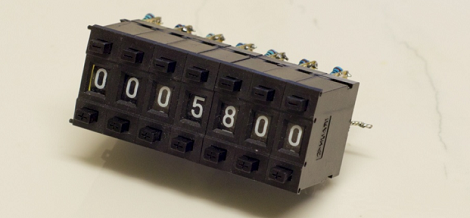
The build uses cheap decimal thumbwheel switches he bought on eBay. Each switch is wired up with resistors for each digit, and each switch is wired up in series. The result is a small, easy to read resistor box with a range of 1 Ω to 10 MΩ.

Continue reading “Resistor Substitution Box”

Modded Wall-E Becomes A Real Robot

[DJ Sures] got his hands on a plastic Wall-E toy and decided to build a robot that includes a camera, voice recognition, and object tracking. The result is adorable so we’re putting this video before the break:

[youtube=http://www.youtube.com/watch?v=OJiMUzJHYFk&w=470]

Continue reading “Modded Wall-E Becomes A Real Robot”