Voice Controlled Robot Controlled By An Android Phone

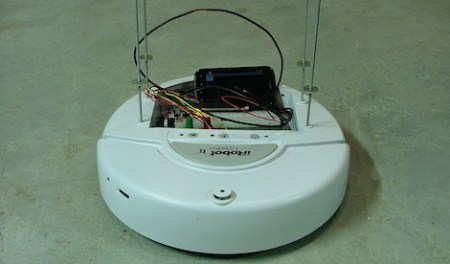
[Jeff] sent in a build of a voice controlled robot he just finished based on the Android ADK and an iRobot Create.

The robot is able to obey voice commands telling it where to go. Currently the robot responds to forward, reverse, left, right, stop, and ‘whistle while you work.’ It’s a creative use of the Android ADK with some obvious applications, but this project really shines with the write up on instructables. It’s rare that we’ve seen a project so well documented; it’s a great project for someone who wants to get their feet wet in the world of robotics.

[Jeff]’s write up goes through the steps of hooking up the ADK board to iRobot and providing all the electronic necessities. [Jeff] graciously provided the code for his robot if anyone would like to add to his project.

The ultimate goal [Jeff] is currently working towards is something akin to a TurtleBot, while keeping the voice control of the robot. In all, a very nice project.
Augmented Reality Game Could Come From The Seventies

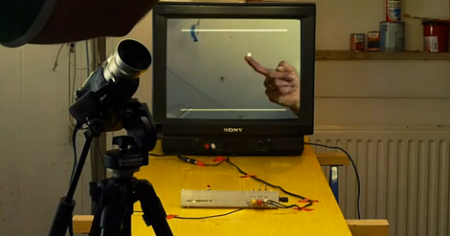
[Niklas Roy] sent in a project he just completed called PING! Augmented Pixel. At first glance the entire build is just a plain jane retro video game stuffed into an ATmega8 but looks can be deceiving. The video game is actually an augmented reality device that inserts a pixel into a video feed. The bouncing pixel can be manipulated with a camera – push the pixel and it goes off in another direction.

The project runs on an ATmega8 clocked at 16 MHz, and reads the video feed with the help of an LM1881 sync separator. There’s no schematics, but he thankfully included some code for his project. Everything is set up for PAL video, but this could be easily adapted for NTSC. Any Hack A Day readers want to take up the challenge of building this from just a description?

[Niklas] says there’s no reason this couldn’t have been done by Atari in the late seventies. There were economic reasons for not putting out a video camera controller, of course, and the R&D department may have been too busy playing Breakout with their eyebrows.

Check out the demo of the augmented pixel after the break.

Continue reading “Augmented Reality Game Could Come From The Seventies”

CEE Is A Swiss Army Knife For Analog Electronics

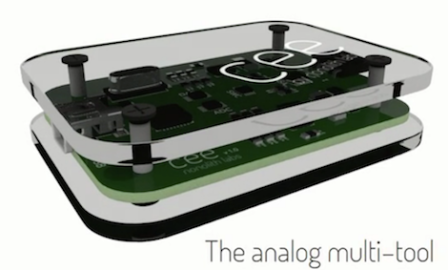
The team at nonolith labs announced their CEE, a device for billed as, “an analog buspirate” that is meant to control, experiment, and explore the world of analog electronics. Nonolith labs started a kickstarter campaign for the CEE.

The CEE is capable of sub-millivolt and milliamp sampling at 44.1k samples/second, and sourcing 2 channels of 5V @ 2A with a little bit of soldering. This allows for precise control of motors and sensors with the web-based UI. We’re thinking this would be a great way to teach high schoolers the art of electronics, and would be great combined with a few lectures from Paul Horowitz.

The CEE ties into nonolith labs Pixelpulse, a pretty handy tool for visualizing analog and digital signals. You can check out a demo of Pixelpulse simulating a charging capacitor here.

We’re hoping this focus on education on analog electronics catches on – you can learn a lot more by building a 555-based mini Segway than you can slapping a microcontroller in every project. This would go under the same theory as, “any idiot can count to one.”

Check out the video of the CEE on the kickstarter campaign page.

Sandbox Game In A Sandbox

The team at Monobanda have been working on a sandbox game called Mimicry that uses a Kinect to read the terrain of a sandbox.

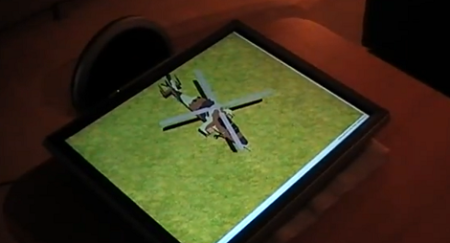
From the teaser video and press release, the eventual goal appears to be controlling both a character in the game and the environment simultaneously. By reading the terrain of the sandbox with a Kinect, the team was able to import that into the game world. The team says the game world is inhabited by tiny virtual characters that, “roll around, jump and glide through the Mimicry world.” Anyone playing Mimicry can create obstacles for these little creatures or build them a race track. The Monobandia team says the point of this game is, “to create your own games.” With a fully editable world and its ‘rolling ball’ inhabitants, we can’t wait to make our own custom Beyblade arena.

Since the release of the Kinect SDK a few weeks ago, we’ve been seeing some really amazing projects that should have been day-1 demos from Microsoft. We’ve been impressed with the projects we’ve seen so far, and can’t wait to see what others come up with next. If you have a neat build, be sure to send it into the tip line.

Check out a video testing the game mechanics after the break.

Continue reading “Sandbox Game In A Sandbox”

3D Display Using A Kinect

Youtube user [programming4fun] got a Kinect for father’s day and with just a little bit of code, came up with a 3D display using only a Kinect. Instead of the usual Kinect hacks like computer vision or playing Mario, we think the ‘Holographic display’ for the Kinect is one of the most useful implementations of the Kinect we’ve seen.

The build uses the Kinect SDK. The end result is a lot like the Kinect snowglobe we covered earlier, only instead of custom acrylic domes and a projector, this build enables pseudo-3D on any display. The hack works by having the Kinect track the users head. From that, it’s pretty simple to display a projection of a 3D model.

The system only supports a 3D display for one person, although with shutter glasses, that could be could be doubled. [programming4fun] says he’s thinking about adding anaglyph 3D – while the effect on video is pretty amazing, he says it’s not entirely convincing in real life.

We talked to the extremely modest [programming4fun], and he says the build isn’t technologically impressive at all. We’d disagree with that assessment because interfaces requiring movement have been around since 1963 and they still haven’t caught on for a wide audience. While there have been a few motion controlled devices that have worked well, most of them have been pretty bad. The Kinect 3D display seems like it would have some utility with a Microsoft Surface type device.

[programming4fun] says if there’s enough interest he might be convinced to clean up his code and create an installer. Check out the video after the break.

UPDATE: [programming4fun] uploaded another demo with a “behind the scenes” look after this was published. Check it out.

Continue reading “3D Display Using A Kinect”

Game Boy Communicates Directly With An SD Card

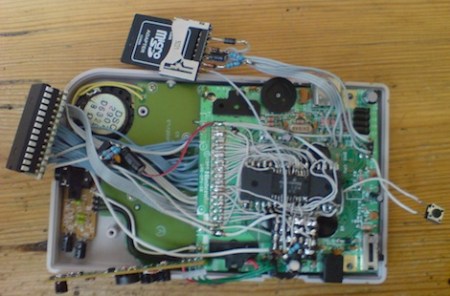
[kgsws] just finished his Game Boy upgrade that allows him to load games from an SD card. Loading a game off an SD card has been done before, but [kgsws] decided to not to use a cartridge-based device. In the end, he threw out all the stops and finished his project by having the Game Boy access an SD card directly.

[kgsws] his project trying to figure out how to put some GPIO pins on a game cartridge, but figured that this would take too much hardware. After looking at the specs of the link port, he realized that it was the wrong polarity. Not to be deterred, [kgsws] realized that there was something like a general-purpose I/O on the Game Boy – the joypad input.

Continue reading “Game Boy Communicates Directly With An SD Card”

Livescribe Shuts Down Developer Program

[Kelly] sent in a tip saying that Livescribe, the company behind a remarkable smartpen able to record handwriting, was shuttering the developer program by taking down their dev forums and removing the SDK, taking away the ability to write custom apps. [Kelly] posted about this on her blog.

Livescribe has a thriving community around it and the pens themselves have had some incredible hacks, like Zork played on an Echo smartpen.

Livescribe’s official reason for shutting down the development program is to concentrate on, “cloud access, storage and services.” While we’re still wondering why Livescribe would sideline the developers that give a platform more functionality, it’s astonishing that a company would take down the SDK and delete the dev forums of their own product.

Although the largest Livescribe development and hacking forum has been shut down, we fully expect an independent forum to pop up within the week. We’ll be sure to post a link to that forum when we get word of it. If you know where the new forum is, be sure to send it into the tip line.