Internal 7-segment PS3 Display

[Zach] sent in his temperature controller and display for PS3, and even though it only works with a PS3 fat, we like our PS2 backwards compatibility very much, thank you.

The build stated off with [Zach] putting thermal sensors on the CPU, the RSX, and Northbridge of his PS3. After starting out controlling the fan with his laptop, he moved on to an integrated fan and display controller after seeing this post about a ‘hidden display.’ In the end, one of the coolest looking PS3 mods we’ve ever seen was born.

The build runs off an Arduino Pro that gets the temperatures from the sensors, prints everything to a custom 7-segment display board, and controls the fan. [Zach] thankfully made the Arduino source available and also put up some board files if you’d like to make your own. It’s a pretty impressive build that’s completely invisible when the PS3 is powered off.

Continue reading “Internal 7-segment PS3 Display”

Voice Recognition System Controls Everything, Hopefully Won’t Kill Us.

[Aaron Bitler] and [Bud Townsend] have been working a natural user system that is, in their own words, “what android@home should have been.”

The video they posted is pretty impressive. The automation system responds to voice and can control appliances, ‘throw a party’, and provide a user with their location. This is just the foundation of a system that can be built upon – developers  can easily integrate a microphone and speaker into a device so it can connect to the system’s server. Apps, too, are pretty extensible – they’re registered on the server with meta tags that provide a wealth of data to be manipulated. It’s a very, very cool project that we really want to try out.

Continue reading “Voice Recognition System Controls Everything, Hopefully Won’t Kill Us.”

Mini IR Theremin

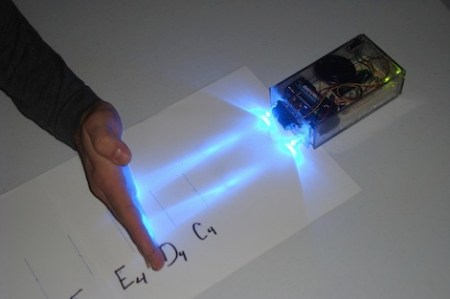
[Chris] at PyroElectro sent in a great 8-part write-up of a miniature infrared theremin.

The theremin is based on a PIC microcontroller and an infrared distance sensor.  The build log goes through the theory of operations for the IR sensor and tone generation. [Chris] definitely does a great job showing the math that went into the design.

Although this project isn’t a true theremin because it operates on light like a few other projects we’ve covered in the past, it’s easier to play because of the hard-coded notes. The build does show some promise though – he could likely expand it to use more accurate ultrasonic sensors or use, “two proximity sensors, one for treble and one for bass like an accordion.”

The theremin is usually played with both hands providing a continuous pitch and volume. This project features hard-coded, discrete notes, so we’re wondering about the possibility of implementing MIDI on this IR theremin. The original MIDIbox was based on the same microcontroller as this project, so it’s definitely a possibility.

Check out the video of the theremin in action below.

Continue reading “Mini IR Theremin”

Minecraft Is Now A 3d Design Tool

[Cody Sumter] and [Jason Boggess] are students at the MIT Media Lab, and they just came up with Minecraft.Print(), an attempt to create a bridge between Minecraft and the real world via 3D Printers.

The print is first prepared by placing obsidian, diamond, gold, and iron blocks on opposite corners of the model in Minecraft. From there, a Python script takes over and parses the world map to generate an .STL file for a RepRap or MakerBot.

So far, [Cody] and [Jason] have printed a few Companion Cubes and the model of the Enterprise D. We’re pretty impressed with the resolution of the prints, especially considering the original model is voxelated. The prints look very nice, and right now we really want to print out all the cool stuff we’ve seen, like Isengardgigantic CPU, or maybe a Minecraft 3D printer.

Minecraft.Print() sure is a nice program [Cody] and [Jason] have there. It would be a shame if anything happened to it. Check out a video demo after the break.

Continue reading “Minecraft Is Now A 3d Design Tool”

ArduDelta Would Make A Great Pick And Place Machine

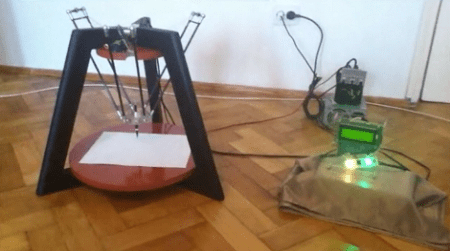
[Bogdan] sent in a great build of a delta robot he originally posted on the Arduino forum, but he didn’t receive much feedback there. We think a build like this deserves a lot more credit.

After working for 7 months on his robot, [Bogdan] has a pretty stable (and very classy) platform made out of wood. The platform and arms in delta robots are usually extremely light to reduce the inertia of the tool so [Bodan] crafted these out of carbon fiber tubes and plexiglas. Everything is controlled by an Arduino Mega2560 encased in a plexiglas enclosure with a 20×4 LCD, status LEDs, and an infrared receiver.

Continue reading “ArduDelta Would Make A Great Pick And Place Machine”

Infrared Control For Appliances

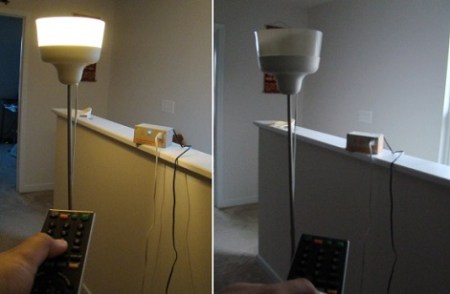
[RB] at Embedded Lab sent in a great guide on how to control appliances with a remote control using a really clever implementation of a decade counter and IR receiver.

The build itself is very simple – just a relay connected to mains power and a handful of resistors and transistors. The device is controlled with a decade counter and an infrared module usually found tucked away in the bezel of a TV.

When everything is plugged in, the first pulse from the remote switches the relay on, providing power to the outlet. When a second pulse is received, the reset pin on the decade counter is activated, setting the device back to its original off state. It’s a pretty clever build, and could be built with parts lying around the bench.

The project is powered through wall power with the help of a transformer and a 7805 regulator, but we think the size could be reduced with a pass-through power enclosure – the circuit certainly is small enough. In all, a very nice, low component count build.

Playing Chess On A Microcontroller

[Arthur Benemann] started a little project for his electrical engineering program, and suffered the worst case of feature creep we’ve ever seen. He just posted an instructable of his picChess project that is able to play chess on a VGA monitor with a keyboard, with sound, a clock, temperature sensor. Apparently, [Arthur] was bored one evening and threw in an implementation of Conway’s game of life.

[Arthur] chose a DSPIC33F μC for his project with everything laid out on a bread board. He’s quite proud of his VGA routine, the first time he’s ever used DMA. We’re really impressed by [Arthur]’s chess engine – his is the first homebrew chess engine we’ve seen on Hack A Day. Although the engine is a brute-force search with Alpha-beta pruning, the engine itself seems fairly advanced that will even supports castling.

Although a few rules aren’t supported and the ELO rating of the engine isn’t known, [Arthur]’s engine should still be able to beat an amateur player. A fairly impressive feat indeed.

Check out [Arthur]’s video after the break.

Continue reading “Playing Chess On A Microcontroller”