Americans love their coffee. The Brits adore their tea. In South America, the number one way to get through the day is with yerba mate, a tea made from the yerba plant. It is typically shared in a social setting, with one person preparing the beverage for everyone to enjoy. Although caffeine certainly deserves a ceremony, it never needs one. Hit the streets and you’ll see people everywhere with a thermos under one arm, keeping water hot and ready to refill the cup of mate in their hand.
The Stanley vacuum thermos is quite a popular choice for drinkers on the go, but the Argentinian government recently placed new restrictions foreign imports. [Roni Bandini] decided to build a minimum viable mate machine so he always has perfectly hot water on tap.
An Arduino Nano heats the water and displays the rising temperature on an LCD screen. When the temperature is just right, the display asks for your cup. An ultrasonic sensor detects the cup and dispenses a certain amount of water determined in the sketch. Yerba leaves can be used a few times before losing their flavor, so the machine keeps track and lets him know when it’s time to replace them. You can sip on a brief demo after the break.
[8BitsAndAByte] caved in to increasing holiday madness and bought the cutest little Christmas tree. A special tree deserves special decorations, so they packed it with NeoPixels that turn from red to green and back again one by one. Here’s where the trendiness comes in: the speed at which they change is determined by the popularity of “Christmas” as a search term.
The NeoPixels are controlled by a Raspberry Pi 3B+ that uses PyTrends to grab a value from Google Trends once an hour. The service returns a value between 0 to 100, where 100 means the search term is extremely popular, and 0 means it’s probably the dead of January. Each NeoPixel is wired to the underside of a translucent printed gift box that does a great job of diffusing the light.
You know how Christmas trees have a tendency to stick around well into the new year? This one might last even longer than usual, thanks to the bonus party mode. Press the arcade button on the box cleverly disguised as a present, and the lights change from red to green and back at warp speed while the speaker inside blasts the party anthem of your choice. Be sure to check out the demo/build video waiting for you under after the break.
How could this little tree get any more special? Well, a rotating platform couldn’t hurt.
Over the years, humans have come up with four forces that can be used to describe every single interaction in the physical world. They are gravity, electromagnetism, the weak nuclear force that causes particle decay, and the strong nuclear force that binds quarks into atoms. Together, these have become the standard model of particle physics. But the existence of dark matter makes this model seem incomplete. Surely there must be another force (or forces) that explain both its existence and the reason for its darkness.
Hungarian scientists from the Atomki Nuclear Research Institute led by Professor Attila Krasznahorkay believe they have found evidence of a fifth force of nature. While monitoring an excited helium atom’s decay, they observed it emitting light, which is not unusual. What is unusual is that the particles split at a precise angle of 115 degrees, as though they were knocked off course by an invisible force.
The scientists dubbed this particle X17, because they calculated its mass at 17 megaelectronvolts (MeV). One electron Volt describes the kinetic energy gained by a single electron as it moves from zero volts to a potential of one volt, and so a megaelectronvolt is equal to the energy gained when an electron moves from zero volts to one million volts.
What Are Those First Four, Again?
Let’s start with the easy one, gravity. It gives objects weight, and keeps things more or less glued in place on Earth. Though gravity is a relatively weak force, it dominates on a large scale and holds entire galaxies together. Gravity helps us work and have fun. Without gravity, there would be no water towers, hydroelectric power plants, or roller coasters.
The electromagnetic force is a two-headed beast that dominates at the human scale. Almost everything we are and do is underpinned by this force that surrounds us like an ethereal soup. Electricity and magnetism are considered a dual force because they work on the same principle — that opposite forces attract and like forces repel.
This force holds atoms together and makes electronics possible. It’s also responsible for visible light itself. Each fundamental force has a carrier particle, and for electromagnetism, that particle is the photon. What we think of as visible light is the result of photons carrying electrostatic force between electrons and protons.
The weak and strong nuclear forces aren’t as easy to grasp because they operate at the subatomic level. The weak nuclear force is responsible for beta decay, where a neutron can turn into a proton plus an electron and anti-neutrino, which is one type of radioactive decay. Weak interactions explain how particles can change by changing the quarks inside them.
The strong nuclear force is the strongest force in nature, but it only dominates at the atomic scale. Imagine a nucleus with multiple protons. All those protons are positively charged, so why don’t they repel each other and rip the nucleus apart? The strong nuclear force is about 130x stronger than the electromagnetic force, so when protons are close enough together, it will dominate. The strong nuclear force holds both the nucleus together as well as the nucleons themselves.
The Force of Change
Suspicion of a fifth force has been around for a while. Atomki researchers observed a similar effect in 2015 when they studied the light emitted during the decay of a beryllium-8 isotope. As it decayed, the constituent electrons and positrons consistently repelled each other at another strange angle — exactly 140 degrees. They dubbed it a “protophobic” force, as in a force that’s afraid of protons. Labs around the world made repeated attempts to prove the discovery a fluke or a mistake, but they all produced the same results as Atomki.
Professor Attila Krasznahorkay and his team published their observations in late October, though the paper has yet to be peer-reviewed. Now, the plan at Atomki is to observe other atoms’ decay. If they can find a third atom that exhibits this strange behavior, we may have to take the standard model back to the drawing board to accommodate this development.
So what happens if science concludes that the X17 particle is evidence of a fifth force of nature? We don’t really know for sure. It might offer clues into dark matter, and it might bring us closer to a unified field theory. We’re at the edge of known science here, so feel free to speculate wildly in the comments.
Emily Velasco seems to absolutely delight in the weird, and we think that is wonderful. Weird brings us together. If you can be weird with someone else, you’ll have a special bond for life. In her inspiring 2019 Supercon talk (embedded below), Emily explains why she is drawn to weird things, and why you should be, too. Her enthusiasm is both palpable and infectious, so don’t be surprised if you suddenly want to drop everything to accompany her on a treasure hunt adventure and spend the rest of the day making things.
Emily doesn’t try to push making weird things on to you, but her reasons for working in weird are quite compelling. Weird things catch the eye and interrupt the tedium of our lives. They give us pause and invite us to look again. You can choose to turn away if you want. But if you look closer, you might find that ugly, weird, and annoying things begin to charm you.
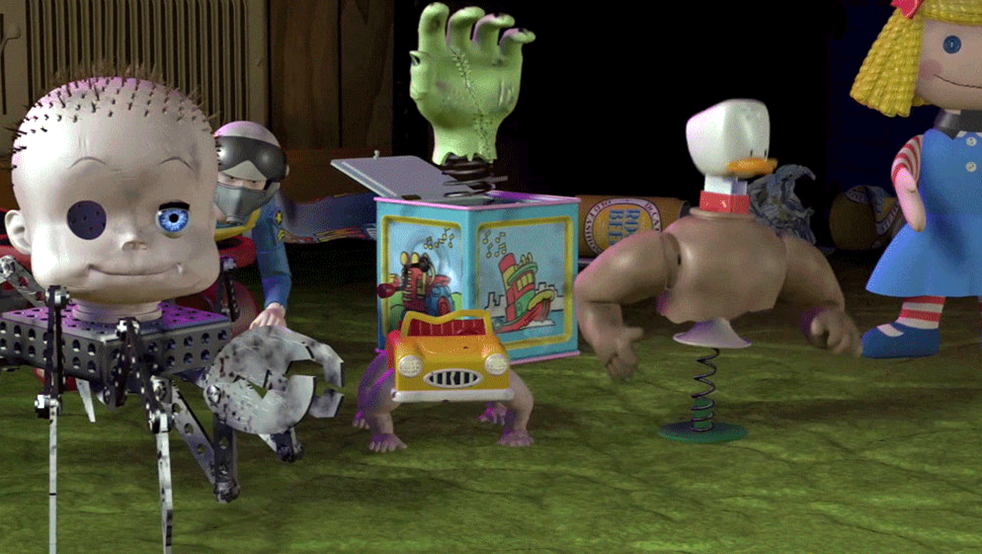
Emily says the formative force that pulled her toward the weird was the gang of mutant toys that the villainous Sid made in Toy Story. They force you to look closer and to consider them. But Emily is far from mean-spirited — she builds her creations with love, and not to act out or to spite her little sister. They’re not what you expect, and even if someone finds them off-putting at first, they are undeniably interesting.
We know at least one person who ought to make Santa’s ‘nice’ list this year. [Fran] was probably near the top of it already, but sending Santa a handmade greeting card with a fully-functioning guitar amp inside will probably make him rewrite her name in glitter, or silver Sharpie.
This stocking stuffer-sized amp is based around the LM386 and the bare minimum components necessary to make it rock. Everything is dead-bug soldered and sandwiched between two pieces of card stock. The first version with a single 386 sounded okay, but [Fran] wanted it louder, so she added another stage with a second 386. [Fran] glued the rim of the speaker directly to the card so it can act like a cone and give a better sound than the speaker does by itself.
All Santa needs to rock out is his axe and a small interface made of a 1/4″ jack and a 9 V wired to a 3-pin header that plugs into the card. He can take a break from Christmas music and let some of those cookies digest while he jams. Be sure to check out the build video after the break if you want to stay off the ‘naughty’ list.
Whether you’re new to electronics and programming, or you were bit-banging bare metal long before hair metal, CircuitPython is a great tool for getting a project up and working without all the fuss. The boards show up as mass storage devices, and programming consists of editing the Python file and saving it back to the board.
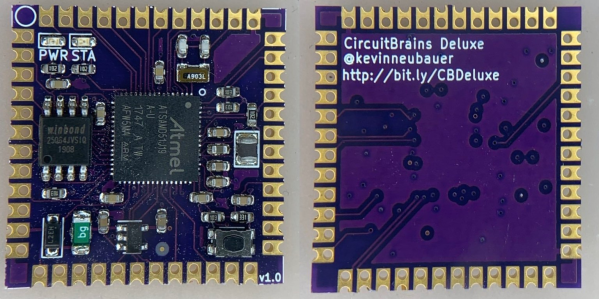
The only hard part about CircuitPython is trying to cram those official boards into small projects. [Kevin Neubauer] got tired of making his own board every time and came up with a slim system-on-module that has all the core functionality of CircuitPython. CircuitBrains Deluxe has regular holes for using headers, but also has castellated pads so he can solder these modules directly to a larger project PCB. [Kevin] says these are still in the testing and cost-optimization phase, but we would totally buy a few of them.
Macros are meant to make our lives easier, but they live up to this promise with mixed results. Generally speaking, a macro is a special combination of keys on the keyboard that execute a custom task — their goal is to speed up your productivity by getting away from mousing through menus. But once a macro requires more than two keys, they can get a bit cumbersome to input. I have personally found that repeated use of macros that require ctrl+shift can potentially cause problems. I don’t know about you (and your repetitive stress mileage may vary), but personal injury is the polar opposite of what I want from something that’s supposed to be convenient.
I love keyboard shortcuts, and not just because I prefer keyboard navigation in general. A lot of little things about writing for the web can be streamlined with shortcuts, like writing html tags and doing image manipulation. And I’m always looking for a better workflow to pin down my fleeting mental fragments, at least until that dark day that I can turn on Dropbox Thoughts™ and burn my brainwaves directly to disk.