Disco Bulb Keeps The Party Spinning

Even if you don’t like disco, you might like the slick moves that went into this project. [W&M] built a miniature motorized mirror ball inside of a standard incandescent light bulb, and the results are something to dance about.

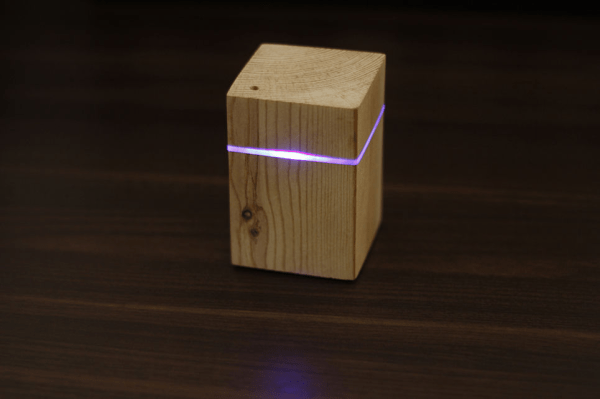
Short of blowing a glass bulb, building a motor, and growing the wood, this is about as scratch-built as it gets. Much of the woodworking is done on a metal lathe, and this includes the base of the mirror ball itself. As with all good thing-in-a-bottle builds, the ball is too big to go in the bulb, so [W&M] quartered it, drilled a few holes, and ran a string through the pieces so they can be carefully glued and drawn back together into a sphere. He even cut up mirror tiles and painstakingly applied them with tweezers.

This disco bulb is meant to be hung from the ceiling and wired into mains like a regular mirror ball. [M&W] stuffed the guts from a small USB wall charger into the handmade beech base to provide clean power for both the geared motor that spins the ball and the tiny LED that illuminates it. Slip into your best leisure suit (or sweat suit, we won’t judge) and hustle past the break to watch the build video.

We don’t see a lot of disco balls around here, but we did see a disco icosahedron once.
Continue reading “Disco Bulb Keeps The Party Spinning” →

Counting Is For Sheep: Use A Light To Fall Asleep

How do you get to sleep at night? For some of us, it can be the most difficult thing we do all day. Worrying about falling asleep and letting other intrusive thoughts in night after night only compounds the problem, as less sleep leads to depression which (for us) leads to even less sleep. We lay there, trapped inside a vortex of churning thoughts, imprisoned in a mind that feels like it’s malfunctioning and half-wishing for a future where instructor-led meditation videos can be beamed to the insides of our eyelids. In the meantime, there is FADing, the Fall Asleep Device.

FADing takes its cues from a relaxation technique that uses light to focus your attention and control your breathing. The light’s intensity waxes and wanes on a schedule designed to get you down from the average eleven breaths per minute to a zen-like six breaths per minute. You surrender to the light, breathing in as it intensifies and breathing out as it fades. There are commercial products that bring this technique to the bedroom, but they aren’t cheap and don’t offer much control. Fail to fall asleep in the prescribed window and you’re back to square one with one more thing to think about: buyer’s remorse.

[Youz] was inspired by these devices but dissatisfied with the price tag and lack of options, so he created his own version with a flexible window of operation that appeals to both back- and side-sleepers. It uses an Arduino Nano and two momentaries to control two LEDs, a relay to hold the power after startup, a 9V, and a diode to protect the Nano. One LED projects on the ceiling, and the other radiates through a slice of acrylic which has been shaded blue. One button is for power, and the other lets you add time by two-minute increments. You can see the build video after the break and then tell us how you’d do it with a 555, a coin cell, and a chunk of uranium glass in the comments.

Once you can focus on your breathing without a light, reuse that Nano to measure the quality of all that sleep you’re getting.

Continue reading “Counting Is For Sheep: Use A Light To Fall Asleep” →

A New Life For A Dead VIC-20

What was the first computer you bent to your programmatic will? If you’re old enough, it was probably a Commodore. For [Jagged-path], it was a VIC-20. After finding a broken one on Kijiji, he recaptured that 80s feeling with VicPi, a revitalization project that marries modern computing power with vintage form factor.

The VicPi can be used as a standalone computer or a USB keyboard for an external computer. As you’ve probably guessed, there’s a Raspberry Pi involved. There is also a Keyrah board, which is arguably the easiest way to convert Commodore (and Amiga) keystrokes to USB without breaking a sweat.

There are a lot of nice touches that really make this project. A toggle switch on the back selects between VicPi mode and keyboard mode, and the distinction is made with a two-color LED in place of the VIC-20’s power LED. [Jagged-path] used panel mount cables to extend the HDMI, 3.5mm, and USB ports and ran them out to a custom metal panel that’s treated with rubberized black paint. Another nice touch: the dedicated keyboard port is USB-B, so it’s easy to differentiate from the Pi inputs.

If you have a working VIC-20 but not the rare Votrax Type ‘n Talk synthesizer peripheral, you can use an old Android phone to hear those Voodoo Castle responses.

Gertrude Elion, DNA Hacker

Some people become scientists because they have an insatiable sense of curiosity. For others, the interest is born of tragedy—they lose a loved one to disease and are driven to find a cure. In the case of Gertrude Elion, both are true. Gertrude was a brilliant and curious student who could have done anything given her aptitude. But when she lost her grandfather to cancer, her path became clear.

As a biochemist and pharmacologist for what is now GlaxoSmithKline, Gertrude and Dr. George Hitchings created many different types of drugs by synthesizing natural nucleic compounds in order to bait pathogens and kill them. Their unorthodox, designer drug method led them to create the first successful anti-cancer drugs and won them a Nobel Prize in 1988.

Continue reading “Gertrude Elion, DNA Hacker” →

Tricked-out Barbecue Will Make You Do A Spit Take

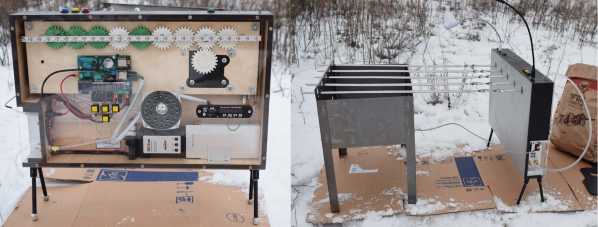
[Strn] and his friends love to barbecue no matter what it’s like outside. But something always seems to interrupt the fun: either it’s time to get up and turn the meat, or the music stops because somebody’s phone ran out of juice, or darkness falls and there aren’t enough flashlights or charged-up phones. He had the idea to build the Swiss Army knife of barbecues, a portable powerhouse that solves all of these problems and more (translated).

Most importantly, the E-Mangal rotates the skewers for even cooking. It does this with a 3D-printed worm gear system driven by the heater flap actuator from a car. After 25 minutes of slow rotation, a voice announces that it’s time to eat. [Strn] and friends will never hurt for music options between the pre-loaded tracks, Bluetooth audio, FM antenna, USB, and SD options running through a 3W amp. Two USB lights illuminate nighttime barbecuing, and the 10 Ah battery can do it all and keep everyone’s phone charged. For safety’s sake, [Strn] included a half-liter water tank to extinguish the coals via jet stream. Everything is run by a PIC18F, and it can be controlled at the box or through a simple web interface.

We love the look of this barbecue controller almost as much as the functionality. The sturdy stance of those short, angled legs give it a mid-century appliance feel, and seeing all the guts on display is always a plus. Grab a turkey leg and take the tour after the break.

The E-Mangal has a thermocouple in the coal box to measure the temperature, but there’s no direct control. If you’re more interested in temperature options than entertainment, here’s a project that micromanages everything on the grill.

Continue reading “Tricked-out Barbecue Will Make You Do A Spit Take” →

Build A Sandblasting Rig For $6

Let’s get something out of the way: yes, this assumes you already own or have access to a compressor. So if you do, and know what you’re getting into, why not build a cheap sandblasting rig? That’s what [adamf135] did after seeing someone do it on YouTube. He seriously doubted it would work, but the results are pretty impressive.

This one doesn’t require much more than an empty 20oz bottle, a cheap air gun/nozzle, and an adapter. The hardest part of this hack seems to be cutting a groove in the nozzle for the blasting material without severing it completely. [Adam] cut a 1/2″ section out of his, but that large of an opening really uses up the blasting material. He recommends going smaller. After snipping off the sealing ring, he runs the nozzle through a 3/16″ hole drilled through the strongest part of the bottle and seals it off with hot glue. Watch it power through rust and paint with crushed glass after the break.

If you do any open sandblasting like this, be sure to at least wear a mask. If you don’t want to spray fine particles all over the shop, you could build a wet media blasting cabinet instead, or go even lower-tech and build a drill-powered parts tumbler.

Continue reading “Build A Sandblasting Rig For $6” →

DIY Spray Booth Is Both Light And Lit

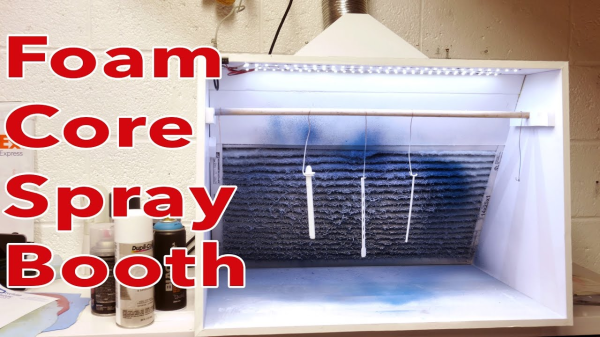
Industrial designer [Eric Strebel] has access to big, walk-in spray booths, but bigger isn’t always better. For small jobs, it’s overkill, and he wanted his own spray booth anyway. If you’re ready to upgrade from that ratty old cardboard box in the garage, look no further than [Eric]’s spray booth how-to after the break.

If you don’t already know, [Eric] is something of a foam core legend. He has several videos about model building techniques that produce really slick results, so it’s no surprise to see these skills transfer to a larger build. The booth is built from a single 40″ x 60″ sheet of 1/2″ foam core board, a furnace filter, and a vent fan modified to fit his shop’s system. The whole thing cost less than $200, most of which goes toward the fan.

[Eric] modified an existing spray booth plan to fit his needs and added some really nice touches along the way. All the edges are beveled and the unfinished faces are taped, so at first glance it looks like it’s made out of painted wood or melamine board. The furnace filter slides out one side for easy replacement and is braced with foam scraps so it won’t fall forward. The best part of this booth is the LED strips—they make for way better working conditions than the dim recesses of a cardboard box.

If you’d rather build a walk-in spray booth, why not make your own sliding barn doors, too?

Continue reading “DIY Spray Booth Is Both Light And Lit” →