MRRF: MakerOS For Maker Business Management

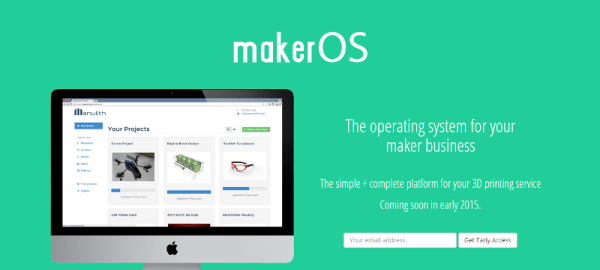
If you’re a maker business, making the things is usually your chief concern, whether you’re 3D printing widgets or milling them. But if you don’t put enough time and energy into things like client interaction and payments, you may find that you don’t have customers. [Mike Moceri] was tired of bloated systems like Salesforce that cost entirely too much for what they are. He created makerOS to help maker businesses be more effective without wasting time, starting with his own—a Detroit-based 3D printing, design, and prototyping firm called Manulith.

When a business registers with makerOS, they get a custom subdomain. makerOS is white-label software that provides a dashboard for the business owner and opens the lines of communication between maker and client. The client sees their own dashboard, and here they can can fill out a short form to describe what they want and upload photos and files from common cloud services. The dashboard provides a simple way to quote products and services, take payments, and facilitate discussion between manufacturer and client through a sort of wall/bulletin board which supports @ mentions and push notifications.

It’s free to register a subdomain with makerOS and install it on your existing site. The minimal costs associated are transaction based and flexible as your company grows.
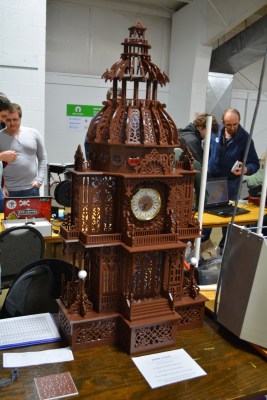
MRRF: (not Quite) Chocolate Clock

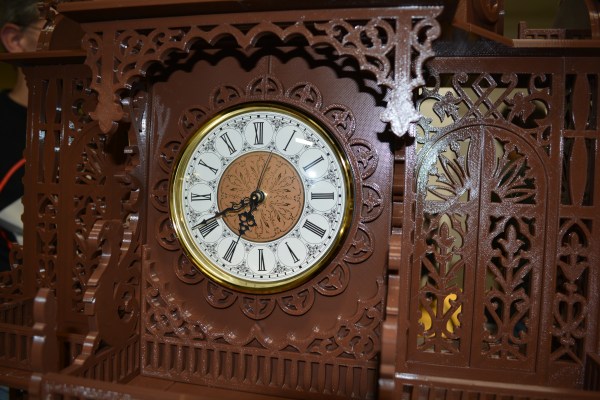
[Jason] is a woodworker. At least, he was until he saw his first 3D printer. While he may still work in wood, he particularly likes adapting scroll saw patterns for 3D printing. His clock started as a woodworking pattern for use on a scroll saw. To adapt it for 3D printing, [Jason] scanned the plotter-sized pattern pieces into Inkscape, where he was able to do things like add bevels before sending the pieces to OpenSCAD.

tall chococlockAs you might imagine, a great deal of work went into this build, beginning with the scanning. [Jason] starting scanning last October and finished in January. Printing started January 9th, and he told me the final pieces were printed early this morning. We know you want all the details, so here goes: this build took just over six rolls of PLA at 20% infill. It’s 48″ tall and about 24″ wide. It was printed on what [Jason] referred to as his “very modified” Replicator 2. He glued the pieces together with Testor’s, and that took about 30 hours. All through the project, he kept meticulous notes in a spreadsheet of print times and filament used.

We were honored to be among the first to see [Jason]’s incredible clock build at this year’s Midwest RepRap Festival. He would like to take it on tour this year to the nearby Maker Faires. If he can figure out how transport it safely, he’d like to show it at World Maker Faire in NYC.

Retrotechtacular: On The Wings Of Goodyear

At the opposite end of the spectrum from the various blimp and rigid-hull airships Goodyear has created over the years stands the Goodyear Inflatoplane, the company’s foray into experimental inflatable aircraft. Goodyear had recently created a rubberized nylon material they called Airmat, the faces of which were connected internally by nylon threads. This material was originally developed during research into the viability of emergency airplane wings.

The United States military became interested in the Inflatoplane after Goodyear had performed successful testing of demonstration model GA-33. They believed that the Inflatoplane could be dropped from the air in a rigid container to facilitate an emergency rescue, or trucked around with the rest of the cargo as a last resort for just exactly the right situation. It seems like a good idea on paper. The Inflatoplane could stay packed into a fairly small container until it was needed. The GA-468 one-seater model could go almost 400 miles on 20 gallons of fuel, and required less pressure to inflate than the average car tire.

This episode of the Discovery Channel series WINGS includes a real-time demonstration of taking an Inflatoplane from crate to air set to late ’80s montage music. It takes the pilot a full five minutes to unfurl and  the plane, and he does it on a nice and level grassy spot by a lake that looks more like a cozy picnic spot than threatening enemy territory. While it’s better than not having an inflatable emergency aircraft, it just isn’t that practical.

Goodyear had all kinds of plans for future improvements, such as a vertical takeoff model and a rocket-powered version. But the Inflatoplane military initiative was grounded around the time that someone speaking for the Army deadpanned that they “could not find a valid military use for an aircraft that could be taken down by a well-aimed bow and arrow.”

Continue reading “Retrotechtacular: On The Wings Of Goodyear” →

IoT Chameleon Lamp Does It With Python

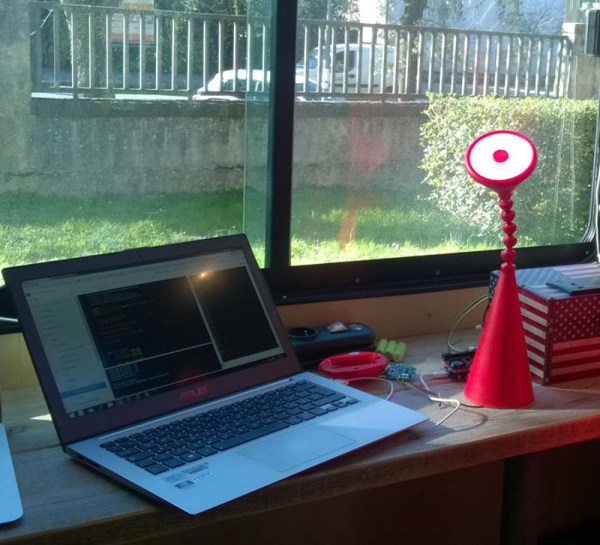
If this Internet of Things thing is gonna leave the launchpad, it will need the help of practical and semi-practical project ideas for smartifying everyday items. Part of getting those projects off the ground is overcoming the language barrier between humans that want to easily prototype complex ideas and hardware that wants specific instructions. A company called Things on Internet [TOI] has created a system called VIPER to easily program any Spark Core, UDOO or Arduino Due with Python by creating a virtual machine on the board.

The suite includes a shield, an IDE, and the app. By modifying a simple goose neck IKEA lamp, [TOI] demonstrates VIPER (Viper Is Python Embedded in Realtime). They opened the lamp and added an 24-LED Adafruit NeoPixel ring, which can be controlled remotely by smartphone using the VIPER app. To demonstrate the capacitive sensing capabilities of the VIPER shield, they lined the head of the lamp with foil. This code example will change the NeoPixels to a random color each time the button is pressed in the app.

Check out the lamp demonstration after the break and stay for the RC car.

Continue reading “IoT Chameleon Lamp Does It With Python” →

Custom PLCs For Automation Industries

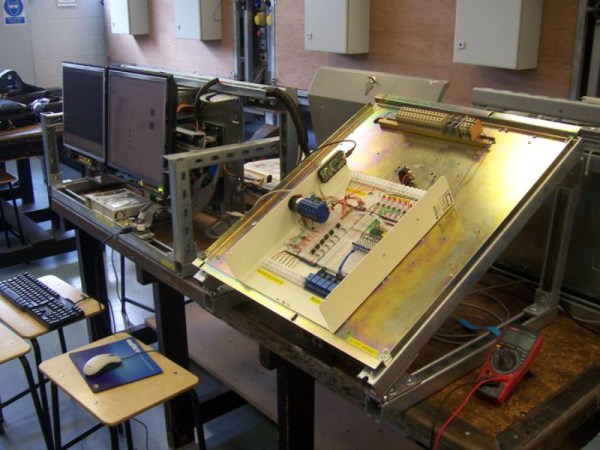
For many years, factories have used PLCs for automated control over industrial equipment. These systems are usually expensive, proprietary, and generally incapable of being reprogrammed. [Oliver], an engineering student in Ireland created a system for factories to develop their own application-specific PLCs as a final project for Automation Engineering.

In-house PLC creation has many benefits for manufacturers, not the least of which is the opportunity for customization. Making your own PLCs also means no licensing fees and total control over equipment automation. This system is a complete setup including an HMI interface with touchscreen input and a SCADA system for remotely controlling various pieces equipment of equipment from a laptop.

[Oliver] built a metal frame out of industrial-grade strut channel to house an XP machine, two monitors, and the beautifully breadboarded PLC design station. It’s based around a PIC16F887 and includes rugged features expected of a system that never goes into sleep mode, like eight channels of opto-isolation. [Oliver] also developed an environment for engineers to easily program their custom PLCs through a simple HMI interface and ladder logic.

Broken Bread Maker Rises Again, Drives Tool-Sharpening Turntable

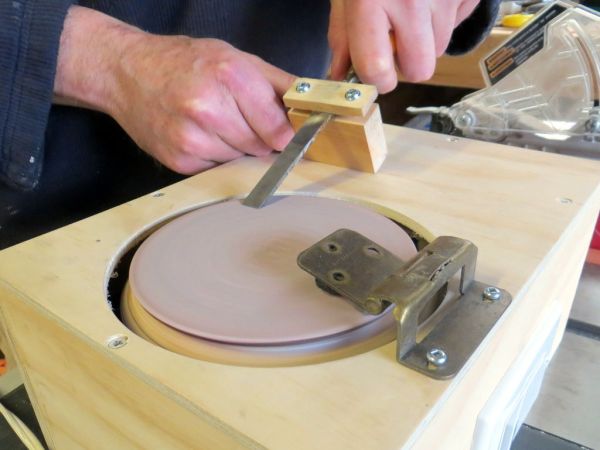
Poor [makendo] had seven broken bread makers lying around, all with failed paddle drivers. Since they also all have big motors and other useful parts in them, he decided to turn one of them into a powered tool-sharpening turntable.

First, [makendo]  salvaged the motor, the gear, and the thick circular glass window from one of the bread makers. He cut a platter from plywood the size of the glass window, chamfering the edge to fit the gear. Next, he built a housing from scrap plywood, separating the motor from the platter with a crosspiece to keep the motor free from dust. A large magnet on a hinge collects metal powder from the system quite effectively. The sharpener spins at about 200RPM: fast enough to do the job and slow enough not to get hot.

According to [makendo], the sharpener restores bevels nicely but doesn’t make edges”scary sharp”. To that end, he used a toaster oven door as a base for a series of micro-abrasive grits of sandpaper as a finishing rig. In order to sharpen his chisels uniformly, he made a jig to hold them firmly in place against either the powered turntable or the fine sandpapers.

[Thanks for the tip, Scott]


Dirt Cheap Motor Balancing And Vibration Analysis

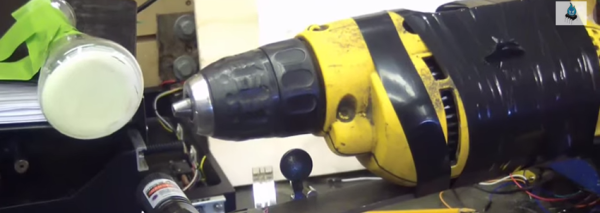
Ever the enterprising hacker and discerning tool aficionado, [Chris] knows the importance of “feel”. As a general rule, cheap tools will shake in your hand because the motors are not well-balanced. He wanted a way to quantify said feel on the cheap, and made a video describing how he was able to determine the damping of a drill using a few items most people have lying around: an earbud, a neodymium magnet, scrap steel, and Audacity.

He’s affixed the body of the drill to a cantilevered piece of scrap steel secured in a vise. The neodymium magnet stuck to the steel interrupts the magnetic field in the earbud, which is held in place with a third hand tool. [Chris] taped the drill’s trigger down and controls its speed a variac. First, [Chris] finds the natural frequency of the system using Audacity’s plot spectrum, and then gets the drill to run at the same speed to induce wobbling at different nodes. As he explains, one need not even use software to show the vibration nodes—a laser attached to the system and aimed at a phosphorescent target will plot the sine wave.

Just for fun, he severely unbalances the drill to find the frequencies at which the system will shake itself apart. Check it out after the break.

Continue reading “Dirt Cheap Motor Balancing And Vibration Analysis” →