Do You Really Need To Dry Filament?

There’s a lot of opinions and theories around the storing and drying of 3D printing materials. Some people are absolutely convinced you must bake filament if it been stored outside an airtight bag, even for a few days. Some others have ‘never had a problem.’ So it’s about time someone in the know has done some testing to try to pin down the answer to the question we’re all asking; How bad is wet filament really?

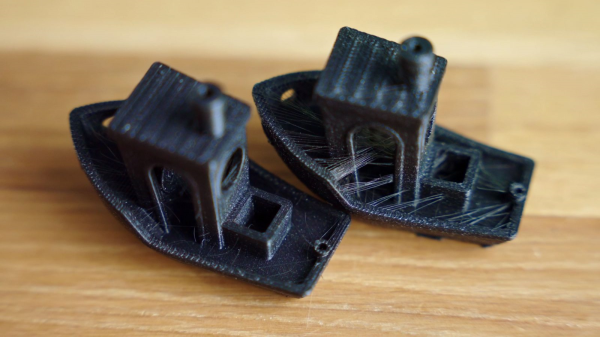
[Thomas Sanladerer] setup a simple experiment, using samples of three common types of filament, specifically PLA, PET-G and ASA. He stored the samples in three environments, on his desk, outside in the garden, and finally submerged in water for a full week. What followed was a whole lot of printing, but they all did print.

Different filaments will absorb water at different rates, depending upon their chemical composition and the environment, nylon being apparently particularly fond of a good soaking. It would seem that the most obvious print defect that occurs with increased water absorption is that of stringing, and other than being annoying and reducing surface quality somewhat, it’s not all that serious in the grand scheme of things. It was interesting to note that water absorption doesn’t seem to affect the strength of the final part.
Continue reading “Do You Really Need To Dry Filament?”

Indoor Blimp Sails Through The Air Using Ultrasonic Transducers

Quadcopter type drones can be flown indoors, but unless you have a lot of space, it usually just ends in a crash. The prospect of being hit in the face by the propellor blades, spinning at 10k RPM doesn’t bear thinking about, and then there’s the noise. So, as a solution for indoor photography, or operating in public spaces, they are not viable. Japanese mobile operator DOCOMO has a new take on an old idea; the blimp. But, surely even a helium filled vehicle needs blades to steer around the room, we hear you cry? Not so, if you use a pair of specialised ultrasonic transducer arrays to move the air instead! (Video, embedded below)

Three banks of thrusters provide a 180 degree steerable net force

Details are scarce, but DOCOMO have fitted a helium balloon with modules on either side that can produce a steerable thrust, allowing the vehicle to effect all the expected aerial manoeuvres with ease and grace. The module at the bottom contains the control electronics, an upwards facing RGB LED for some extra bling, and of course a video camera to capture those all-important video shots.

We’d love to find a source for those ultrasonic transducer devices, and can only guess at the physical arrangement that allows for air to pass in one direction only, to effect a net thrust. We can find a few research papers hinting at the ability to use ultrasound to propel through air, like this one (bah! IEEExplore Paywall!) but to our knowledge,  this technology is not quite in the hands of hackers just yet.

Blimps are by no means scarce on these fine pages, here is a Blimpduino, an Arduino controlled 3D printed blimp, an illuminated blimp art installation by Japanese artist [Kensho Miyoshi] and if using helium is just too darn safe for you (or if you want to help prevent this allegedly precious resource from being lost into space) you could just build a remote controlled blimp using hydrogen instead. Just don’t light a match.

Continue reading “Indoor Blimp Sails Through The Air Using Ultrasonic Transducers”

Fifty Shades Of Brown: 3D Printing With Sugar

[Norbert Heinz] has been busy for the 2021 Hackaday Prize entry, working on the design of a direct granule extruder for 3D printing with waste materials, or materials that are not provided in the form of a filament. Sugar is pretty common in most households, so since that’s already available in granular form, [Norbert] gave 3D printing with granulated sugar a try. (Video, embedded below.)

[Editor’s note: He earned fifth place for this one! Well, not the sugar in particular, but the overall great work on granular extruders.]

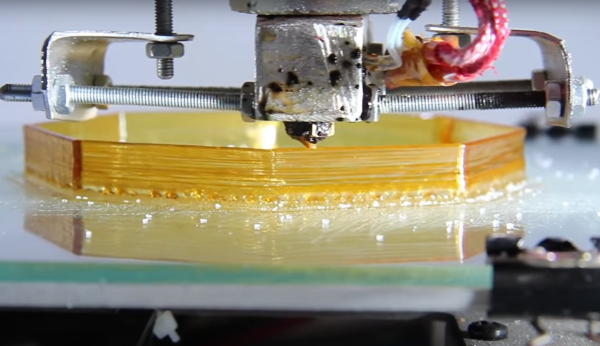
Success was somewhat variable, as the gloopy material is notoriously fickle to work with, but the setup did produce some structures that stayed in one piece, at least for a while. Initially [Norbert] tried it real slow, effectively printing with the liquified sweet stuff, by dragging a molten blob of it around on the end of the extruder nozzle. Whilst this did work, the resulting print resolution did leave something to be desired. The next thing tried was increased print speed. This produced clearer prints, as the sugar did not have time to caramelise, or form a noticeable blob, but as soon as the bed started to cool, it caused it to crack badly.

Going slow seemed to be the way forward, as more time to cool may have reduced the stresses in the structure due to the increased cooling time. But anyway, the way we see it, is it’s fun trying, and if it fails, you can just eat it, so long as you disregard all that food safety stuff anyway.

[Norbert] documents the granule extruder journey on the project Hackaday.io page, so it should be straightforward enough to duplicate this is you were so inclined.

We’ve covered a few sugary hacks before; Need a renewable bed adhesive? out of glue stick? try sugar as a bed adhesive! Printing in gloopy, sloppy materials is nothing new at all, we covered it nearly ten years ago.

Continue reading “Fifty Shades Of Brown: 3D Printing With Sugar”

Inverted Pendulum Balanced On A Drone

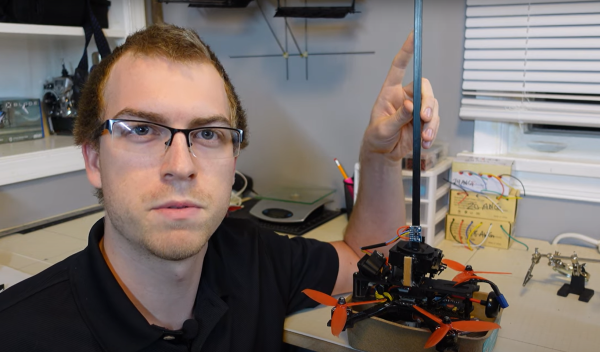
[Nicholas Rehm] works during the day at the Applied Physics Laboratory at Johns Hopkins, Maryland, so has considerable experience with a variety of UAV applications. The question arose about how the perseverance mars rover landing worked, which prompted [Nicholas] to hang a rock under his drone, attached via a winch. This proved to be interesting. But what is more interesting for us, is what happens when you try to attach an inverted pendulum to the top of a drone in flight? (video embedded, below)

This is a classic control theory problem, where you need to measure the angle of the pendulum with respect to the base, and close the loop by calculating the necessary acceleration from the pendulum angle. Typically this is demonstrated in one dimension only, but it is only a little more complicated to balance a pendulum with two degrees of freedom.

[Nicholas] first tried to derive the pendulum angle by simply removing the centering springs from an analog joystick, and using it to attach the pendulum rod to the drone body. As is quite obvious, this has a big drawback. The pendulum angle from vertical is now the sum of the joystick angle and the drone angle, which with the associated measurement errors, proved to be an unusable setup. Not to be discouraged, [Nicholas] simply added another IMU board to the bottom of the pendulum, and kept the joystick mechanism as a pivot only. And, as you can see from the video after the break, this indeed worked.

The flight controller is [Nicholas’] own project, dRehmFlight (GitHub), which is an Arduino library intended for the Teensy 4.0, using the ubiquitous MPU6050 6-DOF IMU. [Nicholas] also made an intro video for the controller, which may prove instructive for those wishing to go down this road to build their own VTOL aircraft. The code for pendulum experiment is not available at the time of writing, perhaps it will hit the GitHub in the future?

Continue reading “Inverted Pendulum Balanced On A Drone”

Slick Keyboard Built With PCB Magic

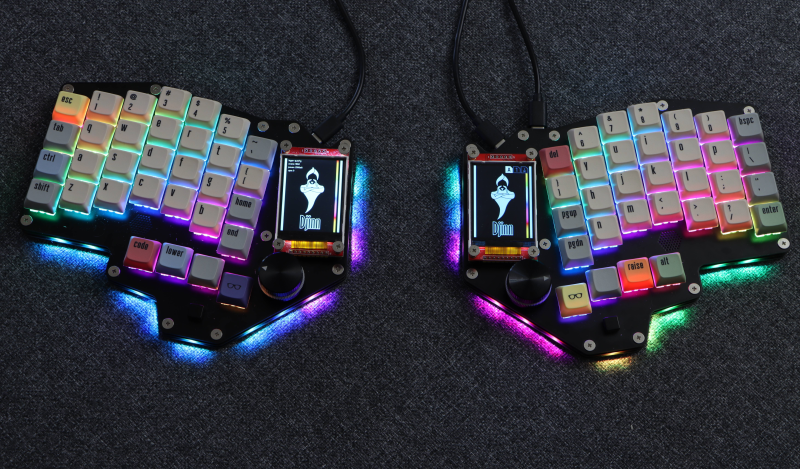
Sometimes a chance conversation leads you to discover something cool you’ve not seen before, and before you know it, you’re ordering parts for yet another hardware build. That’s what happened to this scribe the other day when chatting on some random discord, to QMK maintainer [Nick Brassel aka tzarc] about Djinn, a gorgeous 64-key split mechanical keyboard testbed. It’s a testbed because it uses the newest STM32G4x microcontroller family, and QMK currently does not have support for this in the mainline release. For the time being, [Nick] maintains a custom release, until it gets merged.

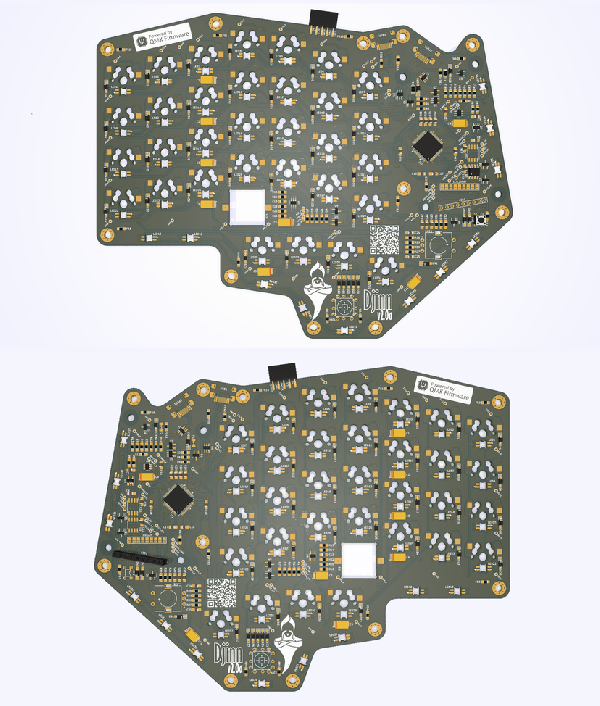
Hardware-wise, the design is fabulous, with a lot of attention to detail. We have individual per-key RGB LEDs, RGB underglow, a rotary encoder, a five-way tactile thumb switch, and a 240×320 LCD per half. The keyboard is based on a three PCB stack, two of which are there purely for structure. This slick design has enough features to keep a fair few of us happy.

Interestingly, when you look at the design files (KiCAD, naturally) [Nick] has chosen to take a mirrored approach to the PCB. That means the left and right sides are actually the same PCB layout. The components are populated on different sides of the PCB depending on which half you’re looking at! By mirroring footprints on both PCB sides, and hooking everything up in parallel, it’s possible to do it all with a single master layout.

This is a simple but genius idea that this scribe hadn’t come across before (the shame!) Secondarily it keeps costs down, as your typical Chinese prototyping house will not deal in PCB quantities below five, so you can make two complete keyboards on one order, rather than needing two orders to make five. (Yes, there are actually three unique PCBs, but we’re simplifying the situation, ok?)

Now, if only this pesky electronics shortage could abate a bit, and we could get the parts to build this beauty!

Obviously, we’ve covered many, many keyboards over the years. Here’s our own [Kristina’s] column all about the things. If you need a little help with your typing skills, this shocking example may be the one for you. If your taste is proper old-school clackers, there’s something for everyone.

Polymer Discovery Gives 3D-printed Sand Super Strength

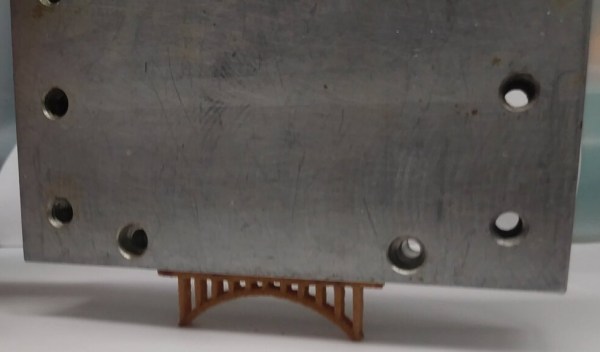
Research activity into 3D printing never seems to end, with an almost constant stream of new techniques and improvements upon old ones hitting the news practically daily. This time, the focus is on a technique we’ve not covered so much, namely binder jetting additive manufacturing (BJAM for short, catchy huh?) Specifically the team from Oak Ridge National Laboratory, who have been exploring the use of so-called hyperbranched Polyethyleneimine (PEI) as a binder for jetting onto plain old foundry silica sand (nature, free access.)

Roll, spray, bake. Simples.

The PEI binder was mixed with a 75:25 mix of water and 1-propanol (not to be mixed up with 2-propanol aka isopropanol) to get the correct viscosity for jetting with a piezoelectric print head and the correct surface tension to allow adequate powder bed penetration, giving optimal binding efficiency. The team reported a two-fold increase in strength over previous jetting techniques, however, the real news is what they did next; by infusing the printed part (known as the green part) with common old ethyl cyanoacrylate (ECA, or super glue to us) the structural strength of the print increased a further eight times due to the reaction between the binder and the ECA infiltrate.

To further bestow the virtues of the PEI binder/ECA mix, it turns out to be water-soluble, at least for a couple of days, so can be used to make complex form washout tooling — internal supports that can be washed away. After a few days, the curing process is complete, resulting in a structure that is reportedly stronger than concrete.  Reinforce this with carbon fiber, and boy do you have a tough building material!

Not bad for some pretty common materials and a simple printing process.

We covered a similar binder jetting process for using sawdust a little while ago, and a neat way of printing with metal powder by carrying it in a stream of argon and cooking it with a laser, but there is an opening for a DIY effort to get in on the binder jetting game.

Thanks [Victor] for the tip!

Isolated Oscilloscope Design Process Shows How It’s Done

[Bart Schroder] was busy designing high voltage variable speed motor drives and was lamenting the inability of a standard scope to visualise the waveforms around the switch transistors. This is due to the three phase nature of such motors being driven with three current waveforms, out of phase with each other by 120 degrees, where current flows between each pair of winding taps, without being referenced to a common notion of ground. The average scope on your bench however, definitely is ground-referenced, so visualising such waveforms is a bit of a faff. Then there’s the fact that the motors run at many hundreds of volts, and the prospect of probing that with your precious bench instrument is a little nerve-wracking to say the least. The solution to the issue was obvious, build your own isolated high voltage oscilloscope, and here is the Cleverscope CS448 development journey for your viewing pleasure.

The scope itself is specification-wise nothing too flash, it’s the isolated channels that make it special. It does however have some niceties such as an extra eight 100 Mbps digital inputs and a handy 65 MHz signal generator. Also, don’t reach for your wallets just yet, as this is a specialised instrument with an even smaller potential user base than a normal scope, so these units are rather pricey. That all said, it’s not the existence of the scope that is the focus here, it’s the journey from problem to solution that interests us the most. There is much to learn from [Bart’s] journey, for example, where to place the frontend ADC? Isolated side or not? The noise floor of the signal chain dictated the former.

Continue reading “Isolated Oscilloscope Design Process Shows How It’s Done”