Old TV Lends Case To Retro Magic Mirror

Remember the days when the television was the most important appliance in the house? On at dawn for the morning news and weather, and off when Johnny Carson said goodnight, it was the indispensable portal to the larger world. Broadcast TV may have relinquished its hold on the public mind in favor of smartphones, but an information portal built into an old TV might take you back to the old days.

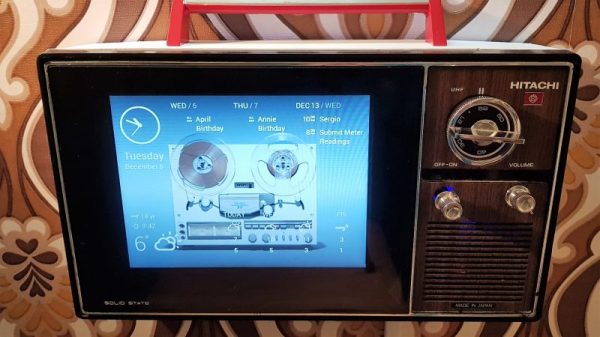
It seems like [MisterM] has a little bit of a thing for the retro look. Witness the wallpaper in the video after the break for proof, as well as his Google-ized Radio Shack intercom project from a few months back. His current project should fit right in, based on an 8″ black-and-white TV from the 70s as it is. TVs were bulky back then to allow for the long neck of the CRT, so he decided to lop off the majority of the case and use just the bezel for his build. An 8″ Pimoroni display sits where the old tube once lived, and replicates the original 4:3 aspect ratio. With Chromium set up in kiosk mode, the family can quickly select from a variety of news and information “channels” using the original tuning knob, while parts from a salvaged mouse turns the volume control into a scroll wheel.

It’s a nice twist on the magic mirror concept, and a little different from the other retro-TV projects we’ve seen, like a retro gaming console or an old-time case for a smart TV.

Continue reading “Old TV Lends Case To Retro Magic Mirror”

Maria Mitchell: The First Woman Astronomy Professor

On an October night in 1847, a telescope on the roof of the Pacific National Bank building on Nantucket Island was trained onto the deep black sky. At the eyepiece was an accomplished amateur astronomer on the verge of a major discovery — a new comet, one not recorded in any almanac. The comet, which we today know by the dry designator C/1847 T1, is more popularly known as “Miss Mitchell’s Comet,” named after its discoverer, a 29-year old woman named Maria Mitchell. The discovery of the comet would, after a fashion, secure her reputation as a scholar and a scientist, but it was hardly her first success, and it wouldn’t be her last by a long shot.

Continue reading “Maria Mitchell: The First Woman Astronomy Professor”

Make Christmas Commercial Again With This Tiny TV Ornament

Readers of a certain age will remember a time when the Christmas season in the US officially kicked off after Thanksgiving. That was when advertisers began saturation bombing the communal mind with holiday-themed TV commercials night and day. Broadcast TV no longer holds sway like it did back then, and advertisers now start their onslaught in September, but you can put a little retro-commercialism back to Christmas with this 90s Christmas commercial-playing ornament for your tree.

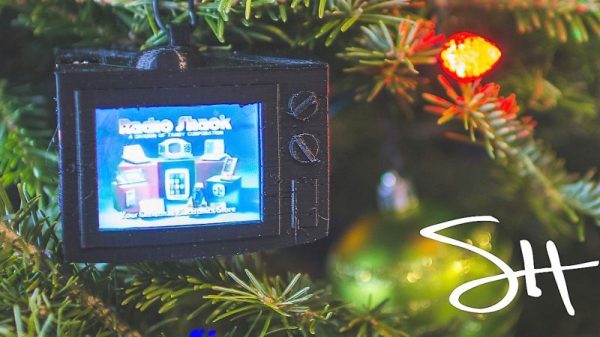
The idea came to [SeanHodgins] after stumbling upon a collection of Christmas commercials from the 1990s on YouTube. With his content identified, he set about building a tree-worthy display from a Pi Zero W and a TFT LCD display. An audio amp and tiny speaker from an old tablet and a LiPo battery and charger form the guts of [Sean]’s TV, which were stuffed into a 3D-printed TV case, appropriately modeled after the TV from The Simpsons. The small fresnel lens that mimics the curved screens of yore is a nice touch. The software has some neat tricks, such as an HTTP server that accepts the slug of a YouTube video, fetches the MP4, and automatically plays it. We prefer our Christmas tree ornaments a little quieter, so a volume control would have been nice, but aside from that this looks like a ton of fun.

This isn’t [Sean]’s first foray into tricked-out ornaments, of course; readers might recall his IoT cheer-measuring Christmas ornaments from last season.

Continue reading “Make Christmas Commercial Again With This Tiny TV Ornament”

Roller Coaster Tycoon IRL

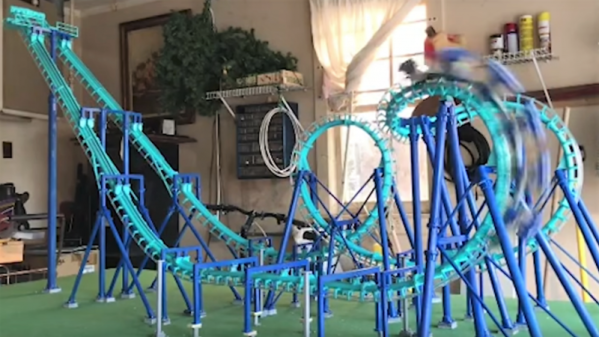
Additive manufacturing has come a long way, but surely we’re not at the point where we can 3D-print a roller coaster, right? It turns out that you can, as long as 1/25th scale is good enough for you.

Some people build model railroads, but [Matt Schmotzer] has always had a thing for roller coasters. Not content with RollerCoaster Tycoon, [Matt] decided to build an accurate and working model of Invertigo, a boomerang coaster at King’s Park, the coaster nirvana in Cincinnati, Ohio. Covering a sheet of plywood and standing about 3′ tall, [Matt]’s model recreates the original in painstaking detail, from the supporting towers and bracing to the track sections themselves. It appears that he printed everything in sections just like the original was manufactured, with sections bolted together. Even though all the parts were sanded and vapor smoothed, the tracks themselves were too rough to use, so those were replaced with plastic tubing. But everything else is printed, and everything works. An Arduino Mega controls the lift motors, opens and closes the safety bars on the cars, and operates the passenger gates and drop floor in the station. The video below shows it in action.

Fancy a coaster of your own, but want something a little bigger? We understand completely.

Continue reading “Roller Coaster Tycoon IRL”

Tapping Into A Ham Radio’s Potential With SDRPlay

Software-defined radios are great tools for the amateur radio operator, allowing visualization of large swaths of spectrum and letting hams quickly home in on faint signals with the click of a mouse. High-end ham radios often have this function built in, but by tapping into the RF stage of a transceiver with an SDR, even budget-conscious hams can enjoy high-end features.

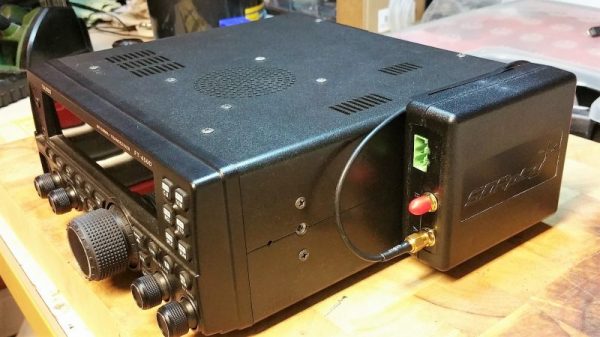
With both a rugged and reliable Yaesu FT-450D and the versatile SDRPlay in his shack, UK ham [Dave (G7IYK)] looked for the best way to link the two devices. Using two separate antennas was possible but inelegant, and switching the RF path between the two devices seemed clumsy. So he settled on tapping into the RF stage of the transceiver with a high-impedance low-noise amplifier (LNA) and feeding the output to the SDRPlay. The simple LNA was built on a milled PCB. A little sleuthing with the Yaesu manual — ham radio gear almost always includes schematics — led him to the right tap point in the RF path, just before the bandpass filter network. This lets the SDRPlay see the signal before the IF stage. He also identified likely points to source power for the LNA only when the radio is not transmitting. With the LNA inside the radio and the SDRPlay outside, he now has a waterfall display and thanks to Omni-Rig remote control software, he can tune the Yaesu at the click of a mouse.

If you need to learn more about SDRPlay, [Al Williams]’ guide to GNU Radio and SDRPlay is a great place to start.

Continue reading “Tapping Into A Ham Radio’s Potential With SDRPlay”

Driver Board Makes Nixie Projects Easier Than Ever

We know, we know — yet another Nixie clock. But really, this one has a neat trick: an easy to use, feature packed driver for Nixies that makes good-looking projects a snap.

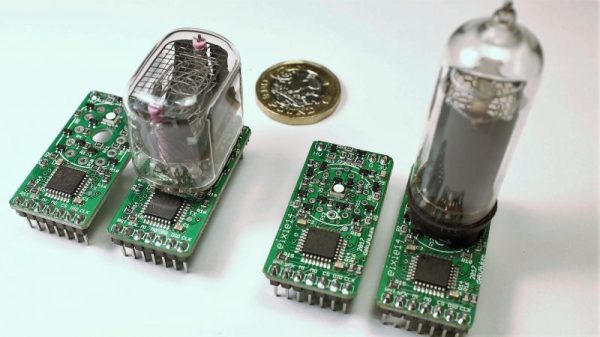
As cool as Nixies are — we’ll admit that to a certain degree, familiarity breeds contempt — they can be tricky to integrate. [dekuNukem] notes that aside from the high voltages, laying hands on vintage driver chips like the 7441 can be challenging and expensive. The problem was solved with about $3 worth of parts, including an STM32 microcontroller and some high-voltage transistors. The PCBs come in two flavors, one for the IN-12 and one for the IN-14, and connections for the SPI interface and both high- and low-voltage supplies are brought out to header pins. That makes the module easy to plug into a motherboard or riser card. The driver supports overdriving to accommodate poisoned cathodes, 127 brightness levels for smooth dimming, and a fully adjustable RBG backlight under the tube. See the boards in action in the video below, which features a nicely styled, high-accuracy clock.

From Nixie tachs to Nixie IoT clocks, [dekuNukem]’s boards should make creative Nixie projects even easier. But if you’re trying to drive a Nixie Darth Vader, you’re probably on your own.

Danielle Applestone: Building The Workforce Of 2030

You wake up one morning with The Idea — the one new thing that the world can’t do without. You slave away at it night and day, locked in a garage expending the perspiration that Edison said was 99 percent of your job. You Kickstart, you succeed, you get your prototypes out the door. Orders for the new thing pour in, you get a permanent space in some old factory, and build assembly workstations.  You order mountains of parts and arrange them on shiny chrome racks, and you’re ready to go — except for one thing. There’s nobody sitting at those nice new workstations, ready to assemble your product. What’s worse, all your attempts to find qualified people have led nowhere, and you can’t even find someone who knows which end of a soldering iron to hold.

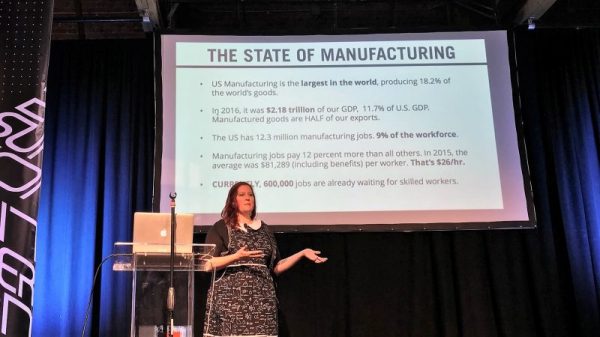
Granted, the soldering iron lesson is usually something that only needs to happen once, but it’s not something the budding entrepreneur needs to waste time on. Finding qualified workers to power a manufacturing operation in the 21st century is no mean feat, as Dr. Danielle Applestone discussed at the 2017 Hackaday Superconference. Dr. Applestone knows whereof she speaks — she was the driving force behind the popular Othermill, serving as CEO for Other Machine Co. and orchestrating its rise to the forefront of the desktop milling field. Now rebranded as Bantam Tools, the company is somewhat unique in that it doesn’t ship its manufacturing off to foreign shores — they assemble their products right in the heart of Berkeley, California. So finding qualified workers is something that’s very much on her mind on a daily basis.

Continue reading “Danielle Applestone: Building The Workforce Of 2030”