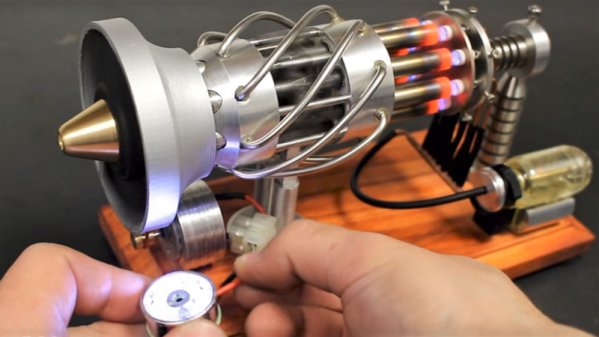
16-Cylinder Stirling Engine Gets A Tune Up

Tiny catapults, kinetic sculptures, a Newton’s Cradle — all kinds of nifty toys can adorn the desk of the executive in your life. On the high end of the scale, a 16-cylinder butane-powered Stirling engine makes a nice statement, but when it comes equipped with a propeller that looks ready for finger-chopping, some mods might be in order before bestowing the gift.

We don’t knock [JohnnyQ90] for buying a rotary Stirling engine from one of the usual sources rather than building, of course. With his micro Tesla turbine and various nitro-powered tools, he’s proven that he has the machining chops to scratch-build one of these engines. And it wasn’t just the digit dicing potential of the OEM engine that inspired him. There was a little too much slop in the bearings for his liking, so he machined a new bearing block and shaft extension. With a 3D-printed shroud, a small computer fan, and snappy brass nose cone, the engine started looking more like a small jet engine. And the addition of a pulley and a small generator gave the engine something interesting to do. What’s more, the increased airflow over the cold end of the engine boosted performance.

Need the basics of Stirling engines? Here’s a quick look at the 200-year history of these remarkable devices.

Continue reading “16-Cylinder Stirling Engine Gets A Tune Up”

Ask Hackaday: Preserving Electronic Devices

Conventional wisdom holds that we no longer make things to last for the long haul, and that we live in a disposable world. It’s understandable — after all, most of us have a cell phone in our pocket that’s no more than a year or two old, and it’s often cheaper to buy a new printer than replace the ink cartridges. But most of that disposability is driven by market forces, like new software that makes a device obsolete long before it breaks down, or the razor and blades model that makes you pay through the nose for ink. It turns out that most electronic devices are actually pretty well engineered, and as long as they’re not abused can still be operating decades down the road.

But what happens when you want to put an electromechanical device away and preserve it for a rainy day? What can you do to make sure the device will operate again a few years down the road? Are there steps one can take beyond the typical “keep it in a cool, dry place” advice? In short, how do you preserve electronic devices?

Continue reading “Ask Hackaday: Preserving Electronic Devices”

Home-Brew Ruby Laser Packs A Wallop

In the past half-century, lasers have gone from expensive physics experiments using rods of ruby to cheap cutting or engraving tools, and toys used to tease cats. Advances in physics made it all possible, but it turns out that ruby lasers are still a lot of fun to play with, if you can do it without killing yourself.

With a setup that looks like something from a mad scientist movie set, [styropyro]’s high-powered laser is a lot closer to the ray gun of science fiction than the usual lasers we see, though hardly portable. The business end of the rig is a large ruby rod nestled inside a coiled xenon flash lamp, which in turn is contained within a polished reflector. The power supply for the lamp is massive — microwave oven transformers, a huge voltage multiplier, and a bank of capacitors that he says can store 20 kilojoules. When triggered by a high-voltage pulse from a 555 oscillator and an old car ignition coil, the laser outputs a powerful pulse of light, which [styropyro] uses to dramatic effect, including destroying his own optics. We’d love to hear more about the power supply design; that Cockcroft-Walton multiplier made from PVC tubes bears some exploration.

Whatever the details, the build is pretty impressive, but we do urge a few simple safety precautions. Perhaps a look at [Ben Krasnow]’s 8-kJ ruby laser would help.

Continue reading “Home-Brew Ruby Laser Packs A Wallop”

A Watch Only A Ham Can Use

We’re not sure what to make of this one. With the variety of smartwatches and fitness trackers out there, we can’t be surprised by what sort of hardware ends up strapped to wrists these days. So a watch with an RPN calculator isn’t too much of a stretch. But adding a hex editor? And a disassembler? Oh, and while you’re at it, a transceiver for the 70cm ham band? Now that’s something you don’t see every day.

The mind boggles at not only the technical prowess needed to pull off what [Travis Goodspeed (KK4VCZ)] calls the GoodWatch, but at the thought process that led to all these features being packed into the case of a Casio calculator watch. But a lot of hacking is more about the “Why not?” than the “Why?”, and when you start looking at the feature set of the CC430F6137 microcontroller [Travis] chose, things start to make sense. The chip has a built-in RF subsystem, intended no doubt to enable wireless sensor designs. The GoodWatch20 puts the transceiver to work in the 430-MHz band, implementing a simple low-power (QRP) beacon. But the real story here is in the hacks [Travis] used to pull this off, like using flecks of Post-It notes to probe the LCD connections, and that he managed to stay within the confines of the original case.

There’s some real skill here, and it makes for an interesting read. And since the GoodWatch is powered by a coin cell, we think it’d be a great entry for our Coin Cell Challenge contest.

[via r/AmateurRadio]

Jerri Nielsen: Surviving The Last Place On Earth

There may be no place on Earth less visited by humans than the South Pole. Despite a permanent research base with buildings clustered about the pole and active scientific programs, comparatively few people have made the arduous journey there. From October to February, up to 200 people may be stationed at the Amundsen-Scott South Pole Station for the Antarctic summer, and tourists checking an item off their bucket lists come and go. But by March, when the sun dips below the horizon for the next six months, almost everyone has cleared out, except for a couple of dozen “winter-overs” who settle in to maintain the station, carry on research, and survive the worst weather Mother Nature brews up anywhere on the planet.

To be a winter-over means accepting the fact that whatever happens, once that last plane leaves, you’re on your own for eight months. Such isolation and self-reliance require special people, and Dr. Jerri Nielsen was one who took the challenge. But as she and the other winter-overs watched the last plane leave the Pole in 1998 and prepared for the ritual first-night screening of John Carpenter’s The Thing, she had no way of knowing what she would have to do to survive the cancer that was even then growing inside her.

Continue reading “Jerri Nielsen: Surviving The Last Place On Earth”

Poor Man’s Laser Scanner Probably Won’t Shoot Your Eye Out, Kid

Yes, laser cutters that come off the slow boat from China are more affordable than ever, and with some tweaks and hacks they can turn out some decent results. But if you just want a laser lightshow that’ll draw boxes on your living room ceiling, this simple X-Y laser scanner might be a good platform to build.

Let’s say right up front that there are more than a few safety issues with [ThingEngineer]’s 3D-printed two-axis scanner. He’s well aware of these potential retina-cooking issues and duly notes that a good pair of laser safety goggles is a must and that the cheap anti-lawsuit glasses that laser module manufacturers often include with their products don’t count.

[Editor’s Note: Glasses are really only intended for alignment operations. Pros enclose lasers beyond a certain power to prevent anyone going blind. Know where your beam terminates, kids.]

With that in mind, there’s a lot to be said for this poor man’s scanner build. Yes, it would be faster with real galvos and low-mass mirrors, but time is money, and the steppers and craft store mirror discs do the job, albeit slowly. We like that everything is so simple, even the method for turning a regular mirror into a front-surface mirror.

[ThingEngineer] proves you don’t need galvanometers to have some simple laser fun. And if steppers don’t do it for you, you can try little brushed DC hobby motors or even 3D-printed cams.

Continue reading “Poor Man’s Laser Scanner Probably Won’t Shoot Your Eye Out, Kid”

Retractable Console Allows Wheelchair User To Get Up Close And Personal

[Rhonda] has multiple sclerosis (MS), a disease that limits her ability to walk and use her arms. She and the other residents of The Boston Home, an extended care facility for people with MS and other neuromuscular diseases, rely on their wheelchairs for mobility. [Rhonda]’s chair comes with a control console that swings out of the way to allow her to come up close to tables and counters, but she has problems applying enough force to manually position it.

Sadly, [Rhonda]’s insurance doesn’t cover a commercial solution to her problem. But The Boston Home has a fully equipped shop to extend and enhance residents’ wheelchairs, and they got together with students from MIT’s Principles and Practices of Assistive Technology (PPAT) course to hack a solution that’s not only useful for [Rhonda] but should be generally applicable to other chairs. The students analyzed the problem, measured the forces needed and the clearances required, and built a prototype pantograph mount for the control console. They’ve made the device simple to replicate and kept the BOM as inexpensive as possible since patients are often out-of-pocket for enhancements like these. The video below shows a little about the problem and the solution.

Wheelchair hacks are pretty common, like the 2015 Hackaday Prize-winning Eyedrivomatic. We’ve also covered totally open-source wheelchairs, both manual and electric.

Continue reading “Retractable Console Allows Wheelchair User To Get Up Close And Personal”