Serious DX: The Deep Space Network

Humanity has been a spacefaring species for barely sixty years now. In that brief time, we’ve fairly mastered the business of putting objects into orbit around the Earth, and done so with such gusto that a cloud of both useful and useless objects now surrounds us. Communicating with satellites in Earth orbit is almost trivial; your phone is probably listening to at least half a dozen geosynchronous GPS birds right now, and any ham radio operator can chat with the astronauts aboard the ISS with nothing more that a $30 handy-talkie and a homemade antenna.

But once our spacecraft get much beyond geosynchronous orbit, communications get a little dicier. The inverse square law and the limited power budget available to most interplanetary craft exact a toll on how much RF energy can be sent back home. And yet the science of these missions demands a reliable connection with enough bandwidth to both control the spacecraft and to retrieve its precious cargo of data. That requires a powerful radio network with some mighty big ears, but as we’ll see, NASA isn’t the only one listening to what’s happening out in deep space. Continue reading “Serious DX: The Deep Space Network”
DIY Air Cannon Snags Drones From The Sky

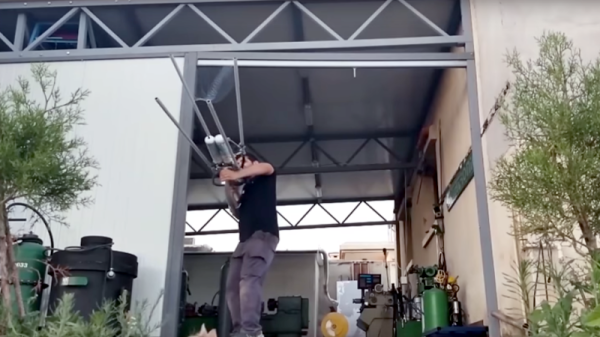
Who hasn’t had the experience of a pesky drone buzzing around that family picnic, or hovering over a suburban backyard where bikini-clad daughters are trying to sunbathe in peace? A shotgun used to suffice for such occasions, but with this compressed-air powered drone catcher, there’s no need to worry about illegally discharging a firearm to secure some privacy.

Before the comment line lights up with outrage, the above scenarios are presented entirely in jest. We do not condone the use of force on a drone, nor do we look favorably on those who use drones in a way that even hints at an invasion of privacy. We can all get along, and even though we hope [Make It Extreme]’s anti-drone gun will never be used in anger, it’s still a neat build that gives us lots of ideas. The rig is essentially four coaxial narrow-bore compressed-air cannons, each launching a slug attached to the corner of a lightweight net. A fairly complex set of linkages sets the spread of the barrels, and a pair of old oxygen tanks serve as reservoirs for the compressed air. A fast-acting dump valve is tripped by an interesting trigger mechanism mounted to a complicated stock and grip; we’d have liked to see more on the fabrication of that bit. The video below shows a test firing that results in a clean takedown of a drone, although we doubt the owner of the quad would characterize it as such.

This build is a bit of a departure from [Make It Extreme]’s usual fare of DIY tools like a shop-built vise or big belt sander, or their unusual vehicles like an off-road hoverboard. But it’s always great to watch a good fabrication video, no matter what the subject.

Continue reading “DIY Air Cannon Snags Drones From The Sky”

Old Intercom Gets Googled With Raspberry Pi And AIY Hat

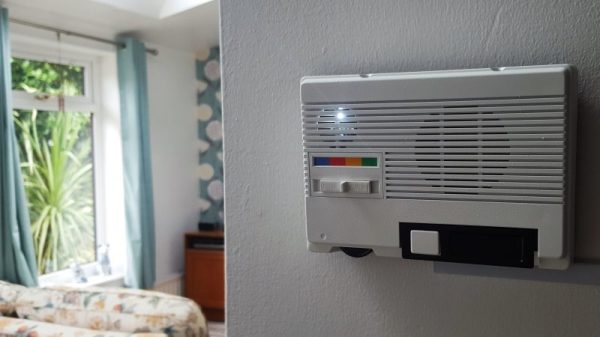
Old Radio Shack intercom; brand new Google Voice interface for a Raspberry Pi. One of these things is not like the other, but they ended up together in this retro-look Google Voice interface, and the results are pretty slick.

The recipient of the Google hive-mind transplant was one of three wireless FM intercoms [MisterM] scored for a measly £4. Looking much as they did when they were the must-have office tool or home accessory for your modern mid-80s lifestyle, the intercom case was the perfect host for the Pi and the Google AIY hat. Only the case was used — not even the original speaker made it into the finished product. The case got a good scrubbing, a fresh coat of paint to perk up the gone-green plastic, and an accent strip of Google’s logo colors over the now-deprecated station selector switch. [MisterM] provided a white LED behind the speaker grille for subtle feedback. A tap of the original talk bar gets Google’s attention for answers to quick questions, and integration into the family’s existing home automation platform turns the lights on and off. See it in action after the break.

[MisterM] was lucky enough to score an AIY hat for free, and as far as we know they’re still hard to come by. If you’re itching to try out the board, fear not — turns out you can roll your own.

Continue reading “Old Intercom Gets Googled With Raspberry Pi And AIY Hat”

The 4-20 MA Current Loop

The I/O capabilities built into most microcontrollers make it easy to measure the analog world. Say you want to build a data logger for temperature. All you need to do is get some kind of sensor that has a linear voltage output that represents the temperature range you need to monitor — zero to five volts representing 0° to 100°C, perhaps. Hook the sensor up to and analog input, whip up a little code, and you’re done. Easy stuff.

Now put a twist on it: you need to mount the sensor far from the microcontroller. The longer your wires, the bigger the voltage drop will be, until eventually your five-volt swing representing a 100° range is more like a one-volt swing. Plus your long sensor leads will act like a nice antenna to pick up all kinds of noise that’ll make digging a usable voltage signal off the line all the harder.

Luckily, industrial process engineers figured out how to deal with these problems a long time ago by using current loops for sensing and control. The most common standard is the 4-mA-to-20-mA current loop, and here we’ll take a look at how it came to be, how it works, and how you can leverage this basic process control technique for your microcontroller projects.

Continue reading “The 4-20 MA Current Loop”

Ask Hackaday: Selling Yourself As A Hacker

While there are plenty of hackers that hack just for the love of it, it’s no secret that many of us are looking to hit it big someday. Tales of the businesses like HP and Apple that started in someone’s garage inevitably lead to musings like, “Hey, I’ve got a garage!” and grand plans to turn that special idea into the Next Big Thing™. Many will try, most will fail for one reason or another, but hope springs eternal, and each new widget seems to start the entrepreneurial cycle again.

But for as much pressure as we may feel to be the next Packard, Wozniak, or Musk, not everyone is cut out to be the boss. Some of us have no interest in or aptitude for business — we don’t want to hire or fire people, we don’t want to wheel and deal, and we certainly don’t want to worry about salesmanship. Some of us just want to abstract all that complexity away and just find a job, preferably one that leverages the things we love to do.
Continue reading “Ask Hackaday: Selling Yourself As A Hacker”

Flush Out Car Thieves With A Key Fob Jammer Locator

We all do it — park our cars, thumb the lock button on the key fob, and trust that our ride will be there when we get back. But there could be evildoers lurking in that parking lot, preventing you from locking up by using a powerful RF jammer. If you want to be sure your car is safe, you might want to scan the lot with a Raspberry Pi and SDR jammer range finder.

Inspired by a recent post featuring a simple jammer detector, [mikeh69] decide to build something that would provide more directional information. His jammer locator consists of an SDR dongle and a Raspberry Pi. The SDR is set to listen to the band used by key fobs for the continuous, strong emissions you’d expect from a jammer, and the Pi generates a tone that varies relative to signal strength. In theory you could walk through a parking lot until you get the strongest signal and locate the bad guys. We can’t say we’d recommend confronting anyone based on this information, but at least you’d know your car is at risk.

We’d venture a guess that a directional antenna would make the search much easier than the whip shown. In that case, brushing up on Yagi-Uda antenna basics might be a good idea.

Hydrodipping 101

Style counts, and sometimes all it takes to jazz up the product of a 3D-printer is a 2D printer and a how-to guide on hydrographic printing.

Hydrographic printing, sometimes called hydrodipping, is a process for transferring graphics onto complex-shaped objects in one simple step. A design is printed on a special film which is then floated on the surface of a tank of water. The object to be decorated is carefully dipped into the water right through the film and the design wraps around all the nooks and crannies in one step.

The video tutorial below details the steps to hydrographic printing and outlines how easy the method has become with the availability of water transfer films for inkjet printers. The film is polyvinyl acetate, which is essentially white glue and hence quite soluble in water. The film dissolves and leaves the ink floating on the surface, ready for dipping.

The video lists quite a few tips for optimizing the process for 3D-printed parts and should let you decorate your parts quickly and easily. And once you master the basics, you might want to look at mathematically warping your design to hydrodip complex surfaces.

Continue reading “Hydrodipping 101”