Fail Of The Week: Good Prosthetic Hand Design Goes Bad

Is this a case of a good design gone wrong in the build phase? Or is this DIY prosthetic arm a poor design from the get-go? Either way, [Will Donaldson] needs some feedback, and Hackaday is just the right place for that.

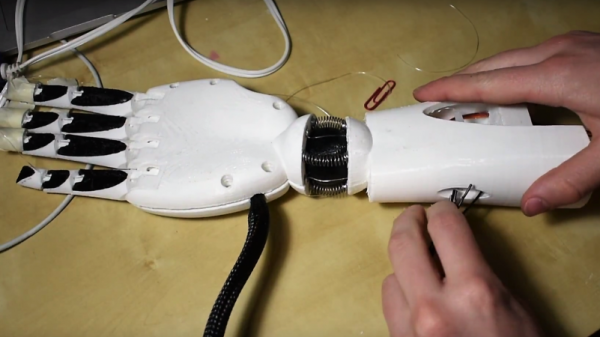
Up front, we’ll say kudos to [Will] for having the guts to post a build that’s less than successful. And we’ll stipulate that when it comes to fully articulated prosthetic hands, it’s easy to fail. His design is ambitious, with an opposable thumb, fingers with three phalanges each, a ball and socket wrist, and internal servos driving everything. It’s also aesthetically pleasing, with a little bit of an I, Robot meets Stormtrooper look.

But [Will]’s build was plagued with print problems from the start, possibly due to the complex nature of the bosses and guides within the palm for all the finger servos. Bad prints led to creaky joints and broken servos. The servos themselves were a source of consternation, modified as they were for continuous rotation and broken apart for remotely mounting their pots in the hand’s knuckles. The video below relates the tale of woe.

There’s a lot to admire with [Will]’s build, but it certainly still has its issues. He’s almost to the point of other more successful DIY hand builds but just needs a little help. What say you in the comments line? Continue reading “Fail Of The Week: Good Prosthetic Hand Design Goes Bad”

Quick Hack Cleans Data From Sump Pump

Nobody likes to monitor things as much as a hacker, even mundane things like sump pumps. And hackers love clean data too, so when [Felix]’s sump pump water level data was made useless by a new pump controller, he just knew he had to hack the controller to clean up his data.

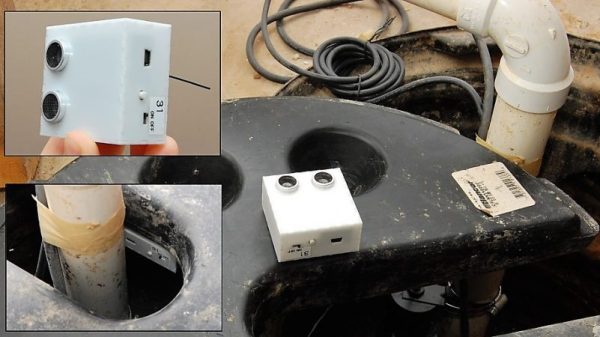
Monitoring a sump pump might seem extreme, but as a system that often protects against catastrophic damage, the responsible homeowner strives to take care of it. [Felix] goes a bit further than the average homeowner, though, with an ultrasonic sensor to continually measure the water level in the sump and alert him to pending catastrophes. Being a belt and suspenders kind of guy, he also added a float switch to control the pump, but found that the rapid cycle time made his measurements useless. Luckily the unit used a 555 timer to control the pump’s run time after triggering, so a simple calculation of the right RC values and a little solder job let him increase the on time of the pump. The result: a dry basement and clean data.

We recently discussed the evolution of home automation if you want to know more about the systems that sensors and actuators like these can be part of. Or for a more nuts and bolts guide to networking things together, our primer on MQTT might help.

North Carolina Hackerspace Destroyed By Fire, Members Vow To Rebuild

There’s something about old industrial buildings that just seems to attract hackerspaces. It could be the open floor plans typical in buildings that used to house big manufacturing operations, or it could be a desire to reinvigorate places where machines once hummed and skilled hands plied their trades. Whatever the attraction, the relationship is not without risk; old buildings with wood floors and frames can be tinderboxes, and tragedy can strike at any moment.

Such a fate befell The Foothills Community Workshop in Granite Falls, North Carolina, this past Friday. Details are still sketchy as the remnants of the 75,000-square foot former Shuford Mills textile factory are still smoldering, and the Fire Marshal’s investigation is not yet complete. Thankfully, no lives were lost, and injuries were limited to heat exhaustion of several of the firefighters from 16 counties who battled the blaze in the hot and humid North Carolina Piedmont.

Continue reading “North Carolina Hackerspace Destroyed By Fire, Members Vow To Rebuild”

Measuring Air Flow With Ultrasonic Sensors

Measuring air flow in an HVAC duct can be a tricky business. Paddle wheel and turbine flow meters introduce not only resistance but maintenance issue due to accumulated dust and debris. Being able to measure ducted airflow cheaply and non-intrusively, like with this ultrasonic flow meter, could be a big deal for DIY projects and the trades in general.

The principle behind the sensor [ItMightBeWorse] is working on is nothing new. He discovered a paper from 2015 that describes the method that measures the change in time-of-flight of an ultrasonic pulse across a moving stream of air in a duct. It’s another one of those “Why didn’t I think of that?” things that makes perfect sense in theory, but takes some engineering to turn into a functional sensor. [ItMightBeWorse] is using readily available HC-SR04 sensor boards and has already done a proof-of-concept build. He’s getting real numbers back and getting close to a sensor that will go into an HVAC automation project. The video below shows his progress to date and hints at a follow-up video with more results soon.

Here’s wishing [ItMightBeWorse] the best of luck with his build. But if things go sideways, he might look to our post-mortem of a failed magnetic flow meter for inspiration.

Continue reading “Measuring Air Flow With Ultrasonic Sensors”

Simple Shop-made Taps For Threading Wood

Wood can be the material of choice for many kinds of projects, but it often falls out of the running in favor of metal or plastic if it needs to take a threaded fastener. But with a little ingenuity you can make your own wood taps and cut threads that will perform great.

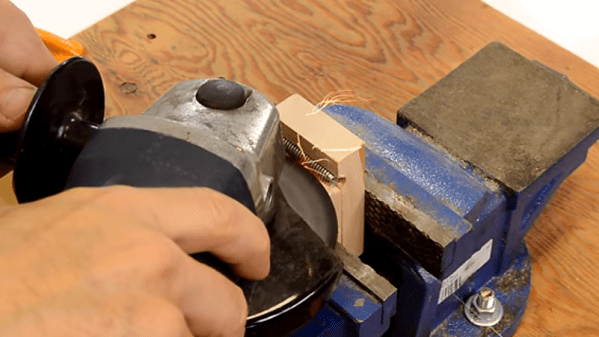
Making wood do things that wood isn’t supposed to do is [Matthias Wandel]’s thing. Hackers the world over know and use his wood gears designer to lay out gears for all kinds of projects from musical marble machines to a wooden Antikythera mechanism. Woodworkers have been threading wood for centuries , so making wood take a decent thread isn’t exactly something new. But doing it on the cheap and making the threads clean and solid has always been tricky. The video after the break shows [Matthias]’ method of cutting a tap out of an ordinary threaded rod or even off-the-shelf lag screws. He uses a simple jig to hold the blank so that flutes can be cut with an angle grinder. The taps work well in the materials he tested, and a little informal stress testing at the end of the video shows promise for long service life of the threads.

Wood threads aren’t suitable for every project, but knowing that you can do it might just open the path to a quick, easy build. This is a great tip to keep in mind.

Continue reading “Simple Shop-made Taps For Threading Wood”

The Tuna Fish Sandwich Foundry

Can you build a foundry out of a loaf of bread and a can of tuna fish? As it turns out, yes you can. And not only can you melt aluminum in said foundry but you can also make a mold from plain beach sand and cast a usable part.

Through the magic of backwoods engineering and that can-do Canadian attitude, [AvE] demonstrates in his inimitable style how a pyrolized loaf of sourdough bread can serve as a perfectly acceptable foundry, using a tuna can as a crucible. We covered [AvE]’s carbon foam creation process before and showed some of its amazing properties, including the refractory characteristics requisite for foundry service. Once reduced to carbon foam, the bread can easily handle the flame of a propane torch and contain the heat long enough to melt aluminum. And using nothing more than beach sand, [AvE] was able to lost-foam cast a knob-like part. Pretty impressive results for such a low-end, field expedient setup.

Normally we warn our more tender-eared readers about [AvE]’s colorful language, lest they succumb to the vapors when he lets the salt out. But he showed remarkable restraint with this one, even with his cutting mat aflame. Pretty SFW, so enjoy seeing what you can do with nothing.

Continue reading “The Tuna Fish Sandwich Foundry”

World’s Largest Super Soaker Is Dangerously Good Clean Fun

Running around while dousing each other with Super Soakers and screaming in delight is de rigueur on suburban lawns on hot summer days, but if you build this giant replica of a Super Soaker that can double as a pressure washer, you might have the upper edge on the neighborhood gang.

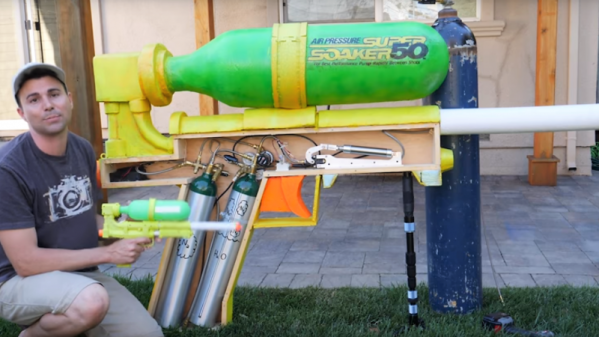
You may remember [Mark Rober] from such projects as his bullseye-catching dart board and his previous entry in the awesome uncle of the year awards, the fully automatic snowball gun. We’re not entirely sure that this seven-foot long replica of the original Super Soaker will win him any uncle or neighbor plaudits, given that it the stream it produces is not far off of what a pressure washer can manage and can literally slice a watermelon in half. Fortunately, [Mark] included swappable nozzles to reduce the pressure enough that relatively safe dousing is still on the table. The housing is a pretty accurate plywood and foam replica of the original toy, but the mechanism is beefed up considerably — a pair of nitrogen tanks, some regulators, and a solenoid valve. See the gun in all its window-smashing, kid-soaking glory in the video after the break.

We realize [Mark]’s build is just a fun way to beat the heat, but it gives us a few ideas for more practical uses. Maybe a DIY water-jet cutter that’s not built around a pressure washer?

Continue reading “World’s Largest Super Soaker Is Dangerously Good Clean Fun”