Robotic Pets Test An Automatic Pet Door

Lots of people get a pet and then hack solutions that help them care for their new friend, like an automatic door to provide access to the great outdoors. Then again, some people build the pet door first and then build the pets to test it.

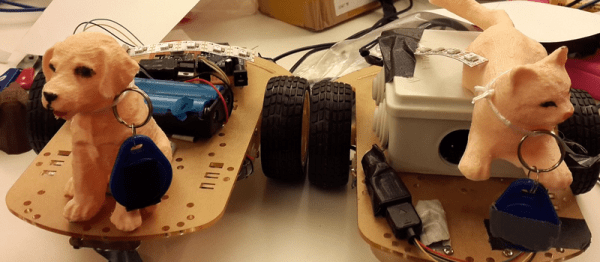
It’s actually not quite as weird as it sounds. [Amir Avni] and his wife attended a recent GeekCon and entered the GeekCon Pets event. GeekCon is a cooperative rather than competitive hackathon that encourages useless builds as a means to foster community and to just have some fun. [Amir] and his wife wanted to build a full-featured automatic pet door, and succeeded – with NFC and an ESP8266, the stepper-powered door worked exactly as planned. But without any actual animal companions to test the system, they had to hack up a few volunteers. They came up with a 3D-printed dog and cat perched atop wireless cars, and with NFC tags dangling from their collars, the door was able to differentiate between the wandering ersatz animals. The video below the break shows the adorable plastic pals in action.

It’s clear from all the pet doors and automatic waterers and feeders we’ve seen that hackers love their pets, but we’re pretty sure this is the first time the pet itself was replaced by a robot. That’s fine for the test environment, but we’d recommend the real thing for production.

Continue reading “Robotic Pets Test An Automatic Pet Door”

How Low Can You Go? The World Of QRP Operation

Newly minted hams like me generally find themselves asking, “What now?” after getting their tickets. Amateur radio has a lot of different sub-disciplines, ranging from volunteering for public service gigs to contesting, the closest thing the hobby has to a full-contact sport. But as I explore my options in the world of ham radio, I keep coming back to the one discipline that seems like the purest technical expression of the art and science of radio communication – low-power operation, or what’s known to hams as QRP. With QRP you can literally talk with someone across the planet on less power than it takes to run a night-light using a radio you built in an Altoids tin. Now that’s a challenge I can sink my teeth into.

Continue reading “How Low Can You Go? The World Of QRP Operation”

Start Your Day The Arduino Way With This IoT Shower Controller

No longer content with adding value to the thermostat in the hallway or making your fridge smarter than it should be, IoT vendors are pushing into the inner sanctum of homes, the holy of holies – the bathroom. Sure, you can spend big bucks on an electronically controlled valve to turn your shower into a remote-controlled spa that shares your bathing habits with the cloud, but if you’re on a more modest budget and have the hacker spirit, you might want to check out this DIY automated shower valve with IoT features.

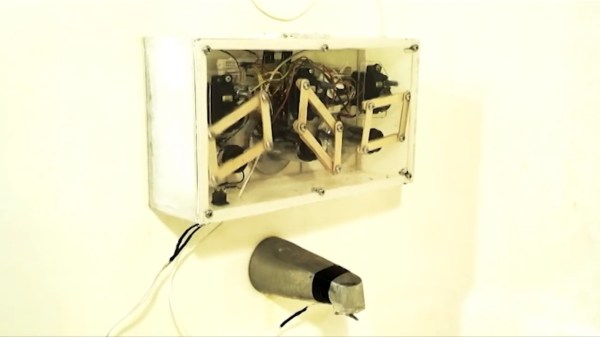
When we last ran into [TVMiller], he was opening gates using Jedi mind tricks, and before that he was shrinking a floating golf green to a manageable size. Such hacks work up a sweat, and while a clean hacker is a happy hacker, all that pesky valve-twisting and temperature-fiddling is so annoying. So with a few parts acquired from the waste stream, like an acrylic box, some salvaged servos, popsicle sticks, and a hell of a lot of caulk, [TVMiller] hacked together a feature-packed controller for his existing shower valves. An Arduino MKR1000 reads the water temperature and controls the servos that allow him to start the shower from his phone. Time and temperature data are sent to the cloud using ThingSpeak. You can see the whole thing in action in the mildly-NSFW video after the break.

Admittedly, this is a pretty janky setup, but it falls under the universal hacker disclaimer of “it’s just a prototype.” Still, we like the idea of retrofitting standard shower valves, and the popsicle-stick parallelograms for increasing leverage is a neat trick. We’ll be watching to see where this goes next.

Continue reading “Start Your Day The Arduino Way With This IoT Shower Controller”

Swarm Of Tiny Pirate Transmitters Gets The Message Out In Syria

They say that the first casualty of war is the truth, and that’s probably only more the case in a civil war. When one side in a conflict controls the message, the other side is at a huge disadvantage. Technology can level the playing field, and in the case of the Syrian Civil War, a swarm of tiny Raspberry Pi transmitters is helping one side get their message out.

We won’t pretend to understand the complexities of this war, but it’s clear that the Syrian government controls broadcast media and access to the internet, and is using them for propaganda while denying the opposition access to the same. A decentralized medium can get the message out under these conditions, and that’s exactly what Pocket FM does. Built around a Raspberry Pi and a frequency-agile FM transmitter, a Pocket FM can take multiple audio feeds and transmit them out to a 5km radius. Small enough to be packed up and deployed quickly and able to be powered by batteries or solar panels, the pirate transmitters can be here one minute and gone the next, yielding a robust network resistant to takedown attempts.

The network built around Pocket FM in Syria is small but growing, and it appears to be making a difference in the conflict. We find the concept of a decentralized network intriguing and potentially empowering, at least in situations where the letter of the law regarding broadcasting is not a prime consideration. That’s where projects like Airchat seek to build an unsanctioned network. The same goes for Tweeting on the Amateur Radio Band in a project aptly named HamRadioTweets.

We wonder how a fleet of these Pi-based transmitters could aid in recovery from natural disasters?

[via r/amateurradio and TomHiggins]

Build Your Own Sensor Skin

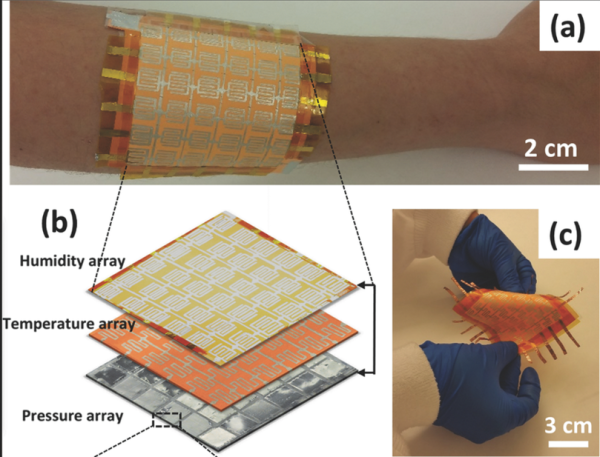
Scientific research, especially in the area of robotics, often leverages cutting-edge technology. Labs filled with the latest measurement and fabrication gear are unleashed on the really tough problems, like how to simulate the exquisite sensing abilities of human skin. One lab doing work in this area has taken a different approach, though, by building multi-functional sensors arrays from paper.

A group from the King Abdullah University of Science and Technology in Saudi Arabia, led by [Muhammad M. Hussain], has published a fascinating paper that’s a tour de force of getting a lot done with nothing. Common household items, like Post-It notes, kitchen sponges, tissue paper, and tin foil, are used to form the basis of what they call “paper skin”. Fabrication techniques – scissors and tape – are ridiculously simple and accessible to anyone who made it through kindergarten.

They do turn to a Circuit Scribe pen for some of their sensors, but even this nod to high technology is well within their stated goal of making it possible for anyone to fabricate sensors at home. The paper goes into great detail about how the sensors are made, how they interact, and how they are interfaced. It’s worth a read to see what you can accomplish with scraps.

For another low-tech paper-based sensor, check out this capacitive touch sensor keyboard.

Thanks for the tip, [Mattias]

Trash Can CNC Gets A Stepper Upgrade

[HomoFaciens] is back at the bench again and working on improvements to his cheap and simple CNC machine.

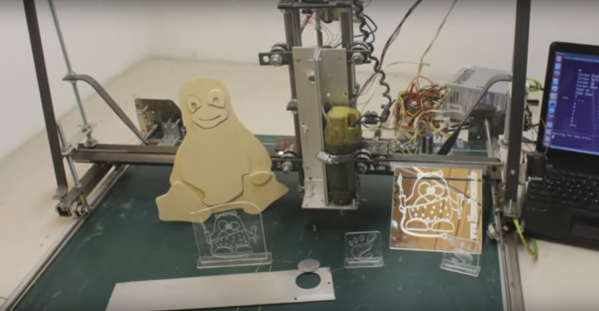
The video below will no doubt remind you about previous versions of [HomoFaciens]’ CNC builds, which we’ve covered in depth. With an eye to spending as little as possible on his builds, most parts are recovered from e-waste, with a fair amount of Dumpster diving thrown in. For this upgrade, the salvaged brushed DC motors with their signature gap-toothed encoder disks are replaced with genuine bipolar steppers. The primary intention of his build is to learn (and teach) as much as possible, so he spends a good amount of time going over steppers and their control – how to determine phase wiring, how to wire up the not-salvaged-but-still-cheap drivers, directional control, and half-stepping. The mechanics are decidedly dodgy, but there are clever expedients aplenty – we especially like the oil cup fabricated from a brass tube and a bolt with a hole drilled in it. Everything just works, and the results to expense ratio is hard to beat.

While we appreciate the upgrades here, we’re still keen to see how junky his other trash can CNC can get. And we’re still waiting on the paper clip and cardboard challenge.

Continue reading “Trash Can CNC Gets A Stepper Upgrade”

An Internet Radio In A Classic Cathedral Case

If you’re looking for a hot collectible item and a great restoration project, cathedral-style radios from the 1930s are a solid choice. But they’re getting harder to find as the years roll by, so if your heart’s content is to listen to modern broadcasts through a radio with a classic look, you may need to roll your own cathedral case for an internet radio.

The cathedral-style case was a hugely successful form-factor for radios back in the day, with variations on the arch-top theme ranging from Gothic to Art Deco. For this build, [nick.r.brewer] decided on a more parabolic arch. His build log has SVG files for the individual ribs that were cut from plywood with an X-Carve. A Raspberry Pi and TFT display were mounted inside the finished case, along with a Bluetooth module and a 20W amplifier and speaker. A big 3-pole rotary switch with custom knob selects the audio source and evokes that 1930s feel. It ended up looking pretty good, and the video after the break shows that it sounds nice, too.

We featured a fair number of internet-radio-in-a-classic-case builds before, but we’re surprised to see no cathedral-style radios have been modded. Maybe it’s time to hit the flea market and estate sales and see what turns up.

Continue reading “An Internet Radio In A Classic Cathedral Case”