The Saga Of Hacking A Bambu X1 Carbon

Bambu Labs make indisputably excellent printers. However, that excellence comes at the cost of freedom. After a firmware release earlier this year, Bambu printers could only work with Bambu’s own slicer. For [Proper Printing], this was unacceptable, so printer modification was in order. 

First on the plate was the pesky Bambu Labs nozzle. They are a pain to replace, and specialty sizes like 1.8mm are nonexistent. To remedy this flaw, a Bambu Labs compatible heat sink, an E3D V6 ring heater, and a heat break assembly are required. The ring heater was needed for clearance with the stock Bambu shroud. With the help of a 3D-printed jig, fresh holes were cut and tapped into the heat sink to make room for the E3D heat break. Some crimping to salvaged connectors and a bit of filing on the heat sink for wire routing, and Bob’s your uncle!

Continue reading “The Saga Of Hacking A Bambu X1 Carbon”

Spinning Top Chair Revisited

Designer furniture generally comes with excellent aesthetics and (sometimes) functionality. However, such furniture comes with a price to match. One such piece of furniture is the Magis Spun Chair. It’s a striking piece with a fun party trick to match: it works like a top spinning while you sit inside. However, it has a prohibitively expensive price tag of $1,200 to match. That’s why [Morley Kert] is on a mission to build one for less. 

This isn’t [Morley]’s first time building a spinning chair. The first attempt featured numerous 3D printed pieces glued together. It did not inspire confidence in spinning, nor was it a striking piece of furniture. So a revisit was in order.

This time around the chair’s construction was CNC milled plywood. Some surfaces featured 3D carving, but the majority were left raw with carving the final shape handled manually. Despite its size, the chair only took four and a half sheets of 3/4 inch plywood by hollowing out the base allowing for more efficient use of material. Once the router had completed the pieces, they were stacked and glued together. Each layer was aligned with hidden dowels making the assembly process fairly straightforward.

However, while usable, the chair looked rather unfinished, so [Morley] went to town on it with a power carving angle grinder. To ensure even carving on the circular profile of the chair, he placed it, or for some sections glued it, on an electronic lazy Susan. After some practice, the carving process turned out really well with a well-shaped and professional looking chair. Some wood varnish and a large amount of sanding finished up the chair very nicely for a total material cost of under $500.

We were happy to see the completion of this chair building saga. If you want to see [Morley] make even more designer furniture for cheap, make sure to check out his other 3D printed chair!

Continue reading “Spinning Top Chair Revisited”

Restoring A Cheap Fume Hood

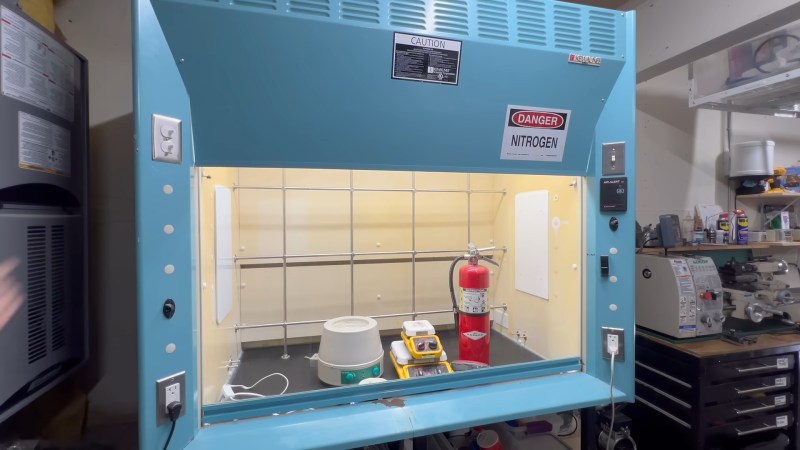
Semiconductor fabrication is complicated requiring nasty chemicals for everything from dopants to etchants. Working with such chemicals at home is dangerous and after releasing hydrochloride acid fumes into his lab, [ProjectsInFlight] decided the time was right to get one for a mere $200.

I can hear the readers down in the comments already saying, “why not just make one?” But a properly engineered fume hood provides laminar flow which absolutely ensures no leakage of fumes out of the hood. However, such proper engineering comes with an impressive price tag, so the used market was the only choice. This is less dangerous then it sounds as companies are required by both OSHA and the EPA to clean their fume hoods before removal, so no chemical residue should remain after purchase.

Continue reading “Restoring A Cheap Fume Hood”

Powering A Submarine With Rubber Bands

A look underneath the water’s surface can be fun and informative! However, making a device to go under the surface poses challenges with communication and water proofing. That’s what this rubber band powered submarine by [PeterSripol] attempts to fix!

The greatest challenge of building such a submersible was the active depth control system. The submarine is slightly negatively buoyant so that once the band power runs out, it returns to the surface. Diving is controlled by pitch fins, which will pitch downward under the torque applied by the rubber bands. Once the rubber band power runs out, elastic returns the fins to their natural pitch up position encouraging surfacing of the submarine. However, this results in uncontrolled dives and risks loss of the submersible.

Continue reading “Powering A Submarine With Rubber Bands”

Over-Engineering An Egg Cracking Machine

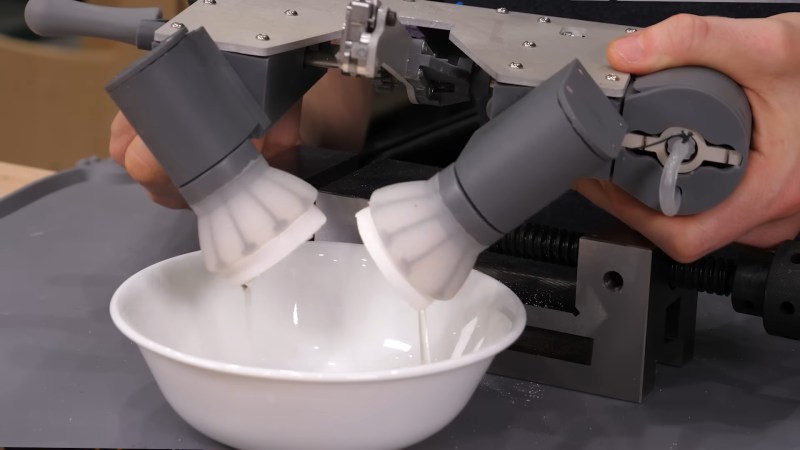
Eggs are perhaps the most beloved staple of breakfast. However, they come with a flaw, they are incredibly messy to work with. Cracking in particular leaves egg on one’s hands and countertop, requiring frequent hand washing. This fundamental flaw of eggs inspired [Stuff Made Here] to fix it with an over-engineered egg cracking robot. 

Continue reading “Over-Engineering An Egg Cracking Machine”

Making The World’s Smallest E-Bike Battery

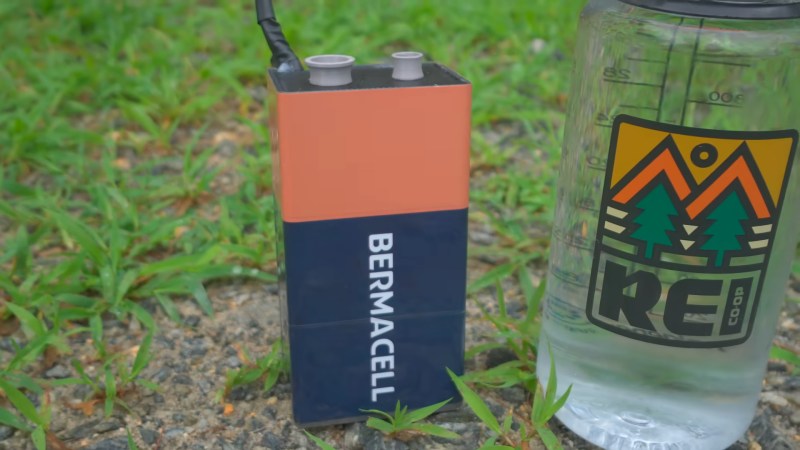
Often times, e-bikes seek to build the biggest battery with the most range. But what if you want to take a couple lunch loops on your bike and only need 20 minutes of charge? That’s [Seth] from Berm Peak set out to find out with his minuscule Bermacell battery.

The battery is made from only 14 18650s, this tiny 52V batty is nearly as small an e-bike battery as can be made. Each cell is 3000 mAh making a total battery capacity of 156 Wh. All the cells were welded in series with an off the shelf BMS and everything was neatly packaged in an over-sized 3D printed 9V battery case. [Seth] plans to make another smaller battery with less then 100 Wh of capacity so he can take it on a plane, so stay tuned for more coverage!

Continue reading “Making The World’s Smallest E-Bike Battery”

Sniffing 5G With Software-Defined Radio

The fifth generation mobile communications protocol (5G) is perhaps the most complicated wireless protocol ever made. Featuring wildly fast download speeds, beam forming base stations, and of course non-standard additions, it’s rather daunting prospect to analyze for the home hacker and researcher alike. But this didn’t stop the ASSET Research Group from developing a 5G sniffer and downlink injector.

The crux of the project is focused around real-time sniffing using one of two Universal Software Radio Peripheral (USRP) software-defined radios (SDRs), and a substantial quantity of compute power. This sniffed data can even be piped into Wireshark for filtering. The frequency is hard-coded into the sniffer for improved performance with the n78 and n41 bands having been tested as of writing. While we expect most of you don’t have the supported USRP hardware, they provided a sample capture file for anyone to analyze.

The other main feature of the project is an exploitation framework with numerous attack vectors developed by ASSET and others. By turning an SDR into a malicious 5G base station, numerous vulnerabilities and “features” can be exploited to with results ranging from downgrading the connection to 4G, fingerprinting and much more. It even includes an attack method we preciously covered called 5Ghull which can cause device failure requiring removal of the SIM Card. These vulnerabilities offer a unique look inside the inner workings of 5G.

If you too are interested in 5G sniffing but don’t have access to the hardware needed, check out this hack turning a Qualcomm phone into a 5G sniffer!